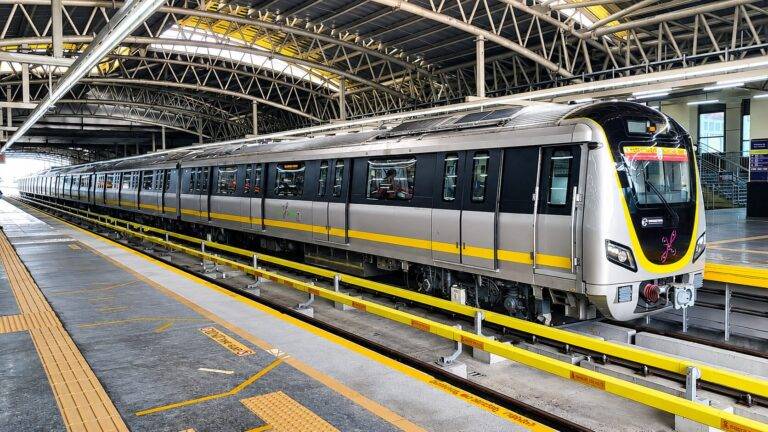
Bengaluru Metro Adds Faster Central Silk Board Link
Bengaluru Metro Rail Corporation has awarded a Rs 55.48 crore contract to build a covered travellator and connecting walkway between the Yellow Line and Blue Line stations at Central Silk Board. The interchange is intended to make transfers between the two corridors easier, reducing the physical gap passengers currently face between the adjacent stations.
The contract covers civil and structural works for the connecting facility, including foundations, support structures, architectural finishes, drainage interfaces and passenger access provisions. The award was issued on August 18 as part of Bengaluru Metro’s Phase-2A works.The planned connection will link the Yellow Line’s Central Silk Board station with the Blue Line’s ORR Central Silk Board station. Because the two stations serve different metro corridors, a direct grade-separated interchange can make the network function more like a connected system rather than a collection of individual lines. That distinction matters at Central Silk Board, one of Bengaluru’s most heavily trafficked transport nodes. The area connects major employment districts with residential neighbourhoods and the Outer Ring Road, creating substantial demand for reliable public transport. A convenient interchange could make metro-to-metro journeys more attractive for commuters who might otherwise rely on cars, taxis or buses for part of the trip. The travellator is particularly relevant for passenger comfort and accessibility. Long walking connections can discourage transfers, especially for older passengers, people with mobility limitations and travellers carrying luggage or other loads.
A covered, mechanised connection can reduce that friction while keeping passengers within a controlled interchange environment. The project is also an example of why interchange design matters as much as expanding rail lines. Adding stations does not automatically create a usable network if transfers require lengthy walks, unsafe crossings or exposure to traffic and weather. Passenger experience at interchange points can influence whether commuters choose public transport for an entire journey. The tender had an estimated value of nearly Rs 59 crore, while the awarded contract was Rs 55.48 crore. Five bidders participated, with the selected contractor emerging as the lowest qualified bidder. The tender documents specify a work period of 274 days. The project also carries an urban-mobility benefit beyond the station boundary. Better interchange infrastructure can encourage more trips to shift towards rail, potentially reducing pressure on some road corridors. That benefit will be stronger if passengers can reach the stations safely by foot, bus and other last-mile modes. However, the interchange will need to be integrated with surrounding pedestrian infrastructure. A comfortable connection inside the station will have limited value if passengers encounter broken footpaths, unsafe crossings or difficult access immediately outside it.
For Bengaluru, the Central Silk Board link is therefore a relatively small piece of a much larger metro expansion. Its success will be measured not only by construction completion, but by whether it makes transfers genuinely easier and helps the city’s expanding metro network function as a coherent, accessible alternative to road-based travel.