


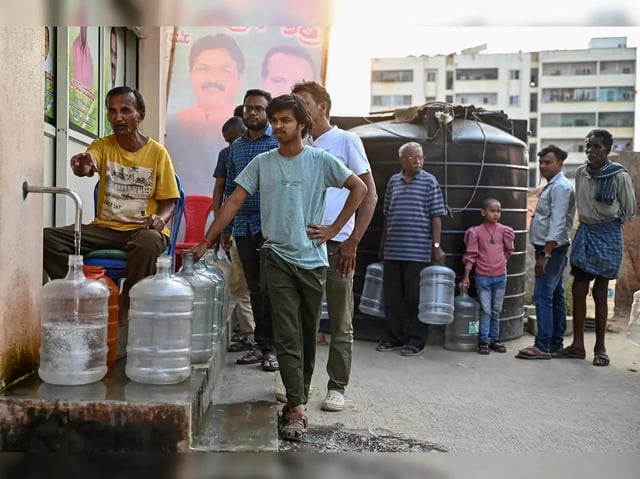
A sharp increase in industrial borewell registrations across Karnataka is raising concerns over the long-term sustainability of groundwater resources as urban expansion and industrial activity continue to accelerate.Water management experts warn that growing dependence on underground reserves could deepen ecological stress in several districts, particularly around high-growth urban and manufacturing corridors linked to Bengaluru.
Recent trends indicate that industrial groundwater extraction has expanded notably over the past year, reflecting rising demand from factories, logistics parks, commercial facilities, and industrial estates. Analysts say the development highlights the widening gap between economic growth and the availability of resilient urban water infrastructure.Karnataka’s urban regions have experienced sustained industrial and real estate expansion driven by technology investment, manufacturing activity, and population growth.However, planners argue that water supply systems have struggled to keep pace with increasing consumption patterns. In many peripheral industrial zones, groundwater remains the most accessible and immediate source of water for operations, despite mounting concerns over aquifer depletion.Hydrologists caution that excessive borewell dependence can lead to falling water tables, declining water quality, and reduced recharge capacity, particularly in areas already vulnerable to erratic rainfall and land-use changes. Bengaluru and its surrounding districts have witnessed significant ecological transformation over the past decade, including the reduction of wetlands, loss of open spaces, and increased concretisation, all of which affect natural groundwater replenishment.Environmental researchers note that unchecked extraction could create long-term economic risks alongside ecological damage.
Industries dependent on groundwater may eventually face higher operational costs, supply instability, and regulatory restrictions if aquifer stress intensifies. Smaller communities located near industrial clusters could also experience unequal access to water resources, especially during dry seasons.Urban planners say the rise in industrial borewells reflects broader structural weaknesses in water governance across expanding Indian cities. While infrastructure investments have focused heavily on roads, commercial development, and housing growth, water security planning has often lagged behind. Experts argue that sustainable urbanisation will require integrated approaches combining wastewater recycling, rainwater harvesting, lake restoration, and stricter groundwater monitoring.Climate specialists further warn that rising temperatures and increasingly unpredictable monsoon cycles may intensify water scarcity risks in southern India. Cities dependent on distant river systems and overdrawn aquifers could face mounting pressure as climate variability disrupts conventional supply patterns.Policy analysts believe the current situation may prompt stronger regulatory scrutiny around industrial water use and groundwater licensing. However, they emphasise that regulation alone may not be sufficient without parallel investment in alternative water systems and conservation infrastructure.
As Karnataka continues to position itself as a major industrial and technology destination, balancing economic expansion with ecological sustainability is likely to become a defining urban governance challenge. For cities such as Bengaluru, the future resilience of growth may depend as much on water stewardship as on infrastructure and investment capacity.
Also Read:Bengaluru Metro Growth Drives Demand For Modern Rail Systems
