


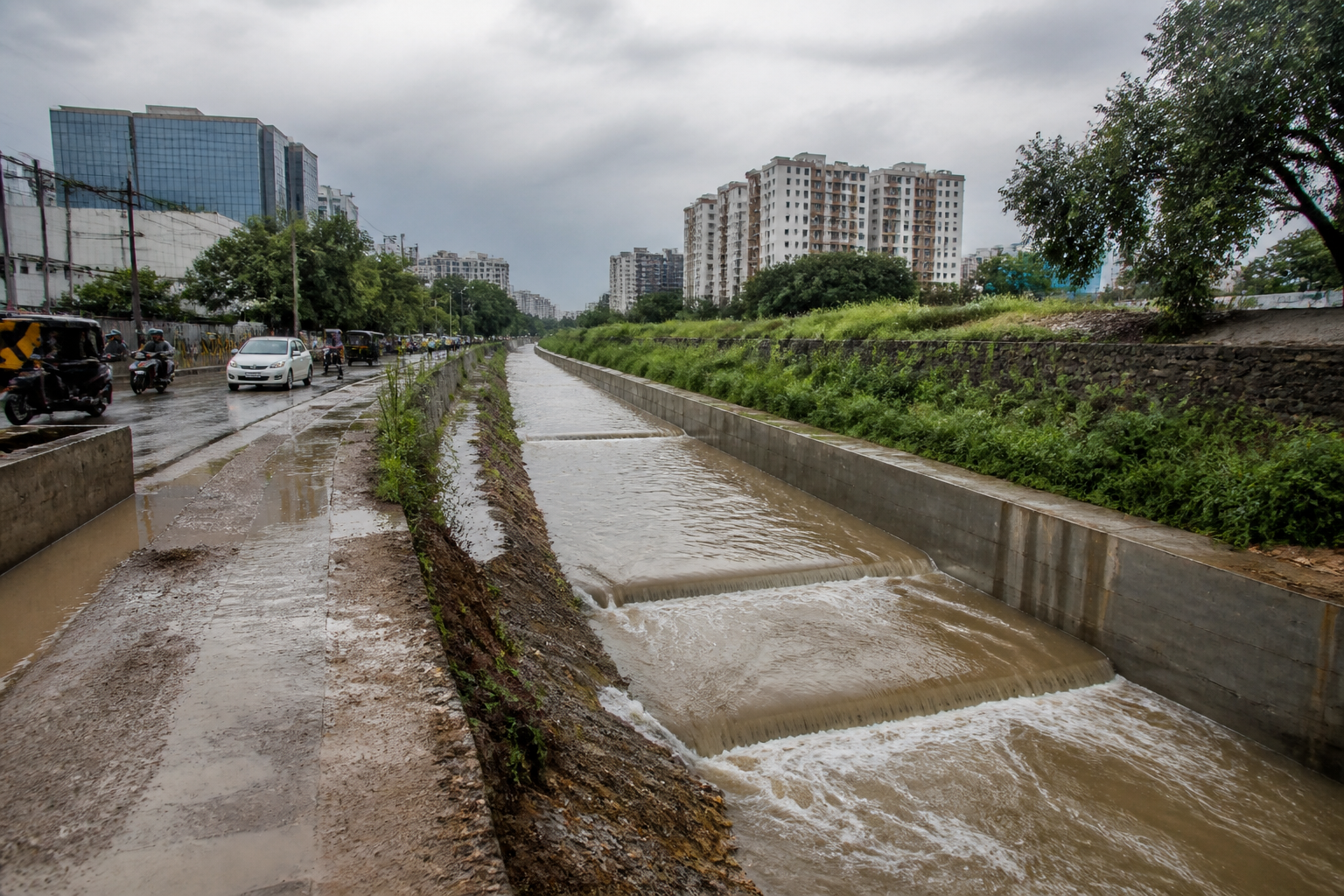
A 1.6-km artificial canal has been built to carry rainwater from the Veerannapalya service road to the Hebbal canal, forming the central part of a Bengaluru flood solution near Manyata Tech Park, according to a report by Vijay Karnataka. The intervention is intended to ease waterlogging that has affected the Outer Ring Road, Veerannapalya and surrounding areas for more than a decade.
During heavy rain, water used to accumulate along an approximately one-kilometre stretch of the Hebbal Outer Ring Road and the Veerannapalya service road. The resulting flooding disrupted traffic and created difficulties for pedestrians, residents and vehicle users. The report said encroachments along the drainage route were removed before the artificial canal was constructed.
The canal is designed to improve the movement of stormwater towards the Hebbal canal. The reported intervention is part of a wider set of drainage works being carried out in north Bengaluru, where low-lying layouts and constrained stormwater routes have repeatedly increased flood risk during intense rainfall.
In the Puthenahalli-Attur area, stormwater and sewage flowing from the Anantapura side had contributed to flooding in Ramanashree California Layout. With the consent of private landowners, a 145-metre-long pipe with a diameter of 600 millimetres has been installed to prevent sewage from entering Puthenahalli Lake. A separate 60-metre canal, funded under the National Disaster Mitigation Fund, has been created to direct rainwater from the Anantapura and Attur catchments towards the lake.
The report said no flooding was reported in the area after rainfall on September 30. That outcome was presented as an early indication that the new drainage arrangements are helping move water away from vulnerable locations, although the supplied report does not provide rainfall intensity data or an independent assessment of the works.
Additional work has been reported in HBR Layout’s Fifth Block near the BESCOM office on 18th Main Road. A 1.5-metre-diameter pipe linked to the HN-1 Valley had obstructed rainwater flows for between eight and 10 years. A new reinforced-cement-concrete culvert and drain have now been built in line with the road gradient, connecting runoff from the road to the drainage network.
The projects also include desilting of stormwater drains in the Sarvagnanagar area and the construction of reinforced-cement-concrete retaining walls along sections of the drainage network. The report said these works were being undertaken as precautionary measures, with support from the National Disaster Mitigation Fund and the World Bank.
The interventions highlight the operational challenge facing Bengaluru’s flood management system: waterlogging is often linked not to a single missing drain, but to broken connections between local roads, layouts, lakes, valley channels and larger stormwater drains. In the locations covered by the report, the response has focused on restoring those links, removing obstructions and adding pumping or storage capacity where low-lying terrain makes gravity-based drainage difficult.
In Dynasty Layout, a low-lying area within Sarvagnanagar, two ground-level water storage ponds and sensor-operated pumps have been installed as flood precautions. The supplied report does not state the ponds’ storage capacity, pump specifications or the total cost of the works. The next test for the system will be its performance during sustained or unusually intense rainfall, when drainage infrastructure across the city faces its greatest pressure.
