


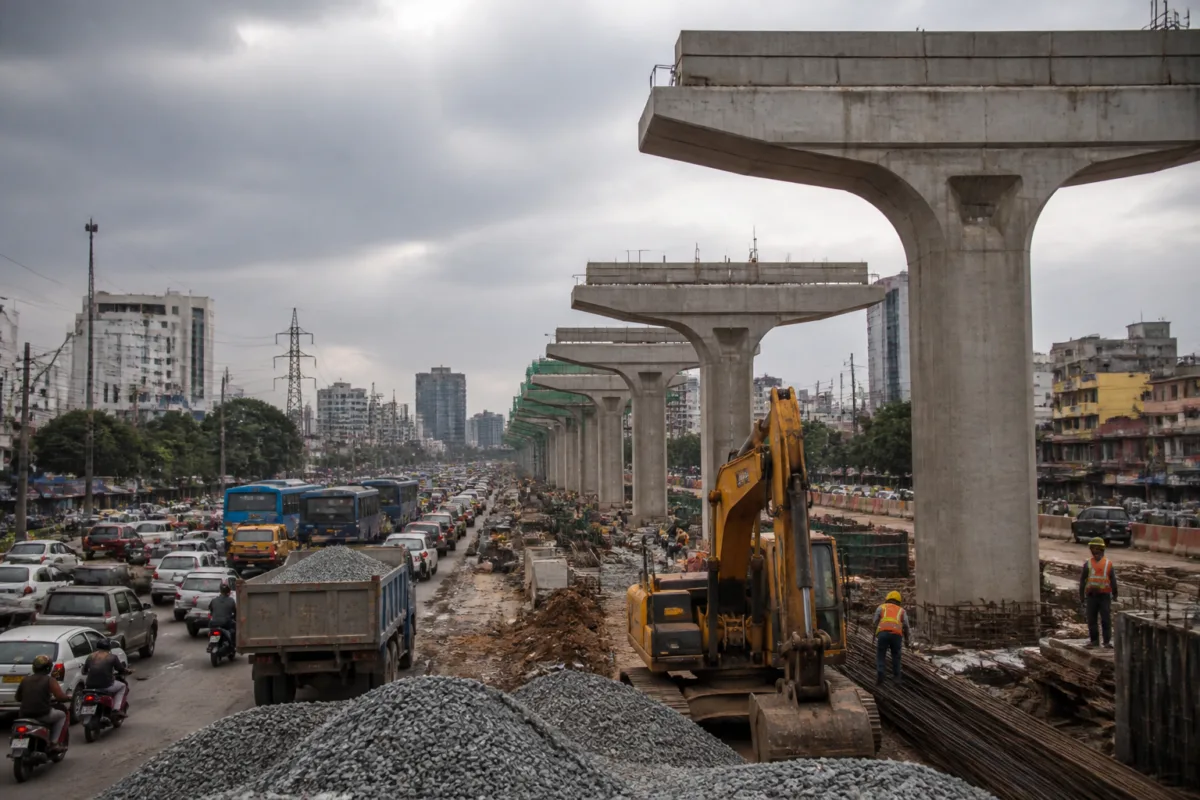
The Bengaluru Blue Line is being built as the city’s long-awaited airport Metro connection, but its construction is increasingly tied to a problem far beyond station sites and viaducts: the availability and movement of basic building materials. Tamil Nadu’s continuing restrictions on transporting stones and construction aggregates to other states have disrupted supplies to Bengaluru, affecting work on the 58-km Namma Metro corridor and increasing costs for contractors.
The immediate impact is being felt in the form of shortages of quarry dust, crushed stone, aggregates and railway ballast. According to a report cited by Economic Times, the disruption has affected concreting, architectural finishing, depot construction and track-related work. The episode shows how an urban infrastructure project can be delayed or made more expensive by decisions taken outside the project’s administrative boundaries.
The Blue Line will connect Silk Board with Kempegowda International Airport, with the corridor divided into sections that are at different stages of construction. Work on the elevated stretch between Silk Board and KR Pura is at an advanced stage, while construction between KR Pura and the airport is still underway. The material shortage is therefore not affecting a single uniform worksite. Its impact varies across viaduct construction, station works, depots, track preparation and road-facing structures.
A senior Bangalore Metro Rail Corporation Limited official told the Times of India that contractors had previously sourced 30 to 40 per cent of their construction materials from crushers in Tamil Nadu’s Krishnagiri district. The official said shortages of quarry dust, crushed stone and aggregates had affected several activities, including concreting, architectural finishing and other construction works. This dependence makes the corridor vulnerable to supply decisions in a neighbouring state, even though the project itself is being executed in Karnataka.
The disruption has also exposed the limited depth of alternative supply networks. An engineer working for a company executing construction on the Outer Ring Road said contractors had earlier procured aggregates from Hosur, where around 14 quarry-crusher units supplied material. After the restrictions disrupted that source, vendors shifted procurement to four or five crusher units in Bidadi.
That change has had a direct cost effect. The engineer said aggregate prices, which were around Rs 800 per tonne earlier, had more than doubled after suppliers moved to the smaller alternative base. The resulting pressure falls on contractors working on large infrastructure packages, where material quantities are substantial and construction schedules are linked to multiple dependent activities. The supplied report does not establish whether the higher costs will ultimately be absorbed by contractors, reflected in project claims or passed through official contract mechanisms.
The scale of the disrupted movement is also significant. GR Shanmugappa, president of the Karnataka Truck Owners’ and Agents’ Association, said more than 40,000 tonnes of stone had been transported to Bengaluru before the restrictions. He said between 600 and 700 truck owners had been affected. The association’s account places the issue beyond Metro construction: according to Shanmugappa, the restrictions have affected several infrastructure projects in Bengaluru and reduced work for transport operators serving the construction economy.
Tamil Nadu imposed the restrictions citing rising domestic demand, inadequate supplies and escalating construction-material prices. The move was also intended to curb illegal mining and unauthorised transportation of stone materials. The restrictions came into effect on July 27 for an initial three-month period but continued beyond that period, according to the report. The policy therefore combines two objectives that can pull in different directions: protecting local material availability and regulating extraction and transport, while maintaining supply for construction activity in neighbouring urban markets.
The Blue Line’s exposure to the restrictions is particularly important because the corridor already involves technically demanding and spatially constrained construction. Along the Outer Ring Road, work is taking place beside heavy traffic, existing utilities and limited land. Station construction, utility shifting, entry and exit structures and travelators must be coordinated within an intensely used road corridor. A shortage of aggregates adds another operational constraint to sites where sequencing is already difficult.
The corridor also includes a complex section between Hebbal and Kempapura. Officials said the project is being designed to accommodate four Metro tracks on a nearly one-kilometre stretch so that the Blue Line can integrate with the proposed Orange Line in the future. A specialised three-pier portal structure is being built for this configuration, which officials described as the first such arrangement on Namma Metro’s mainline network.
This design requirement matters because it shows that the material shortage is only one part of the project’s delivery challenge. The Blue Line is not simply a long elevated viaduct connecting the city to the airport. It also has to fit future network plans, operate through congested corridors and coordinate new structures with existing urban systems. Any disruption to basic materials enters a construction programme that already has complex engineering and logistical dependencies.
The project’s eventual public value is expected to be measured most visibly by airport access. Once the Hebbal-Kempegowda International Airport stretch opens, passengers from several parts of Bengaluru will have an alternative to road travel for reaching the airport. The line is also expected to mark Bengaluru’s entry into driverless Metro operations. Its trains will use automated train control and safety systems and will undergo testing before passenger services begin.
Those future operating features, however, depend on the completion of physical infrastructure first. Track-related work, depot construction, station structures, finishing and systems installation must progress in sequence. The report does not provide a revised opening date linked specifically to the material shortage, nor does it quantify the total cost increase to the Blue Line. What it establishes is that material availability has disrupted activity over the past three months and created financial pressure for contractors.
The institutional question is how large public infrastructure programmes manage risks that sit outside their direct control. BMRCL can manage design, contracts and construction supervision within the project framework, but it does not control quarry output or transport restrictions in Tamil Nadu. Contractors can look for alternative sources, but shifting from a larger supplier base to four or five units creates concentration risk and raises prices. Truck operators, meanwhile, are affected when a cross-border supply route is curtailed.
The episode also demonstrates why project timelines cannot be understood only through the visible progress of viaducts and stations. Construction depends on a wider chain involving quarries, crushers, transporters, depots, contractors and regulatory authorities. A restriction designed to address local shortages or illegal mining can produce consequences in another state’s transport and construction economy. The effect becomes more pronounced when a major city is executing several infrastructure projects at the same time.
For Bengaluru, the supply disruption comes alongside other difficulties already reported on the airport Metro corridor: heavy traffic along the Outer Ring Road, utility shifting, land constraints, station construction in a busy urban environment and the specialised four-track arrangement near Hebbal and Kempapura. These factors do not prove that the material restrictions alone will determine the project schedule. They do show that the corridor’s delivery depends on several interacting conditions rather than on construction activity at any single location.
The Blue Line therefore provides a clear view of the hidden infrastructure behind a Metro project. The public sees a future airport connection and driverless trains; the project depends equally on quarry dust, crushed stone, railway ballast and the trucks that move them. The current evidence confirms supply disruption, higher aggregate prices and financial pressure on contractors. It does not yet establish a revised completion date or the final cost impact. Those are the developments that will determine whether the material shortage remains a temporary construction constraint or becomes a larger factor in the corridor’s delivery.

