


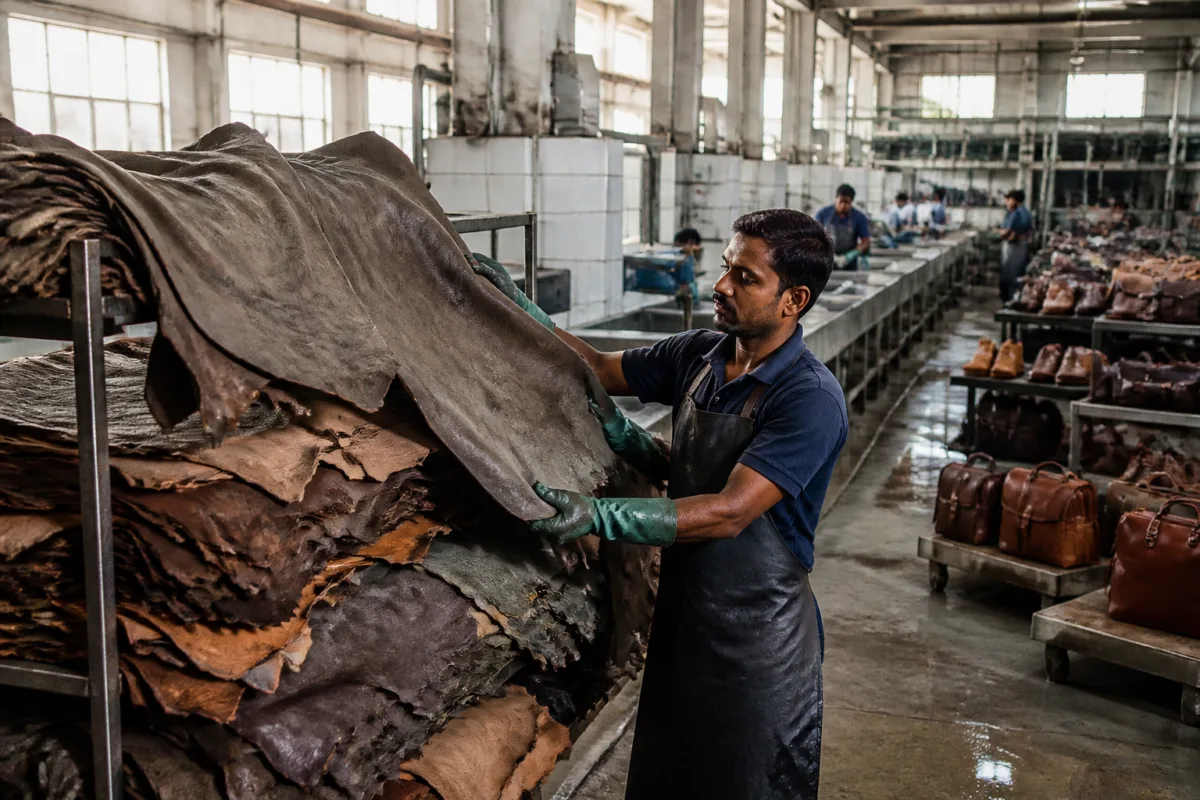
Kolkata’s leather industry is preparing for possible raw-material shortages and higher production costs after West Bengal chief minister Suvendu Adhikari announced that the state government would not allow cow slaughter, according to a report by The Telegraph India. Exporters said the policy could affect the supply of bovine hides used by tanneries and leather-goods manufacturers in and around the Calcutta Leather Complex at Bantala.
The industry uses around 1.5 crore pieces of bovine hide annually, including material imported from other countries, the report said. Bovine hide in this context includes hides from cows, calves, buffaloes and buffalo calves.
The potential disruption matters beyond the tannery sector. Exporters cited in the report said Bengal accounts for more than half of India’s exports of leather accessories such as bags, wallets and portfolios. The state also accounts for around 90% of industrial leather-glove exports. Eastern India produces leather goods worth about ₹5,000 crore annually for export, with the UK, the US and Europe among the main markets.
The state government’s position, as reported, is that slaughterhouses may operate under strict norms but that indiscriminate cow slaughter will not be allowed. Adhikari said violators would face action. The report does not specify the final operating rules, enforcement mechanism or implementation schedule for the policy.
That uncertainty is central to the industry’s concern. Exporters said most raw hides came from slaughterhouses, while a sizeable portion was sourced through unregulated rural markets in Bengal. They warned that restrictions could reduce the availability of higher-quality hide sourced within the state. For products aimed at international buyers, manufacturers said substituting the material may not be straightforward because cowhide is preferred for its grain and durability.
Around 25% of the processed leather and finished goods produced in eastern India uses cow leather, according to the report. Only about 15% of the cow leather used by Kolkata’s leather-goods manufacturers comes from Bengal; the remainder is sourced from Uttar Pradesh, Maharashtra, Bihar, Rajasthan, Gujarat and Telangana. Manufacturers also import raw hide from Italy, France and South America.
The geographic spread of sourcing indicates that the policy’s effects will depend partly on whether supplies from outside Bengal and overseas can compensate for any local shortfall. Exporters cited in the report said importing a larger share from Italy or France could double manufacturing costs, although that claim is an industry estimate and not a confirmed outcome.
The cluster is also closely linked to Kolkata’s freight network. Kolkata airport handles around 3,500 tonnes of export cargo each month, of which nearly 2,000 tonnes comprises high-end leather goods, according to the report. High-end bags, wallets and portfolios are generally sent by air because they can develop fungus during the longer sea journey. Industrial gloves and lower-priced bags are shipped by sea because of their larger volumes.
Manufacturers said specific districts, including Malda, Murshidabad and East Midnapore in Bengal and parts of Bihar, are valued for hides with fewer scratch marks. If local availability declines, buyers may face higher costs or manufacturers may need to alter sourcing patterns, product pricing and shipment planning. The report also said imports from China have practically stopped, while Chinese manufacturers are increasingly using their own raw material for finished leather goods.
For Kolkata’s industrial ecosystem, the issue is therefore not limited to livestock regulation. It connects rural sourcing markets, tanning and manufacturing capacity at Bantala, international procurement, airport and seaport logistics, and the competitiveness of an export-oriented cluster. The immediate unresolved question is how the government will define and enforce the cattle-slaughter restrictions while maintaining lawful industrial supply chains. The reported concerns will become measurable only after the rules, enforcement arrangements and actual availability of hides are clarified.

