


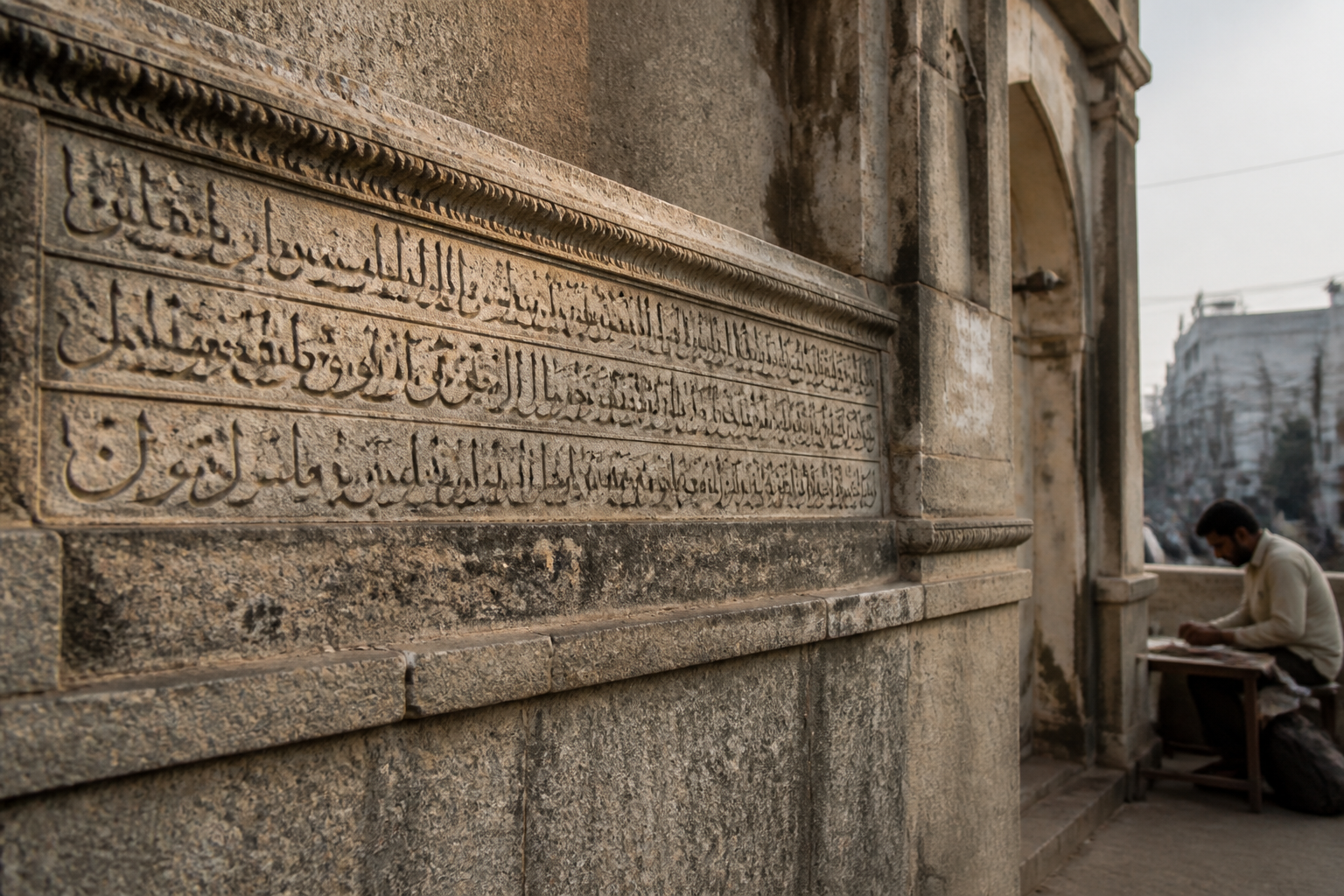
The Archaeological Survey of India has begun digitising Arabic and Persian estampages preserved by its Directorate of Epigraphy in Nagpur, bringing records connected to historic structures in Hyderabad and across the country closer to public and scholarly access under the Bharat SHRI project.
The digitised records will include estampages, transcripts and metadata, which the ASI plans to upload online. The collection includes an Arabic and Persian inscription from the Muhyiuddin Mosque on the Puranapul-Karwan road near Hara Darwaza in Hyderabad.
The inscription records the construction of the mosque by Haji Hussain, a court noble of the Qutb Shahi Sultanate, during the reign of Abdullah Qutb Shah. Its date, 1045 AH, corresponds to 1635 CE. Written in the Naskh script, it was composed by Mir Ali, son of Mir Jan Mashhadi. The inscription was copied in 1952.
Dr K. Muniratnam Reddy, ASI director of epigraphy, told Deccan Chronicle that around 2,000 new inscriptions had been received in recent years. There are nearly 12,000 Persian and Arabic inscriptions across India, he said, while experts have begun digitising the associated estampages.
Around 1,000 of these inscriptions are from Telangana and Andhra Pradesh, according to Reddy. The regional collection covers inscriptions associated with the Asaf Jahis, Qutb Shahis, Bahmanis, Adil Shahis and Mughals. The collection also includes inscriptions connected to a mosque built by Aurangzeb.
An estampage is a paper impression made from an inscription, allowing its text and physical details to be studied without repeatedly handling or exposing the original surface. Digitising these records creates an accessible reference for researchers while preserving information from inscriptions located on historic buildings and monuments.
The online material is also expected to make Hyderabad’s architectural and historical record easier for residents to explore. Several historic structures in the city carry Arabic or Persian inscriptions, but many people cannot read them because Persian is no longer widely known. Those seeking to understand the inscriptions often have to approach specialists.
The ASI has already made 23,000 inscriptions available online. The new digitisation exercise will add the Arabic and Persian estampages and their related records to that larger digital archive. For Hyderabad, the process could make lesser-known details about the origins, patrons and historical periods of surviving structures available beyond specialist circles.
The ASI’s next step is to complete the digitisation and upload the estampages, transcripts and metadata for access by scholars and the public.
