


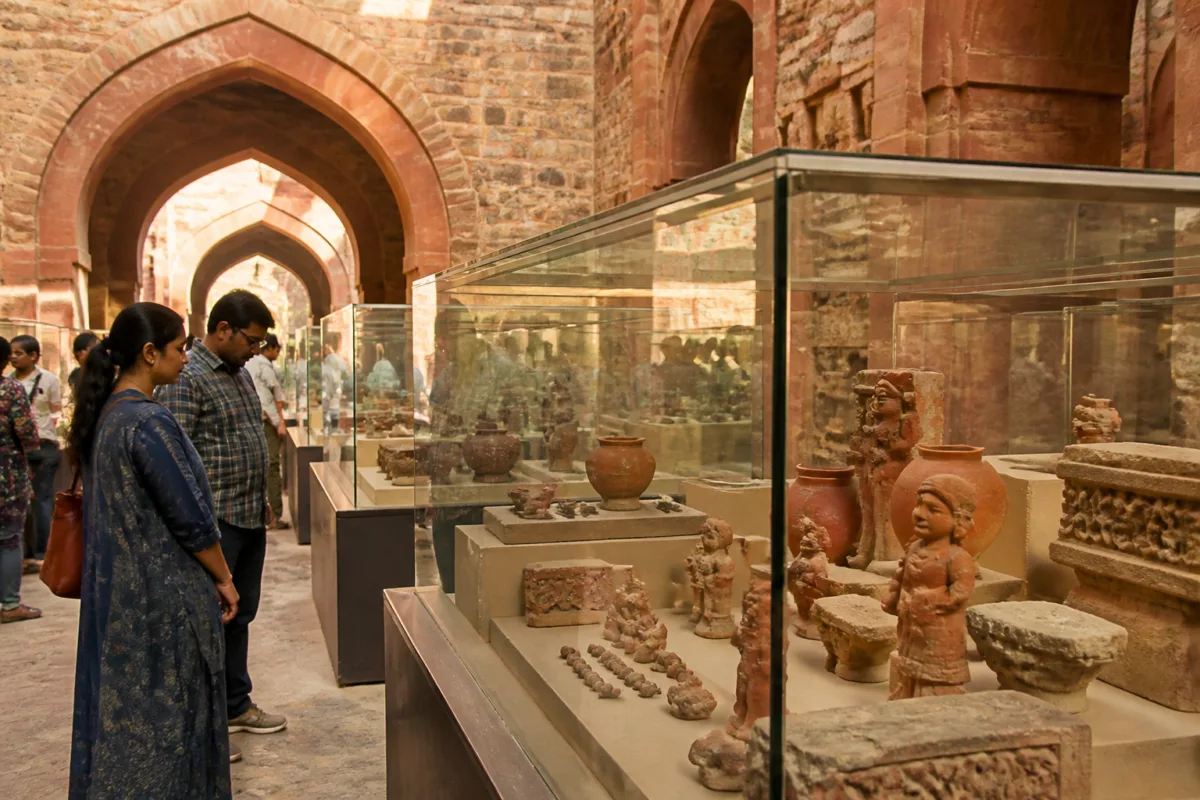
A new archaeological exhibition at Delhi’s Purana Qila was opened to the public on Friday after Prime Minister Narendra Modi inaugurated the first Shanghai Cooperation Organisation Civilisation Dialogue Forum at the historic site, according to a Live Hindustan report.
Titled “Existence — The Essence of Our Existence”, the exhibition presents archaeological evidence spanning 1,200 BC to 1200 AD. The display includes excavated remains, artefacts, architectural fragments and objects associated with different cultural periods found within and around the Purana Qila complex.
The exhibition features Mauryan terracotta figures, Painted Grey Ware vessels, beads, bead-making tools, semi-precious stone fragments and coins. It also includes a Rajput-period stone sculpture of Vaikuntha Vishnu, a terracotta plate depicting Gajalakshmi and a small Ganesha figure, the report said.
Vasant Swarnkar, director of museums at the Archaeological Survey of India, said the site contains cultural layers dating back more than 3,200 years. He said excavations had taken place during 2013-14, 2017-18 and 2022-23, with an attempt at a fourth phase being undertaken this year.
According to Swarnkar, excavations at two locations have yielded remains associated with the pre-Mauryan period, the 12th-century BC Painted Grey Ware culture, the Mahajanapada period, the Mauryan, Shunga, Kushan and post-Gupta periods, as well as the Rajput, Sultanate and Mughal eras.
The exhibition also displays an artefact found at Sarban village bearing an inscription referring to “Indraprastha”, along with reported evidence linked to ritual activity, including a horse skull, a burnt ritual altar, scattered bones and terracotta figures.
The Purana Qila is under the jurisdiction of the ASI. Delhi Tourism Department information describes the fort as roughly rectangular, with a perimeter of about two kilometres. Humayun is credited with beginning the construction of its walls and principal gateways as part of his capital, Dinpanah, while Sher Shah Suri continued the work.
The forum included participation from China, Pakistan, Kazakhstan, Iran, Tajikistan and Uzbekistan, among other countries. The exhibition was presented as a way to showcase Delhi’s archaeological and civilisational history to visiting international representatives.

