


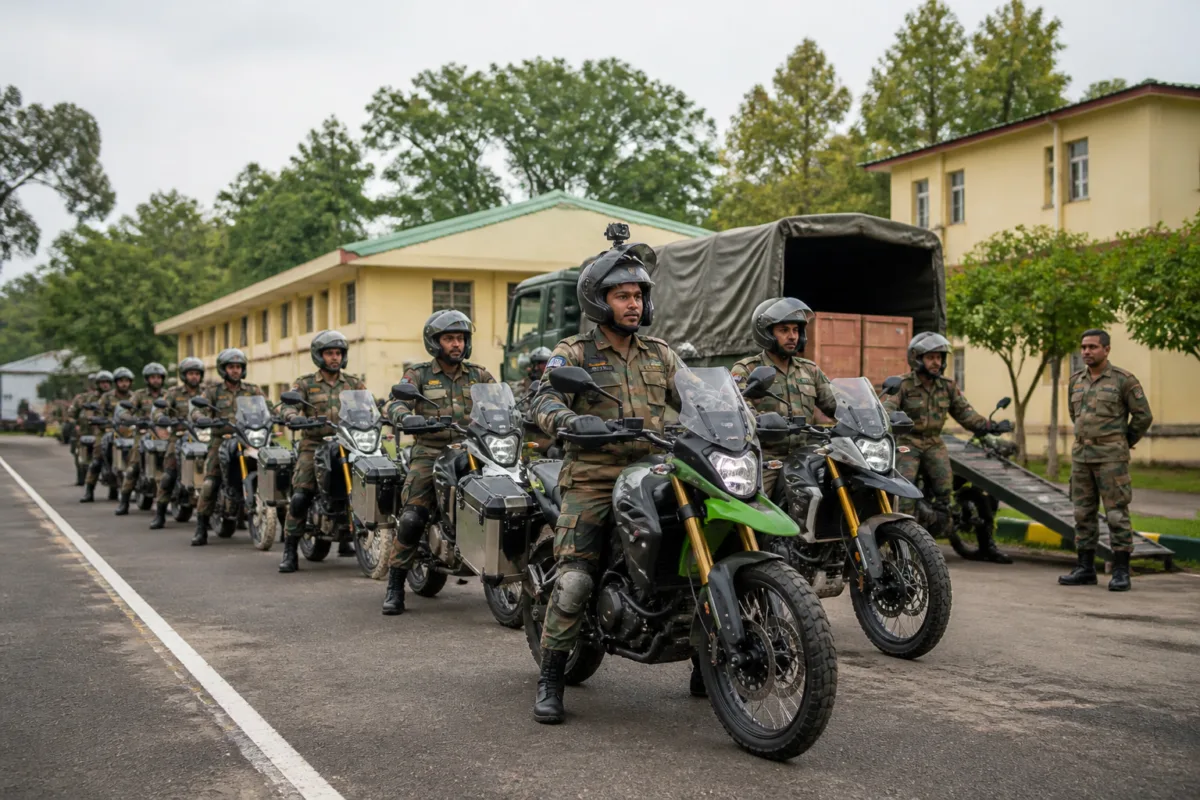
A 12-member Army motorcycle expedition flagged off from Danapur in Bihar will cover 4,858 km across the Himalayan, Gangetic and northeastern regions to assess the potential of electric mobility in demanding terrain.
Major General Jitendra Singh, General Officer Commanding of Jharkhand and Bihar, Danapur sub area, flagged off the team from the Danapur cantonment premises on Saturday. The expedition is being organised as part of the 266th and 12th Army Service Corps reunion day celebrations.
According to a senior officer of the Danapur sub area, the journey is intended to showcase the Indian Army’s focus on innovation, environmental responsibility and sustainable mobility. The route will take the team through mountainous stretches, the Gangetic plains and the varied terrain of the Northeast, exposing the electric vehicles to different geographical and climatic conditions.
The expedition will also examine the operational challenges of using electric vehicles over long distances. These include the availability of charging infrastructure, vehicle range, road conditions and the logistical support required during extended travel. The Army has not disclosed in the supplied report the vehicle specifications, charging network or detailed route schedule.
The route is significant because electric mobility performance depends not only on the vehicle but also on the supporting system around it. Long-distance operations require predictable access to charging points, adequate travel range between stops and logistical planning that can account for terrain and weather. The expedition will provide an opportunity to observe these requirements across three distinct regional environments.
The initiative reflects the Army’s stated interest in emerging technologies and environmentally responsible practices. Electric vehicles can reduce dependence on conventional fuels and lower carbon emissions, but their operational use over a 4,858-km route will also bring practical constraints into focus, including charging time, access to power and the reliability of support arrangements outside established urban networks.
The expedition is linked to the Army Service Corps, whose responsibilities are associated with mobility, transportation and logistical support. By combining the commemorative reunion with a technology-focused journey, the programme places sustainable mobility within the broader context of transport and supply operations.
For cities and infrastructure planners, the expedition’s relevance lies in the support systems that make electric transport workable beyond short, predictable trips. The source report does not provide findings from the journey or indicate whether the Army has set performance benchmarks. Those details may emerge after the team completes its route.
The 12-member team will continue across the eastern region as part of the expedition. Its progress is expected to offer operational observations on electric mobility across mountainous, plain and northeastern terrain.

