


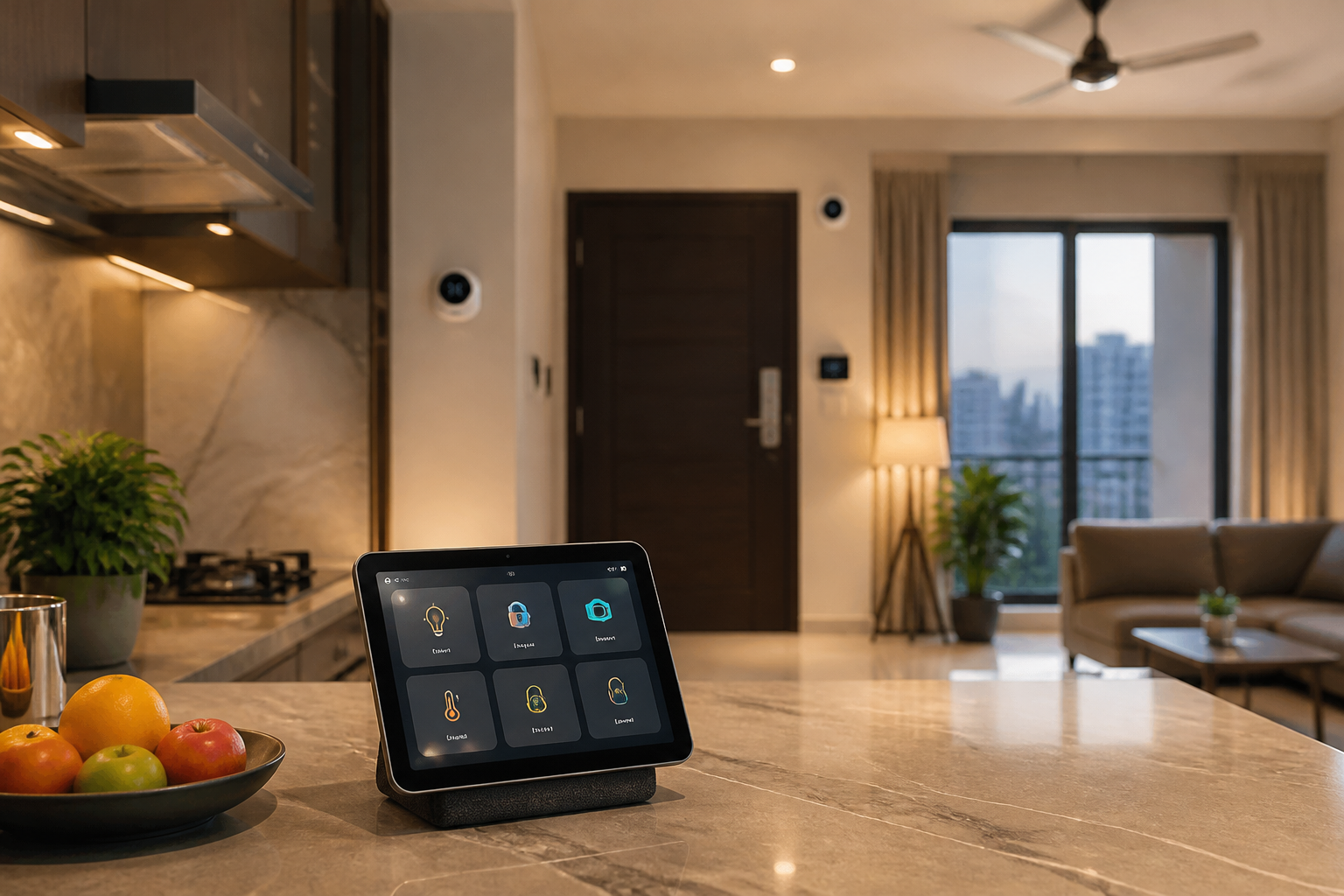
Apple’s HomeView is more than a new screen for the living room or bedside table. With voice control, facial recognition, smart-home controls and compatibility with cameras, thermostats, door locks and lighting, the $299 device represents a broader shift in how technology is being embedded into domestic space. The important question is not only whether households will buy it, but how personal data, home access and everyday infrastructure will be managed when the home becomes an always-present digital interface.
Apple said HomeView will be available on November 13 in two formats: a tabletop version with an aluminium base and adjustable stainless-steel hinge, and a wall-mounted version at the same price. The tabletop model uses a standard USB-C cable, while the wall-mounted model supports several installation options, including power over Ethernet. That distinction places the product somewhere between consumer electronics and fixed building infrastructure. One version can be moved between rooms; the other is designed to become part of the wall and the electrical and data systems around it.
The company is positioning HomeView as the centre of a wider smart-home ecosystem. It is partnering with LG Electronics and Schneider Electric SE on an “Apple Home Collection” of accessories, including indoor and outdoor cameras, a video doorbell, thermostats and door locks. The accessories are expected to begin shipping in December, with prices ranging from $199 to $399. In practical terms, the device is intended to connect the visible and invisible layers of a home: the screen occupants interact with, the sensors that identify them, the systems that regulate temperature and lighting, and the devices that control entry.
That architecture matters because smart-home adoption is often discussed as a matter of convenience. A screen that displays a calendar, plays music or answers questions can be treated as another household gadget. But a device that displays camera feeds, adjusts a thermostat or controls a door lock is also becoming part of the home’s operating infrastructure. Its usefulness depends on how reliably it communicates with other equipment, how it is powered, where it is installed and what happens when the system cannot identify the person using it.
HomeView’s physical design reflects this attempt to fit digital control into ordinary domestic routines. The square 7-inch display is designed to sit on a counter or nightstand, while the wall-mounted option is intended for a more permanent location. Apple said the screen automatically adjusts brightness and colour balance to match its surroundings. It has a maximum brightness of 500 nits and can dim to 0.3 nits, which the company described as the lowest level of any display it has manufactured. That low-brightness capability is specifically relevant to bedside use, where a bright screen can become a source of disturbance rather than convenience.
The device can show clock-like “faces”, photos, widgets and calendar appointments when idle. It can also display controls for locks, lights and other connected devices, or provide a live feed from connected cameras. This range of functions illustrates the design tension at the centre of smart-home technology. The same object is expected to be a clock, photo display, communications device, entertainment accessory, security monitor and building-control panel. Its value increases when more systems are connected to it, but that same dependence also makes the home more reliant on one software and hardware ecosystem.
Apple’s approach to personalisation is based on a built-in 12-megapixel Center Stage camera that can recognise up to six household members. When HomeView identifies a person, it displays that user’s applications, widgets and calendar appointments. Siri AI can use a database of knowledge associated with the specific user when responding to requests or sending messages. The company said personal context is not stored directly on HomeView; the device relies on a nearby iPhone for that information.
This arrangement makes the smartphone a continuing identity and authentication layer inside the home. HomeView is not operating as a fully independent household computer. Its access to personal context depends on the user’s iPhone being on the same Wi-Fi network and having been unlocked recently. Apple said the “recent” period can extend for several hours because it wants the product to be useful when someone first wakes up, without requiring authentication every morning. The company may adjust that period based on customer feedback.
The design also acknowledges that a household is not made up only of one authorised user. Apple said that when a known person leaves the camera’s view, HomeView returns to a default shared household mode within a few seconds. If the system cannot identify who is standing in front of it, the screen provides a generic interface with more limited smart-home controls. Guests can still adjust certain systems, such as a thermostat, but do not receive the same level of personal access.
That distinction between private and shared modes is central to the product’s urban and architectural relevance. Homes are shared spaces, but digital identities are increasingly individual. A calendar appointment, message or personal assistant response may belong to one person, while a thermostat, doorbell or light belongs to everyone. The physical layout of a home does not automatically provide the privacy boundaries that software requires. A device placed in a kitchen, hallway or bedroom therefore has to manage social relationships as well as technical commands.
The launch also places installation and retrofit questions in the foreground. A tabletop device connected through USB-C can be deployed without changing the home. A wall-mounted device supporting power over Ethernet requires a different level of planning. It may be easier to integrate into a new construction project or a professionally managed renovation than into a rented or older home where wiring, drilling and network access are constrained. The supplied material does not establish how widely these installation options will be available, but the difference shows that smart-home products are not equally simple to deploy across all housing types.
Apple’s partnership with LG Electronics and Schneider Electric points to another issue: the connected home depends on multiple manufacturers and systems. Cameras, thermostats, locks and displays may be purchased separately, but residents experience them as one domestic environment. The promise of a unified control screen is therefore also a promise of interoperability. If that promise is narrow, households may have to choose an ecosystem before they choose individual devices. If it is broad, the technical and privacy responsibilities become more complex because more equipment is exchanging information across the home.
The launch comes alongside an upgraded Apple TV 4K and a second-generation HomePod mini. The new Apple TV 4K includes built-in microphones and a remote control that is easier to locate, while the HomePod mini 2 adds new colours and lighting animations linked to album artwork. The HomePod mini 2 will cost $149, compared with $129 for its predecessor, and Apple TV 4K will cost $299, compared with a starting price of $199 for the previous model. Apple attributed the broader wave of price increases to shortages of memory chips and other components.
These price changes are significant because the smart home is rarely built around one purchase. A household that wants cameras, a doorbell, a thermostat, locks and a central display is assembling a network of products rather than buying a single appliance. The cost of the first device may determine whether a consumer enters the ecosystem, but the total cost of expansion determines whether the system becomes a meaningful part of the home. The supplied report does not provide a complete cost estimate for a typical installation, but the listed prices show that the ecosystem can quickly move beyond the cost of an individual screen or speaker.
The product’s central promise is convenience: hands-free voice commands, personalised information and a single place to manage connected devices. Its central challenge is governance inside the home. Who can see a camera feed? When does a guest become an authorised user? How long should an unlocked phone confer access? Which controls remain available when facial recognition fails? Apple has described safeguards for these situations, but the practical experience will depend on how reliably the system recognises occupants and how households configure their connected devices.
HomeView therefore reflects a larger transformation in the built environment. The home is no longer only a physical arrangement of rooms, doors, windows, electrical circuits and appliances. It is also becoming a software-managed system in which identity, connectivity and permissions shape how spaces are used. For residents, that may bring easier control and more personalised services. It may also make ordinary domestic functions dependent on network availability, device compatibility and corporate privacy policies.
Apple’s next milestones are the November 13 availability of HomeView and Apple TV 4K, the October 30 availability of HomePod mini 2, and the December shipping window for the Apple Home Collection accessories. Those dates will show how Apple’s hardware, software and partner products are intended to work together in actual homes. The larger significance of the launch will depend on whether the company can make that integration feel as reliable and unobtrusive as the physical infrastructure it seeks to control.

