


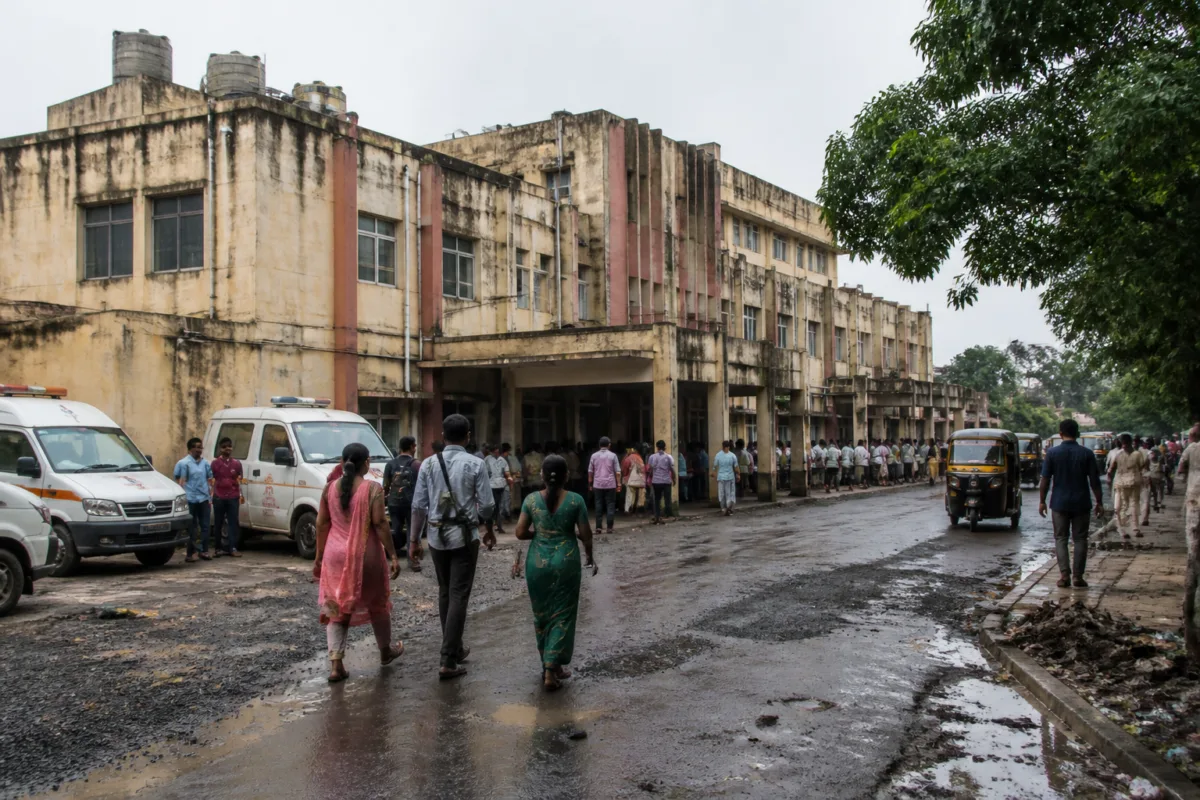
Plans to turn Annasaheb Magar Hospital into a modern multispeciality facility have circulated for years, but a report from Lokmat – Pune says the hospital in Hadapsar continues to face shortages of equipment, specialist doctors, functioning services and safe physical infrastructure. The gap is significant because the municipal hospital serves residents of Hadapsar, Fursungi, Manjari, Mundhwa and adjoining settlements, including low-income communities that may not be able to afford private treatment.
The report describes a public hospital caught between two different expectations. On one side is the promise of a larger, better-equipped institution, including a proposed 200-to-250-bed multispeciality hospital. On the other is the immediate requirement that an existing municipal facility provide basic diagnostic services, emergency treatment, medicines and inpatient care reliably. The distinction matters: expansion can address long-term capacity, but it does not automatically restore services that patients need today.
Annasaheb Magar Hospital’s role has also grown with the expansion of Pune’s municipal limits. The report identifies the hospital as an important healthcare centre for people living in eastern Pune and in nearby settlements. Health and wellness centres and Balasaheb Thackeray Aapla Dawakhana facilities may provide primary care, but residents still depend on a larger hospital for specialist consultations, emergency services and admission. When those functions are weak, the burden shifts either to other public hospitals or to private facilities.
That is the institutional problem at the centre of the story. A network of primary-care centres cannot substitute for a functioning secondary or multispeciality hospital. If patients are directed elsewhere because tests or treatments are unavailable, the system may remain formally distributed across several facilities while becoming practically fragmented for the patient. The person seeking care must arrange another visit, travel to another hospital and potentially face another queue before treatment begins.
The Lokmat report says patients have complained that necessary tests and treatment are not available at Annasaheb Magar Hospital. It also reports allegations that some patients are given medicines based on symptoms without adequate examination, and that people are advised to go to Sassoon Hospital or Kamala Nehru Hospital when required services are unavailable. These claims are attributed to the report and to accounts cited in it; the supplied material does not include an independent municipal audit or hospital-level service data.
For economically vulnerable households, the consequences are especially serious. The report says private hospital treatment is often unaffordable for such residents. A public hospital’s value therefore depends not only on the existence of a building or the number of beds listed in a plan, but on whether diagnostic equipment works, medicines are available, trained personnel are present and patients can be admitted when necessary. A breakdown in any one of these links can turn nominal access into delayed or incomplete care.
The building itself adds another layer of risk. The hospital’s current structure was built in 1956, and the report says it is considered to have reached the end of its useful life and has weakened. The hospital campus is reportedly lower than the adjoining road, allowing rainwater to enter during the monsoon. According to the report, water has reached sensitive areas such as the operation theatre, raising questions about the safety and continuity of medical operations.
This is not simply a maintenance issue. In a public hospital, the condition of the building affects infection control, equipment protection, patient movement, staff safety and the ability to keep critical services running during heavy rain. A low-lying campus can also create recurring operational costs if drainage and site-level problems are not addressed. The supplied report does not establish the structural condition through an engineering assessment, but it does identify the need for the building’s safety to be examined and for repairs or reconstruction to be considered.
The condition of medical equipment is equally important. Lokmat reports that the X-ray machine is not functioning and that the oxygen plant has remained closed for several days. It also says that beds and other materials purchased during the coronavirus period are lying unused. These claims point to a common weakness in public infrastructure: procurement may create physical assets, but service delivery depends on commissioning, maintenance, staffing, power, technical support and regular oversight.
An unused bed is not hospital capacity in practical terms. Nor is a purchased machine a diagnostic service unless it is operational and supported by trained staff. The report’s emphasis on closed equipment therefore shifts the debate away from construction alone. A new building may be necessary, but it will not by itself resolve failures in asset management, staffing or day-to-day administration.
The proposed expansion is nevertheless substantial. Citizens are seeking a well-equipped 200-to-250-bed multispeciality hospital, with the level of modern medical services associated in the report with Sassoon Hospital. An adjoining building that previously housed a police station is reportedly vacant and has been suggested as a possible space for expansion. The report says there has been no concrete decision to use that building or begin the work.
A municipal representative, Hemlata Magar, told Lokmat that the hospital is planned as a super-speciality facility and that an allocation of Rs 4.5 crore has been made this year. She said the effort is intended to provide all facilities to ordinary residents of Hadapsar. The report does not provide the detailed budget head, project schedule, tender status, scope of work or service-capacity plan attached to this allocation. Those details will determine whether the announcement represents immediate operational improvement, preparatory work or a longer-term redevelopment process.
That distinction is important for public accountability. A hospital modernisation plan should normally connect its capital investment to clearly defined service outcomes: which departments will be added, how many beds will become operational, what diagnostic equipment will be commissioned, how many doctors and technical staff will be recruited, and when patients will see a change. The supplied material does not establish those milestones. It records the allocation and the stated intention, while also documenting continuing complaints about the existing facility.
The administrative challenge is therefore one of sequencing. The municipal corporation must manage the current hospital while deciding whether to repair, reconstruct, expand or relocate services. It must also ensure that any temporary arrangement does not reduce access for the communities currently using the facility. The report records demands for more specialist doctors, trained medical staff, testing facilities, medicines, inpatient capacity and the restart of closed equipment. These are operational requirements that cannot be postponed until a larger hospital is completed.
The geography of the catchment area makes the issue broader than a single building. Hadapsar, Fursungi, Manjari and Mundhwa include rapidly changing residential areas as well as informal settlements. The report links the hospital’s increased patient load to villages brought within Pune Municipal Corporation limits. Whether the hospital’s capacity has been formally recalculated after that expansion is not stated in the supplied material, but the pressure described in the report reflects a basic planning question: public services must grow in relation to the population and territory they are expected to serve.
The numbers available in the report illustrate the mismatch between the scale of the stated ambition and the limited clarity around implementation. The building dates to 1956. Citizens are asking for 200 to 250 beds. The reported municipal allocation is Rs 4.5 crore for the current year. Yet there is no project timeline in the supplied material, and no confirmed date for reopening the oxygen plant, repairing the X-ray machine, assessing the building or commencing expansion work.
Residents quoted by Lokmat — Kailas Yadav, Naresh Sonkamble and patient Santosh Kharat — called for functioning equipment, more medical personnel, timely tests, medicines and treatment, along with a safety assessment of the old structure. Their comments underline that the public-health gap is experienced at the point of care. For patients, the question is not whether a multispeciality plan exists in principle, but whether the hospital can provide a dependable service when they arrive.
The evidence currently confirms a prolonged modernisation demand, reported deficiencies in the building and equipment, and a municipal statement about a Rs 4.5-crore provision. It does not yet confirm the hospital’s current bed occupancy, staffing vacancies, equipment inventory, structural safety status or the implementation schedule for the proposed expansion. Those are the documents and operational indicators that will show whether the hospital’s next phase is moving from announcement to delivery.
For eastern Pune, the central urban question is whether public healthcare infrastructure can keep pace with territorial expansion and population growth. The next meaningful milestones are a formal safety assessment of the 1956 building, a public account of the proposed 200-to-250-bed project, the restoration of essential equipment and a clear timetable for staffing and services. Until those steps are documented, the distance between the promise of a modern hospital and the patient’s experience will remain the defining issue.

