


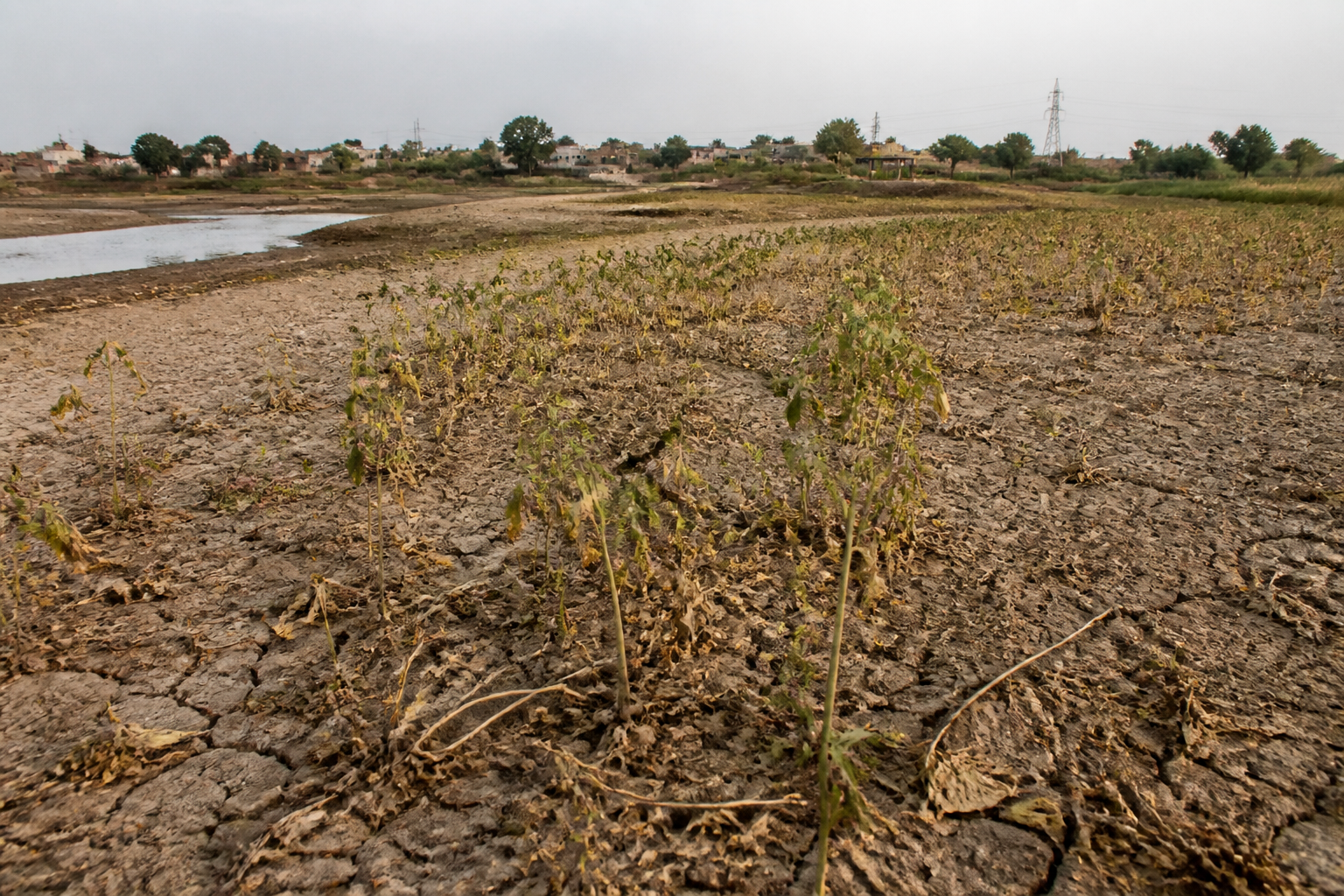
Amravati’s drought declaration across all 14 talukas has exposed a water-management crisis in which the same district has faced destructive flooding, washed-away topsoil and an early end to the monsoon within a single agricultural season. The immediate problem is crop loss, but the larger challenge is administrative: relief must be delivered quickly while irrigation, water conservation and backwater flooding are addressed together rather than as separate emergencies.
The district has been notified as drought-affected from Achalpur and Warud to Dharni and Dhamangaon Railway after the monsoon ended prematurely. The report describes soyabean fields with empty pods, widening cracks and soil stripped by heavy rain earlier in the year. In Mouza Mund Nishankarao, farmer Deepak Bolait said the crop had been damaged so severely that even the input cost would not be recovered. At Mangrul Chavhala, another farmer, Janbaji Paraskar, reported similar losses.
This sequence matters because the district’s crisis is not a conventional drought story. The fields first absorbed excessive water and then entered a dry phase. Heavy rain washed away topsoil and damaged standing crops, while the early withdrawal of the monsoon left farmers facing moisture stress and the prospect of a difficult summer. The report does not establish the scale of crop loss in hectares or the financial value of damage, but the accounts from affected villages show how the combined shock is being experienced at farm level.
The administration’s response is therefore operating on two timelines. The first is immediate relief: officials have been directed to complete panchnamas on priority and extend assistance to affected families. The second is preparation for water scarcity. Collector Ashish Yerekar has warned that the possibility of further rain is nil and that the severity of water scarcity will be felt in the coming days. His warning has placed water conservation, fodder availability and taluka-level mitigation at the centre of the district’s response.
Yerekar held a nine-hour workshop at the Collectorate to review a Taluka Drought Eradication and Management Plan. Chief executive officer Satyam Gandhi and senior officials attended the review, which examined water scarcity, fodder availability and mitigation measures across talukas. The stated approach is one of departmental coordination, suggesting that the drought response is not limited to the revenue administration but also involves departments responsible for water, irrigation and local implementation.
That coordination will be tested by the geography of Amravati. The report places flooded fields in Nandgaon Khandeshwar alongside dry riverbeds in Melghat, indicating that the district does not face a single uniform water condition. A district-wide drought declaration creates an administrative framework for relief, but conditions within the 14 talukas can still differ substantially. The effectiveness of the response will depend on whether planning remains taluka-specific while relief reaches households and farms without delay.
The human consequences described in the report also show why drought management cannot be measured only through rainfall or water-storage indicators. In Salod village, deputy chairperson of the Legislative Council Sachin Ahir met families affected by farmer suicides. Murlidhar Velukar died by suicide in July after years of crop failure that his brother attributed to backwater flooding from a nearby project. Another farmer, Manoj Farkade, died in April, leaving behind his wife Shubhangi and two young children.
Shubhangi has received ex-gratia assistance for farmer-suicide families, but the report records that her struggle to support the household continues. Ahir directed officials to extend the benefits of the Ladki Bahin Yojana, Shravan Bal Yojana and other schemes to the family. This highlights a recurring feature of agrarian distress: compensation after a loss may provide an immediate institutional response, but it does not by itself restore a household’s income, address damaged land or remove the conditions that produced vulnerability.
The backwater problem adds another layer to the district’s water-governance challenge. Farmers in Salod and surrounding areas have linked repeated flooding to backwater from a nearby project. Ahir directed officials to convene a joint meeting between irrigation authorities and affected farmers and promised a policy-level meeting in Nagpur during the Winter Session to seek a permanent solution. The report does not identify the project, establish the engineering cause of the backwater or specify the remedy under consideration. Those details will be important in assessing whether the problem is being treated as a local obstruction, an operating issue or a broader irrigation-management failure.
The contrast between flood damage and drought conditions also raises an institutional question about how water is managed across seasons. Flood protection, irrigation operations, soil conservation, crop-loss assessment and drinking-water planning are often handled through different administrative processes. In Amravati, the events described by the report have brought them into the same district-level emergency. The workshop chaired by the collector and the proposed irrigation-farmer meeting indicate an attempt to connect those functions, but the long-term outcome will depend on decisions that have not yet been announced.
The available evidence points to three immediate administrative priorities. The first is documentation through panchnamas so that crop and household losses can be formally assessed. The second is access to relief and welfare schemes, particularly for families already affected by death, crop failure or loss of earning capacity. The third is preparation for water and fodder scarcity as the district moves into a dry period. These priorities are explicitly reflected in the directions and reviews described in the report.
What remains less clear is the operational scale of the response. The supplied report does not provide a district-wide damage assessment, the number of affected farmers, the volume of water available, the status of reservoirs or the funds allocated for relief and conservation. It also does not specify the timeline for completing surveys or the criteria that will determine assistance. Without those details, the drought declaration confirms the seriousness of the situation but does not yet show how much support will reach each affected taluka.
The case also demonstrates why a drought declaration is more than a rainfall announcement. It activates a chain of administrative actions involving assessment, relief, water planning and coordination between departments. In Amravati, it must also be read alongside the effects of flooding and project-related backwater. If these conditions are handled independently, farmers may receive compensation for one event while remaining exposed to the next. The official meetings described in the report are significant because they acknowledge the need for a combined response, even though the permanent measures have not been defined.
For residents, the most consequential milestones will be the completion of panchnamas, delivery of promised assistance, implementation of taluka-level water plans and the proposed policy discussion on backwater flooding. These steps will reveal whether the declaration becomes a functioning relief and management programme or remains primarily an administrative classification. The evidence currently confirms a district facing crop damage, household distress and impending water scarcity; it does not yet establish whether the institutions responsible can convert that recognition into durable protection.
