


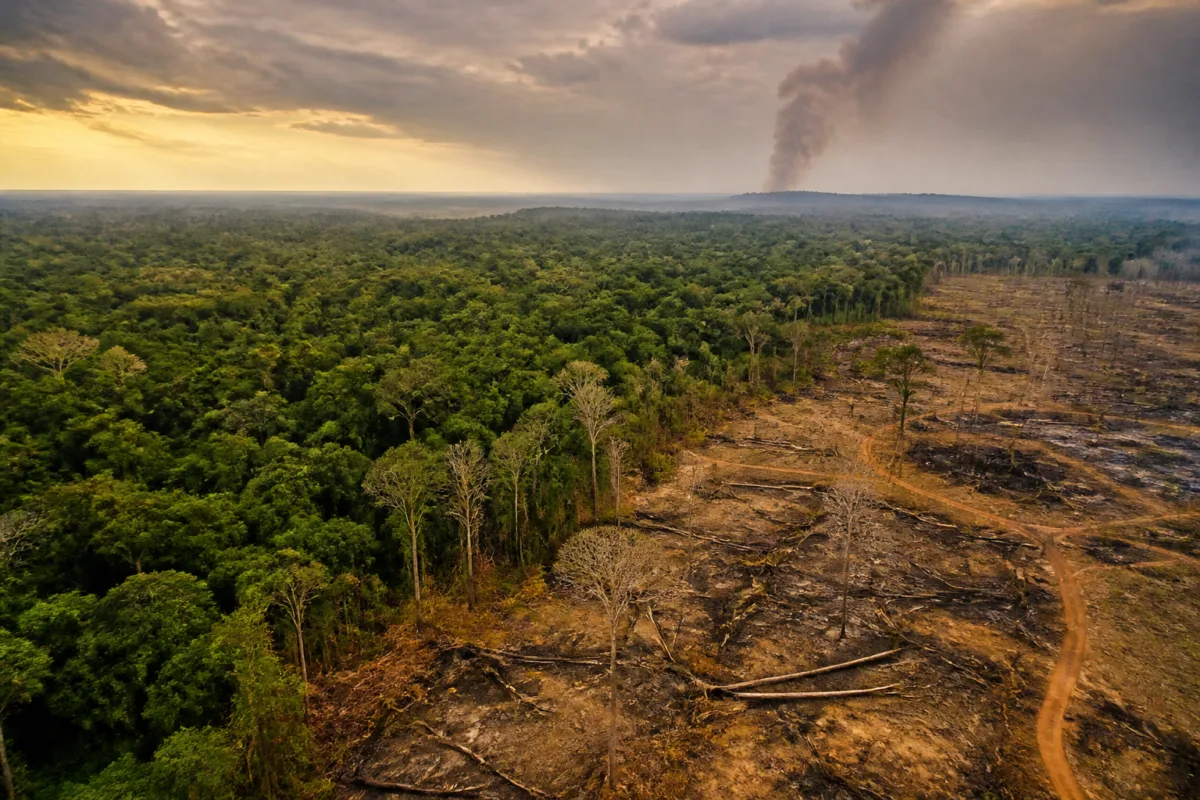
Brazil’s presidential election is also a decision about the future of the Amazon, the world’s largest rainforest and one of the planet’s most important climate systems. While the candidates have not made Amazon policy a dominant campaign issue, scientists and environmental groups say the next government could influence whether the forest moves closer to a tipping point — a threshold after which parts of the dense, humid ecosystem may shift towards a drier and less resilient state.
The significance extends well beyond Brazil’s borders. Brazil contains about 60% of the Amazon, which spreads across several South American countries. The forest generates moisture, supports biodiversity and absorbs large quantities of carbon dioxide, the greenhouse gas that drives global warming. A major change in its condition would therefore affect regional climate systems as well as global efforts to limit temperature rise.
The political choices are consequential because forest loss is shaped not only by environmental conditions but also by enforcement, land-use rules, financing and the balance between economic activity and protection. President Luiz Inácio Lula da Silva has sought to reduce deforestation and finance a sustainable economy through international donations and public and private funding. If re-elected, he is expected to continue that approach.
Senator Flávio Bolsonaro, the other candidate identified in the report, has offered a markedly different position. He has said he does not believe climate change is real while presenting himself as an environmental defender. His proposals include modernising environmental laws and giving landowners in the Amazon greater decision-making power. Environmentalists cited in the report argue that such changes could weaken safeguards and allow deforestation to accelerate.
The contrast follows a recent political history in which enforcement has been central to the trajectory of forest loss. During Jair Bolsonaro’s presidency from 2019 to 2022, deforestation surged as enforcement agencies were dismantled and environmental norms were loosened. Under Lula’s current government, the lowest Amazon deforestation rate on record was announced the week before the election. The two developments illustrate how rapidly administrative decisions can change the direction of a landscape already under pressure.
Yet lower deforestation does not mean that the tipping-point risk has disappeared. The debate among scientists concerns how much forest loss and warming the Amazon can absorb before feedback loops begin to make recovery more difficult. Some research suggests that losing more than 20% of the forest, combined with global warming of around 2 degrees Celsius since the early 1800s, could trigger widespread changes. About 17% of the Amazon has already been cleared, while current warming is about 1.4 degrees Celsius above the early-1800s level.
The figures are not a countdown clock. They are indicators of cumulative stress, and scientists disagree on how directly they can be translated into a precise threshold. Bernardo Flores, an Earth system resilience expert and member of the Science Panel for the Amazon, described the forest as holding together under increasing climate stress until it can no longer do so. He said collapse could occur in parts or across the wider system and could unfold over decades or centuries after a tipping point is crossed.
David Lapola, who studies how the Amazon responds to rising carbon dioxide levels and is a lead author of an upcoming United Nations climate report chapter on tipping points, has urged greater caution. Models indicate a risk of collapse, he said, but observations and experiments have not established that losing 20% of the forest would automatically trigger it. That uncertainty does not remove the danger; it establishes that the precise threshold remains scientifically unresolved.
This distinction is important for public policy. A tipping point cannot be managed like a fixed deadline at which a government can act at the last minute. If the evidence does not identify an exact boundary, forest protection becomes a risk-management problem. The relevant question is not only whether a threshold has been crossed, but whether repeated damage is reducing the forest’s ability to withstand drought, fire and rising temperatures.
A 2024 study led by Flores and published in Nature estimated that 10% to 47% of the Amazon could face multiple threats by 2050, potentially turning parts of the forest into different ecosystems and worsening climate change in the region. The range is wide, reflecting uncertainty in how interacting pressures will develop. It nevertheless shows that the risk is not limited to a single future scenario or a small, isolated area.
Forest degradation is particularly significant because it captures damage that clear-cutting statistics may not fully show. Wildfires, logging and drought affect about 40% of the Amazon, according to the report, and degradation has outpaced clear-cutting in recent years. A forest can remain visually present on a map while losing ecological functions through repeated fires, fragmented habitat, damaged vegetation and reduced moisture.
For scientists, one possible warning sign would be the Amazon becoming substantially drier and experiencing extensive burning. Drought and fire can reinforce one another: damaged forest is more vulnerable to fire, while repeated burning further reduces the forest’s ability to retain moisture and recover. The supplied evidence does not establish that the entire Amazon has crossed such a threshold, but it indicates that the conditions used to assess risk are already changing.
The Amazon’s importance to cities is often obscured by its distance from major urban centres. Its role in generating moisture connects forest conditions to regional rainfall, agriculture, water availability and the stability of settlements across South America. Its carbon storage function also connects local land-use decisions to the global climate system. In that sense, forest governance is part of infrastructure and climate resilience policy, even though it is administered through environmental and land-use institutions rather than municipal agencies.
The political dispute therefore involves more than competing campaign positions. It concerns the capacity of the state to monitor land-use change, enforce environmental rules, finance sustainable economic activity and coordinate public and private funding. It also involves the authority granted to landowners and the extent to which environmental safeguards can be altered without increasing cumulative ecological risk.
The record described in the report shows that policy can move in both directions. Enforcement agencies and environmental norms were weakened during the previous administration, while the current government has pursued lower deforestation and new financing for sustainable development. The announced reduction in deforestation is an important administrative outcome, but it does not by itself resolve the pressures created by accumulated forest loss, warming, drought, fire and degradation.
That is why the election’s relevance to the Amazon cannot be measured only by campaign attention. A policy may be decisive even when it is not a headline issue: the staffing of enforcement bodies, the application of environmental laws, access to conservation finance and the rights given to landowners can all influence the landscape over time. The forest’s response will also depend on climate conditions and damage accumulated across national borders.
The evidence confirms three points. The Amazon is already substantially altered, the factors associated with tipping-point risk are intensifying, and scientists do not yet agree on a precise threshold that would mark irreversible change. What remains uncertain is how those pressures interact and how quickly ecosystem shifts could occur. The next government’s approach to enforcement, environmental regulation and sustainable financing will be among the developments to watch as researchers continue to test how close the rainforest may be to a critical transition.

