


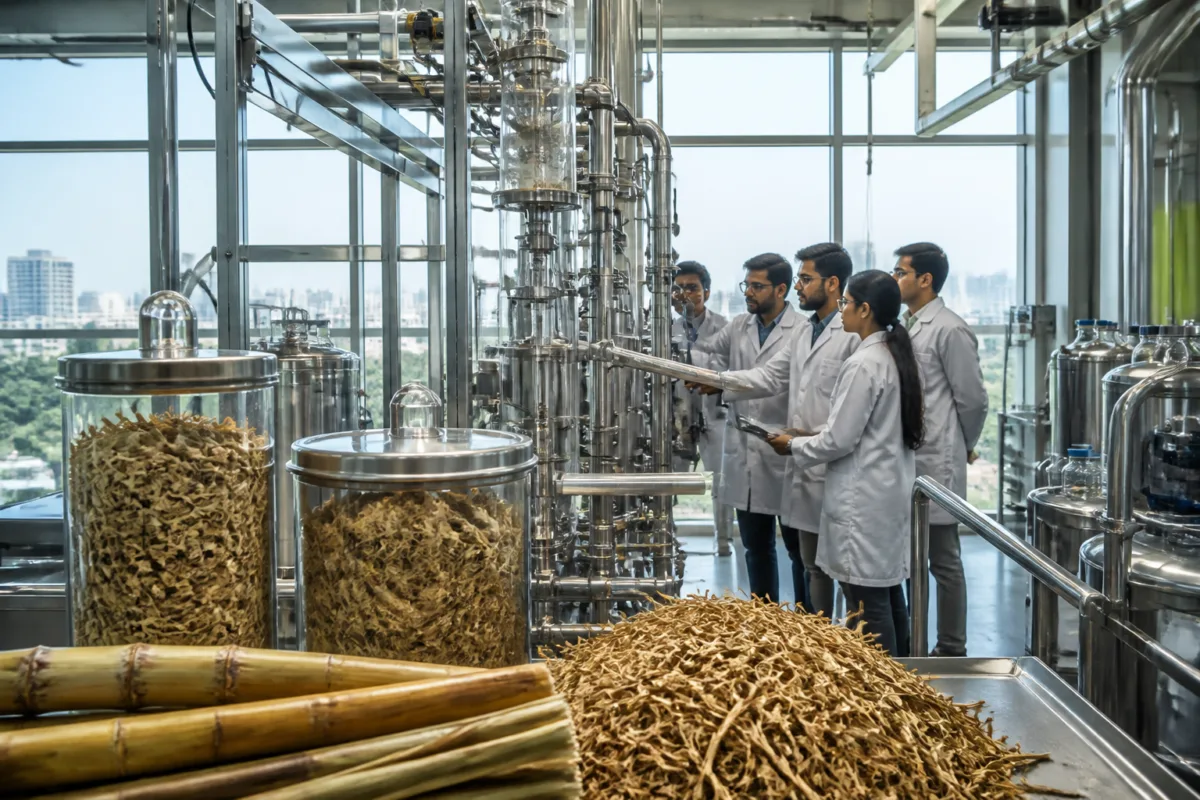
altM’s $10.3 million Series A funding is not only a startup financing event. It is a test of whether agricultural residue can move from a low-value surplus into a dependable industrial feedstock for the materials economy. The Bengaluru-based specialty chemicals company says it will use the capital to expand manufacturing, research and development, and customer qualification as it moves products towards commercial production.
That transition matters because altM is attempting to connect two systems that are usually managed separately: agricultural residue and industrial manufacturing. Its platform is designed to process lignocellulosic biomass, including sugarcane bagasse, rice straw and other agricultural residues, into high-performance chemicals and materials. The company says these products can serve beauty and personal care, textiles, industrial chemicals, construction, packaging and consumer goods.
The scale-up challenge is visible in the company’s own development path. Founded in 2022 by former Tesla manufacturing leaders Apoorv Garg and Yugal Raj Jain, with bioprocessing scientist Harshad Velankar later joining as chief scientific officer, altM raised a $3.5 million seed round in 2023. Since then, it has built an integrated research and pilot manufacturing facility in Bengaluru, bringing laboratory research, demonstration manufacturing and pilot production under one roof.
AltM says its laboratory footprint has expanded nearly fivefold in less than two years. It has commissioned a demonstration manufacturing facility, advanced six molecules to demonstration scale and selected three for pilot plant production. Its first products moving towards commercialisation include a lignin-derived SPF booster for suncare applications, a cellulose-based rheology modifier and bio-derived ferulic acid for cosmetics and personal care formulations.
These details show that the company is no longer presenting biomass conversion only as a laboratory proposition. It is attempting to build the intermediate manufacturing infrastructure needed to qualify products with industrial customers. That distinction is important. A material can be technically possible in a laboratory and still fail to reach the market if its quality, consistency, performance, cost or supply cannot meet the requirements of manufacturers.
Apoorv Garg, co-founder and chief executive officer of altM, said industrial manufacturing had relied on fossil carbon for more than a century. The company, he said, is building a new source of industrial carbon from agricultural residue and focusing on materials and manufacturing processes that allow customers to adopt them at the performance, cost, quality and scale required for industrial applications.
The statement identifies the central commercial problem more clearly than the funding announcement itself. AltM is not simply trying to replace one ingredient with another. It is trying to make a new feedstock acceptable to industries whose production systems are built around established inputs. The reference to performance, cost, quality and scale indicates that customer qualification is a critical stage between developing a molecule and selling it at commercial volumes.
The company’s use of the major fractions of biomass—cellulose, hemicellulose and lignin—also shapes its manufacturing proposition. Instead of relying on a single component of agricultural residue, altM says its platform produces multiple products from one feedstock. That approach could allow the same biomass stream to support several industrial applications, although the supplied information does not establish the eventual economics, operating scale or commercial volumes of the platform.
This is where the company’s Bengaluru facility becomes more than a corporate asset. By placing laboratory research, demonstration manufacturing and pilot production together, altM is creating an internal link between scientific development and process execution. The arrangement is intended to shorten the distance between discovering a product and proving that it can be manufactured repeatedly. The new funding will support the next stage of that process, including manufacturing expansion, research and development and customer qualification programmes.
The investors joining the Series A round include Rainmatter by Zerodha and Mela Ventures, alongside existing investors Omnivore, Theia Ventures, Aureolis Ventures and Spectrum Impact, as well as strategic angel investors. The participation of investors associated with climate, agriculture and deep technology reflects the cross-sector character of the business, although the funding announcement does not disclose the company’s valuation, planned production capacity or the size of individual investments.
Abhinav Negi, lead for Climate and Deep Tech at Rainmatter by Zerodha, said India possessed an immense domestic agricultural residue base and that converting this surplus into high-performance biochemicals could create strategic industrial value. Krishnakumar N, managing partner at Mela Ventures, described the company’s task as addressing one of the hardest problems in industrial chemistry: developing new-age materials that can match the performance of fossil-derived inputs.
Those comments point to two different but connected measures of success. The first is whether agricultural residue can become a reliable raw material for industrial chemistry. The second is whether products derived from it can meet the requirements of customers in sectors with established specifications and procurement systems. The first is a feedstock and process question; the second is a market adoption question.
For the built environment, the relevance is currently prospective rather than demonstrated at scale. AltM lists construction among the sectors that could use materials produced through its platform, but the products identified as moving towards commercialisation are focused on suncare and personal care applications. The supplied information does not specify a construction product, a building-material customer, a project deployment or a commercial contract in the construction sector.
That distinction prevents the funding from being treated as evidence of an immediate change in construction practice. It does, however, place the company within a wider materials question that affects construction and other urban industries: how can manufacturers obtain lower-impact or alternative inputs without compromising the technical and economic conditions that govern procurement? In altM’s case, the answer is being pursued through specialty chemicals and biobased materials rather than through a direct announcement about buildings or infrastructure.
The company’s progress can therefore be read through its development milestones. The seed round supported the creation of an integrated research and pilot facility. The subsequent expansion of the laboratory footprint, commissioning of a demonstration manufacturing facility and advancement of six molecules suggest a movement from early research towards process validation. The selection of three molecules for pilot plant production marks a further narrowing of the company’s commercial focus.
However, the available information leaves several operational questions unanswered. It does not state how much agricultural residue altM currently processes, where that residue is sourced, how seasonal variation is managed, what energy and water requirements its processes have, or how the company will transport feedstock to manufacturing sites. It also does not provide production costs, customer volumes, lifecycle comparisons with fossil-derived inputs or timelines for full commercialisation.
These gaps are material because agricultural residue is not an industrial feedstock simply because it exists in large quantities. It must be collected, aggregated, stored and supplied at a consistent quality. A company seeking to convert it into industrial chemicals also needs processes that can handle variation in the feedstock while producing materials that meet customer specifications. The supplied report does not establish how altM is addressing each of these issues, and those details will become more important as the company expands manufacturing.
The institutional structure around the company is also still taking shape. AltM is coordinating scientific research, process development, pilot manufacturing and customer qualification inside a single company, while its investors provide capital and strategic support. The next phase will test whether this private manufacturing platform can connect effectively with agricultural supply chains and downstream industries. No government programme, public procurement arrangement or institutional partnership is identified in the supplied material.
For cities, the issue extends beyond waste reduction or startup finance. Urban economies depend on material flows that begin outside city boundaries and are transformed through industrial systems before reaching factories, construction sites and consumers. A successful agricultural-residue platform would sit within that chain, linking rural biomass with urban manufacturing demand. But the evidence currently confirms a scale-up effort, not a completed circular supply system.
AltM’s funding is therefore significant because it advances the infrastructure of an alternative materials business, not because it has already displaced fossil-derived inputs. The company has moved from seed-stage development to demonstration and pilot-scale activity, with three molecules selected for pilot production and a stated focus on customer qualification. The next evidence to watch is whether these products achieve repeatable manufacturing, secure industrial customers and expand beyond pilot volumes into commercially viable supply.

