


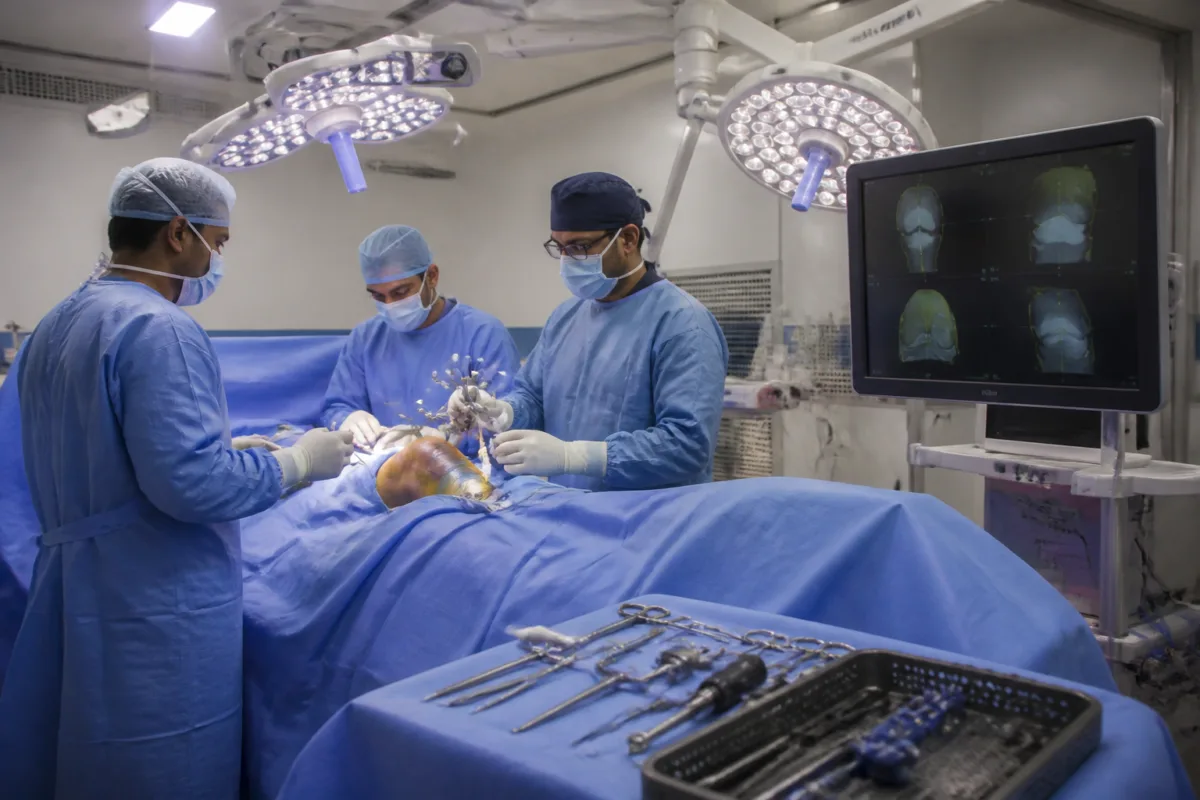
North Goa District Hospital has performed an AI-assisted total knee replacement, bringing technology-enabled surgical guidance into Goa’s public healthcare system and expanding access to advanced orthopaedic treatment in a government facility.
The procedure was performed on Saturday by the hospital’s head of orthopaedics, Dr Vikas Solyekar, with assistance from Dr Prabhav Desai. Dr Divya Pai provided anaesthesia support, while the operation theatre staff assisted with the procedure.
According to Dr Solyekar, the AI-assisted system provides real-time guidance during surgery. The technology is intended to help surgeons achieve accurate knee alignment and precise positioning of the implant, two important aspects of total knee replacement procedures.
The hospital said the procedure reflects efforts by its orthopaedic team to introduce technology-enabled surgical equipment into government healthcare. “Driven by sustained research, continuous learning, and focused efforts by the orthopaedic team to introduce technology-enabled surgical equipment within govt healthcare, ensuring that innovation is not limited to private institutions,” Dr Solyekar said.
He said the adoption of AI-supported systems for joint replacement would strengthen the hospital’s ability to provide high-quality care to patients from different backgrounds. The development is significant for public healthcare because it places advanced surgical technology within a district hospital rather than limiting access to private institutions.
Dr Solyekar said that improved precision could contribute to better functional outcomes and may support earlier mobilisation. He added that patients would still require timely physiotherapy and rehabilitation, with recovery progressing under clinical supervision.
The procedure involved a total knee replacement, but the hospital did not provide details on the patient’s identity, age, clinical condition, implant system, technology provider, cost of the equipment or the patient’s recovery status. It also did not state whether the technology would now be used routinely for other knee replacement surgeries.
The operation nevertheless marks a new step in the hospital’s stated effort to strengthen government healthcare through the adoption of safe, evidence-based medical advancements. The next phase will depend on continued clinical supervision, rehabilitation support and the hospital’s future use of AI-assisted equipment in joint replacement care.

