


A report on Ahmedabad Municipal Corporation’s financial procedures has raised a larger question than whether individual cases of alleged embezzlement occurred: who is responsible for controlling the municipal corporation’s daily revenue flows, and how effectively are its own financial safeguards being enforced? The report says a former mayor objected to the continued use of contractual staff in positions involving financial transactions and questioned whether rules governing municipal employees and officers were being followed.
The immediate issue is not the existence of financial rules. The report indicates that Ahmedabad Municipal Corporation, or AMC, already has procedures covering the handling of receipts, the assignment of financial responsibilities and the withdrawal of financial powers before retirement. The concern is that these controls may not be applied consistently across departments. That distinction is important. A municipality can have a detailed rulebook and still remain exposed if responsibilities are fragmented, if manual processes continue, or if supervisory checks are not documented and enforced.
According to the Gujarati-language report published by Nav Gujarat Samay, the former mayor had earlier stated in the municipal board that contractual employees should not be placed in positions involving financial transactions. Such responsibilities, the report says, should be assigned to permanent employees. Despite that position, the report alleges that contractual staff continue to handle financial transactions in several locations within AMC.
The report links this concern to the scale and dispersion of municipal collections. It says that lakhs of rupees are transacted every day across the corporation, including at city civic centres and other departments. The source does not provide a consolidated figure for AMC’s daily receipts, nor does it identify every department where contractual staff are allegedly handling money. Those details matter because financial risk is shaped not only by the amount collected, but also by the number of collection points, the number of people authorised to receive or record payments, and the speed at which collections are reconciled with official accounts.
The report refers to an earlier case in which two or three employees allegedly acted together to misappropriate lakhs of rupees when the new west zone was in operation. It also refers to a recent case involving an assistant-level employee from the estate department placed in the fire brigade, who allegedly misappropriated lakhs of rupees. The report does not provide case numbers, police documents, departmental inquiry findings or court outcomes for these incidents. They therefore remain reported allegations rather than established findings in the material available for this story.
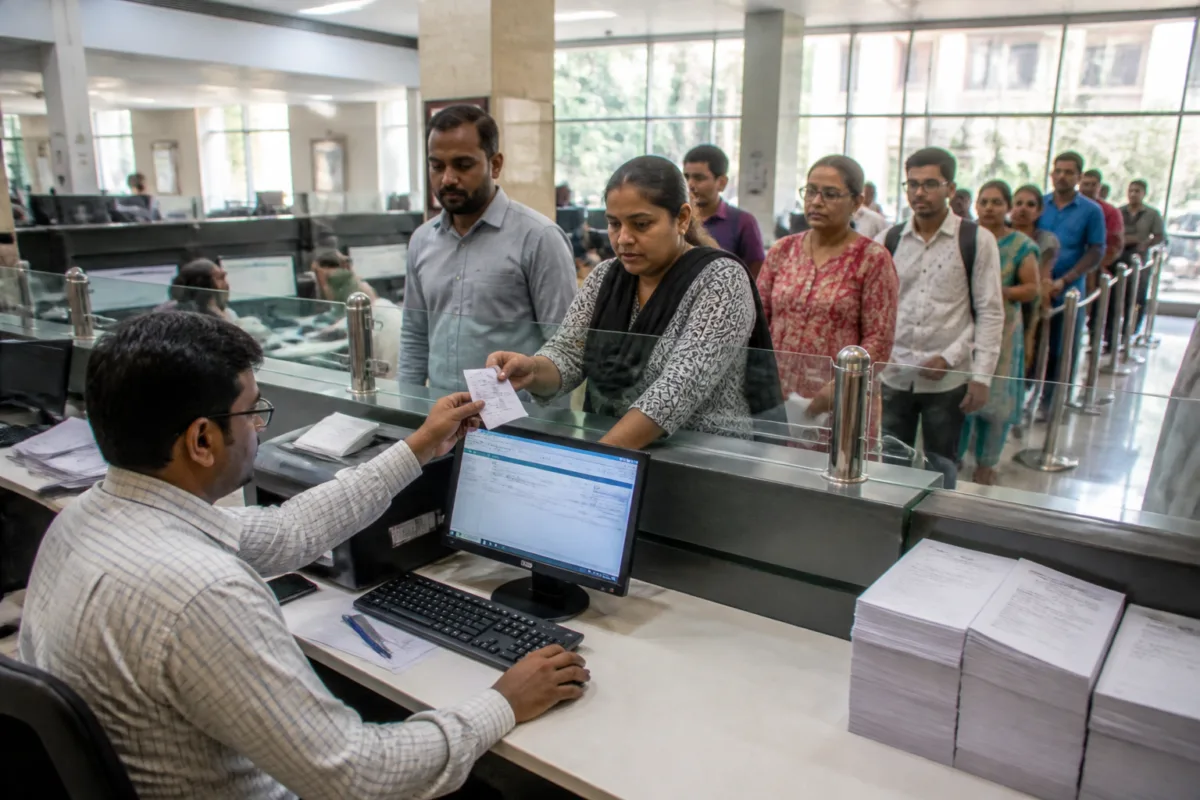
That limitation does not make the administrative question irrelevant. When a municipal body receives payments through multiple counters and departments, the design of the collection system becomes a governance issue. A system dependent on handwritten receipts creates a longer chain between payment, recording, reconciliation and audit. Each additional manual step can make it harder to establish when money was received, by whom it was handled and whether the amount entered in the municipal books matches the amount paid by the applicant.
The report says AMC’s finance department has instructed all departments to register every receipt of municipal income online and to provide applicants with online receipts. Departments that still issue handwritten receipts have reportedly been given 15 days to move to e-challan and online acceptance of payments. Where a manual receipt is issued, responsibility will rest with the concerned department, according to the report.
This instruction is the clearest administrative response described in the source. It attempts to shift revenue collection from a paper-based process to a digital trail. An online receipt can give the payer a verifiable record and can allow the corporation to compare collections across departments. E-challan systems can also reduce dependence on individual cash handlers, provided that access rights, transaction records, reconciliation procedures and exception reporting are properly managed.
Digitisation, however, is not itself a complete control mechanism. The source material does not explain whether all AMC departments are connected to a common financial platform, whether payments are reconciled daily, who can cancel or alter a receipt, or whether senior officers receive regular reports on unmatched transactions. It also does not state how the 15-day deadline will be monitored or what action will follow if a department continues issuing handwritten receipts. These are operational details that determine whether an instruction becomes an enforceable control or remains an administrative circular.
The report also raises a separate question about financial powers held by employees and officers approaching retirement. It says AMC rules require financial powers to be withdrawn three months before an employee or officer retires. At the same time, it alleges that in some cases files continued to be signed until retirement. The source does not identify the officials involved or provide copies of the relevant rules, files or approvals. The claim should therefore be treated as an allegation requiring documentary confirmation.
The purpose of a pre-retirement withdrawal rule is to create a defined transition period. It can allow the corporation to transfer files, review pending transactions and ensure that the person leaving service is not approving new financial decisions immediately before retirement. If such a rule is not consistently followed, the administrative problem is not merely procedural. It can complicate accountability because the authority responsible for a transaction may change before the transaction is fully reviewed or completed.
Taken together, the issues described in the report point to three layers of municipal financial control. The first is personnel control: deciding who is permitted to receive, record or approve money. The second is transaction control: ensuring that every payment generates a traceable receipt and enters the accounts correctly. The third is supervisory control: reviewing exceptions, reconciling collections and acting when procedures are bypassed. A weakness in any one layer can undermine the others.
The reported use of contractual staff in financial roles illustrates the first layer. Contractual employment does not by itself establish wrongdoing, and the source does not provide AMC’s complete staffing policy. But the concern raised by the former mayor is that financial responsibilities may require a level of institutional continuity and accountability that is not guaranteed when duties are assigned to contract personnel. That is a policy question for the corporation, not proof of misconduct by individual workers.
The continuing use of handwritten receipts illustrates the second layer. The finance department’s instruction suggests that AMC itself recognises the need to reduce or eliminate this exposure. The 15-day transition period is a measurable administrative milestone, but the source does not say how many departments or collection points remain outside the online system. Without that baseline, it is not possible to assess the scale of the transition or whether the deadline has been met.
The allegations concerning past misappropriation and the retention of financial powers until retirement relate to the third layer. They concern whether rules are followed after they are issued. The report says some cases may have been suppressed from public view, but that claim is not supported by documentary evidence in the supplied material. It should not be presented as an established pattern. What can be established from the report is that concerns have been raised about oversight, and that AMC’s finance department has directed departments to improve the recording of revenue.
For citizens, the practical issue is straightforward. Municipal payments are often made for certificates, permissions, civic services, applications and other transactions. A receipt is not only proof of payment; it is also the citizen’s evidence if a transaction is later disputed. Moving to online receipts can improve that protection, but only if the digital record is promptly generated, accessible to the applicant and matched with the corporation’s accounts.
The institutional question is whether AMC will publish or internally document the results of its corrective measures. The supplied report does not mention a public audit, an independent inquiry, departmental action or a status report on the alleged cases. It also does not state whether AMC has confirmed or denied the allegations raised in the report. Those gaps prevent a conclusion about the extent of any financial irregularity.
What the available evidence does show is a municipal corporation attempting to tighten revenue controls while facing allegations that existing safeguards have not always been followed. The next significant indicators are whether all departments shift to online receipts within the stated 15-day period, whether manual receipts become exceptional and fully accountable, and whether financial powers are withdrawn in accordance with the three-month rule. Those administrative outcomes will reveal more about AMC’s control system than the existence of rules on paper alone.

