


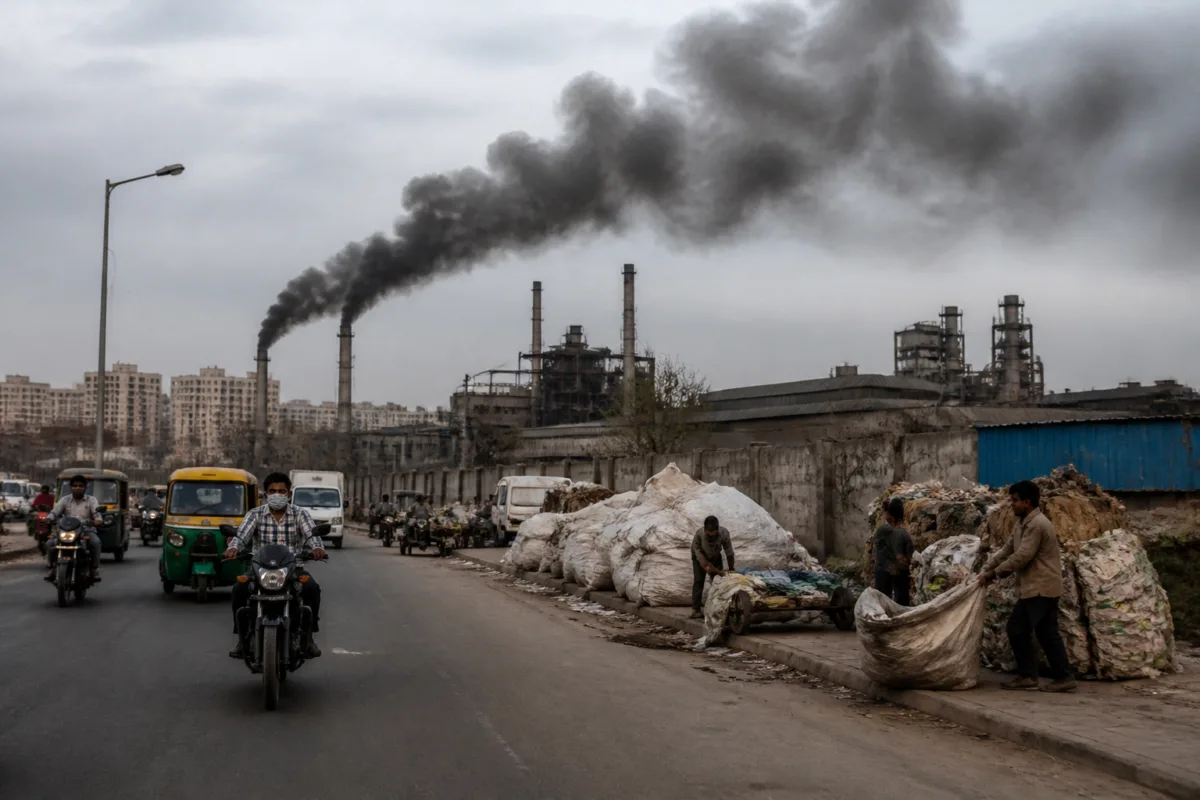
Ahmedabad industrial pollution is being measured with increasingly sophisticated tools, but the enforcement record described in a recent report raises a more basic question: can the city’s institutions convert pollution data into timely action? According to Divya Bhaskar, the Ahmedabad Municipal Corporation sealed 12 factories in the first 10 months of 2026 after issuing closure notices and taking legal action against units linked to emissions, chemical odours and improper waste handling. The report also highlights concerns around Pirana, Vatva, Odhav and other industrial areas where residents are exposed to multiple sources of pollution.
The issue is not limited to factory chimneys. The areas identified in the report include the Pirana dumping site and nearby parts of Behrampura, Narol village, Gyaspur, Odhav GIDC, Piplaj, Danilimda and Vatva GIDC. Kathwada and Naroda GIDC are also mentioned in connection with industrial activity. The reported pollution sources include black smoke from factory chimneys, strong chemical smells, open dumping and the burning of waste. The report further refers to alleged oil and tyre burning by illegal industrial units around Pirana.
This combination matters because urban air pollution is rarely produced by a single source or controlled by a single department. Industrial emissions, road dust, vehicles, construction, biomass burning and waste handling can overlap within the same neighbourhood. When that happens, responsibility is divided across municipal health, solid waste, estate and air-quality units, the Gujarat Pollution Control Board and, in some cases, the police. The Ahmedabad case described by the report shows how that divided responsibility can become an enforcement problem when agencies do not act together.
The AMC’s own account, as cited in the report, is that its Air Quality Management Cell has been investigating industrial and GIDC areas in the eastern part of the city. The investigations cover chemical odours, smoke released into the air and open waste disposal. Between 1 January and 31 October 2026, the civic body says it issued closure notices and undertook legal action against polluting industrial units under applicable environmental laws and rules. The reported figure of 12 sealed factories provides a measurable record of action, but the report does not establish how many inspections were conducted, how many notices were issued in total, or whether the sealed units remained closed.
That missing administrative detail is important. A factory seal is an enforcement event, not necessarily an environmental outcome. To understand whether pollution is actually declining, residents and regulators would need to know the locations of the units, the violations recorded, the legal provisions used, the duration of closure, the penalties imposed and whether operations resumed. The supplied report does not provide those details. It does, however, identify the tension between the scale of the reported pollution complaints and the limited number of sealing actions announced over 10 months.
The report also records an accountability gap involving the GPCB. Divya Bhaskar states that its reporter contacted Rahul Kanojia, identified as a GPCB East official, but received no response by telephone. The report further says that no action by the GPCB against the factories was evident in the material reviewed. That is a reported limitation, not proof that no regulatory action occurred anywhere in the affected areas. Still, the absence of a clearly documented joint enforcement record leaves unanswered questions about how municipal and state-level responsibilities are being coordinated.
The AMC has defended its approach by saying that strict action is being taken against illegally operated industrial units and activities damaging the environment. It has also stated that units are being closed and that regular monitoring and departmental coordination are intended to prevent the same activities from restarting. The report contrasts this official position with the absence of visible joint action involving the GPCB, the corporation and the police. The central institutional issue is therefore not only whether inspections are taking place, but whether agencies share evidence, act on the same cases and monitor compliance after enforcement.
This is particularly relevant in industrial estates, where the presence of an association does not automatically guarantee compliance by every unit. The report says that industrial associations exist in Odhav, Vatva, Kathwada and Naroda GIDC, but also alleges that some factory owners do not follow the rules. It further says that illegal chemical discharge and smoke emissions continue and that GIDC office-bearers may not be informing non-compliant operators to follow regulations. These claims are presented in the report and are not independently established in the supplied material. They point, however, to the difference between formal industrial organisation and effective environmental oversight.
Ahmedabad’s response also includes a data and technology component. The AMC has implemented a Smart Sensing and Digital Intelligence Project with the support of IIT Kanpur, according to the report. The project uses a mobile real-time source-apportionment laboratory to assess different sources of air pollution scientifically and continuously. The stated purpose is to identify major pollution sources and use real-time data and scientific findings to design more targeted and evidence-based control measures.
The source-apportionment approach is significant because it attempts to separate the contribution of different activities. The report lists vehicles, road dust, construction, industries and biomass burning among the sources being assessed for PM2.5 and other air pollutants. A hyperlocal monitoring network is also being used, according to the AMC’s account, to identify pollution hotspots across the city. In principle, such a system can help shift enforcement away from generalised citywide measures towards action in specific locations and against specific sources.
But monitoring does not by itself resolve institutional responsibility. A hotspot map can identify where pollution is concentrated; it cannot seal a factory, prosecute illegal burning or ensure that an operator does not restart after closure. Those actions depend on powers, procedures, staffing and coordination. The Ahmedabad case illustrates the risk of building a stronger evidence system without publishing a correspondingly clear enforcement system. If data identifies industrial hotspots but residents cannot see what action followed, confidence in the monitoring process can remain weak.
The reported geography also shows why pollution control must be treated as an urban management issue rather than only an industrial regulation issue. Pirana is associated in the report with dumping and waste-burning concerns, while Vatva, Odhav, Naroda and Kathwada are industrial areas. Nearby residential communities may experience several pollution sources at once, making it difficult to attribute symptoms or local air-quality deterioration to one activity. For city administration, that means air-quality policy has to connect industrial regulation with solid-waste management, land-use enforcement and public-health administration.
The report’s timeline offers a further institutional signal. The AMC’s enforcement activity from January to October 2026 was publicised after 10 months, according to the report. Delayed disclosure can make it difficult for residents to track whether complaints led to inspections and whether violations were corrected. It also limits the usefulness of enforcement as a deterrent if the public record does not show which actions were taken and what happened afterwards. The supplied material does not establish whether the delay resulted from administrative procedure, reporting practice or another reason.
The evidence currently confirms three things. First, Ahmedabad has identified industrial and waste-related pollution hotspots across several eastern and southern parts of the city. Second, the AMC says it has taken action against 12 factories during the first 10 months of 2026 and is using a technology-supported monitoring programme with IIT Kanpur. Third, the report describes a lack of visible joint action and unanswered questions about the role of the GPCB. What remains unclear is the full scale of violations, the compliance status of sealed units, the number of GPCB actions and whether measured pollution levels have changed after enforcement.
The larger urban question is whether Ahmedabad can connect scientific diagnosis with transparent, sustained and coordinated regulation. The city is developing tools to identify pollution sources, but the effectiveness of those tools will ultimately be judged by what happens after a hotspot is identified: which authority acts, how quickly it acts, whether the action is documented and whether the pollution source remains controlled. The next meaningful evidence will therefore be the AMC’s detailed enforcement record, the GPCB’s response and follow-up data showing whether identified industrial hotspots have improved.

