


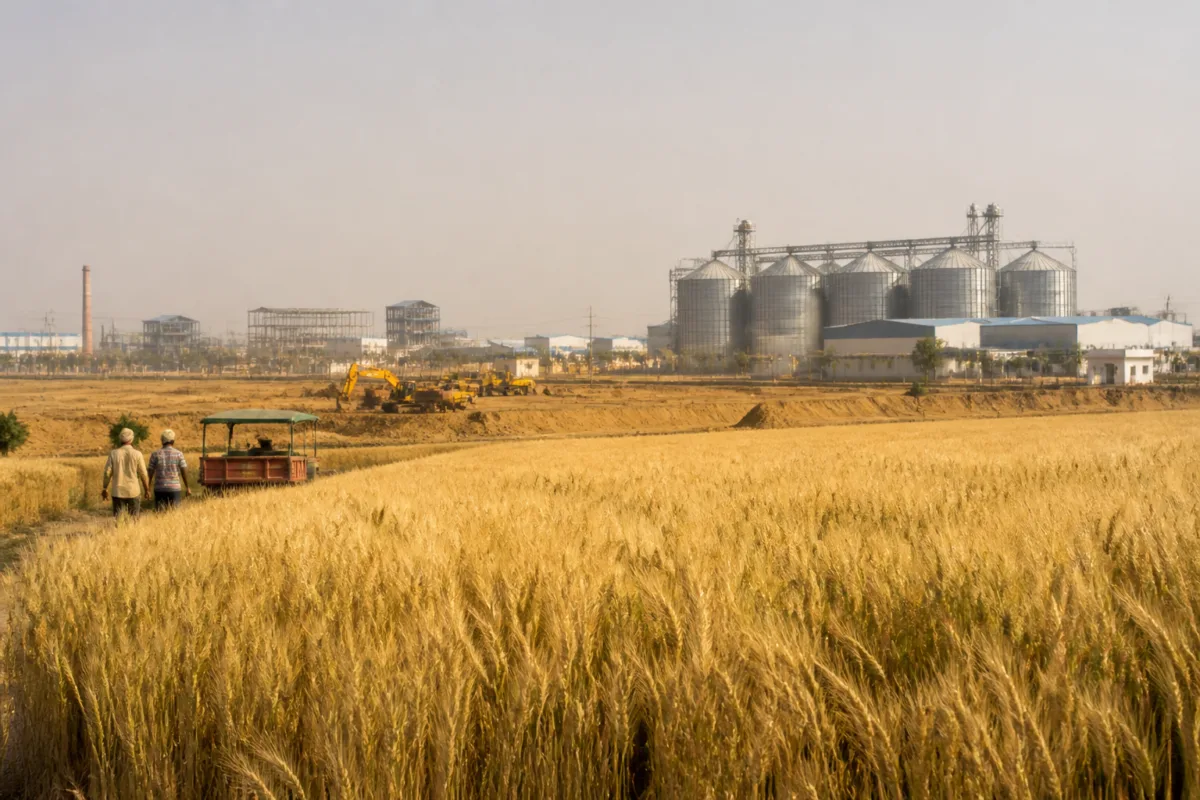
Agar-Malwa investment is moving beyond a land-allocation proposal into a larger test of whether industrial infrastructure can connect farmers, processing capacity and jobs across a mostly agricultural region. French multinational Soufflet Malt has proposed a Rs 1,200 crore barley malting unit in Agar-Malwa district, seeking 20 hectares in the third phase of an industrial park. The project, if it completes land allotment and other formalities, would procure about 2.50 lakh tonnes of barley annually and link more than 50,000 farmers across Agar-Malwa, Ujjain, Shajapur, Dewas and Mandsaur.
The proposal is significant because its stated footprint extends well beyond the boundary of the plant. It places an industrial buyer at the centre of a regional agricultural network and connects decisions about industrial land with crop quality, procurement and employment. MPIDC executive director Rajesh Rathore said the company had submitted the proposal and had been shown land, while the process was under way. District collector Sher Singh Meena has made 107.50 hectares available for Phase 3 of the industrial park, with 20 hectares identified for the proposed unit.
That distinction between a proposal and a functioning plant is important. The project has not been described as operational, and the source report says further steps will follow after land allotment and other formalities. The investment figure, procurement target and employment estimates therefore describe the company’s proposal rather than an already delivered economic outcome. The immediate urban and regional planning question is how public authorities convert an industrial park allocation into a functioning production and supply chain.
For Agar-Malwa and neighbouring districts, the proposed plant represents a form of industrialisation tied directly to local agricultural output. Soufflet Malt plans to help farmers improve barley quality while procuring their produce. Rathore said access to a major industrial buyer nearby was expected to encourage barley cultivation in the region. The claim is not simply about adding a factory; it is about changing the relationship between cultivation and markets by placing processing demand closer to the production base.
The proposed annual procurement volume gives the project its strongest regional dimension. At around 2.50 lakh tonnes, the stated requirement would create a substantial demand channel for barley across five districts. The report does not establish how much barley is currently grown in each district, how much of the proposed requirement would be met locally, or whether the full procurement target would be reached in the first year. Those unknowns will matter in assessing whether the plant becomes a genuine regional agricultural anchor or remains an isolated industrial facility.
The proposed employment figure also needs to be read alongside the project’s supply-chain role. Soufflet Malt expects to create about 1,000 jobs, divided equally between 500 direct and 500 indirect positions. Direct employment would be associated with the plant, while indirect employment would arise through connected activities, although the supplied report does not specify the occupations or locations involved. The wider economic effect could therefore depend as much on procurement, transport and farm-support systems as on the factory workforce itself.
Malt is produced by soaking barley under controlled conditions to allow germination before drying it at a set temperature. It is used in food processing and beverage industries, including biscuits, bread, bakery products and chocolate. This makes the proposed facility an agro-processing unit rather than a plant that merely stores or trades raw grain. Officials said it would promote local processing of agricultural produce, giving the project a stated role in moving part of the value chain closer to the farm-producing region.
Soufflet Malt’s existing presence provides some institutional background. The company has operated in India since 2014 and runs a malt manufacturing unit in Alwar, Rajasthan, with an annual capacity of about 18,000 tonnes. It operates in around 20 countries. The report does not state whether the Agar-Malwa proposal would use the same operating model or how its proposed capacity would compare with the Alwar facility. It does, however, establish that the company has an existing Indian manufacturing presence rather than being a completely new entrant to the country.
The land requirement raises a second planning issue. Twenty hectares is a defined portion of the 107.50 hectares made available for Phase 3 of the industrial park. The allocation places a large industrial use within a planned estate, where access, utilities, internal roads, logistics and other common infrastructure will determine whether the site can support production at the proposed scale. The source does not provide details of water demand, power supply, road connectivity, storage, effluent management or the proposed transport routes. These matters remain part of the formal process ahead rather than established project outcomes.
The proposal also follows an earlier agro-industrial expression of interest in the district. In August 2025, Canadian company McCain Foods India Pvt Ltd submitted an expression of interest to MPIDC for a Rs 3,800 crore facility producing potato flakes and fries, with potential employment of 2,500 people. The two proposals point to an emerging administrative effort to attract food-processing investment to Agar-Malwa and the wider Malwa region. However, an expression of interest and a submitted investment proposal are not the same as completed construction or production, and the supplied information does not confirm the status of the McCain project beyond its submission.
Together, the proposals show how industrial parks are being positioned as platforms for agricultural processing. Their value depends on more than the headline investment amount. A plant must secure land, complete formal approvals, build the facility, obtain reliable utilities and establish procurement relationships. Farmers, in turn, need clarity on quality requirements and the practical terms on which produce will be purchased. The source attributes the expectation of better crop prices to MPIDC’s Rathore, but it does not provide price data or a procurement agreement that would demonstrate the effect.
This is where the institutional structure becomes central. MPIDC is handling the industrial proposal and land process, while the district administration has made land available for the industrial park. The company is responsible for the proposed plant, farmer engagement and procurement model. The report identifies these roles but does not set out a detailed implementation timetable, approval schedule or financing structure. The next measurable milestones are therefore land allotment, completion of formalities and movement from proposal to construction.
The numbers supplied in the report provide a clear scale for evaluating that progress: Rs 1,200 crore in proposed investment, 20 hectares sought, 2.50 lakh tonnes of annual barley procurement, more than 50,000 farmers across five districts and about 1,000 proposed jobs. They also reveal the gap between economic promise and verified delivery. No construction date, commissioning date or confirmed production start has been announced in the supplied material. The proposal’s impact remains contingent on each subsequent administrative and commercial step.
For the region, the larger question is whether industrial land can be used to build a durable link between agricultural production and local value addition. The proposed malt unit places that question in concrete terms: can a plant create predictable demand for farmers while generating employment beyond the factory gates? The evidence currently confirms intent, land identification and a stated operating model. It does not yet confirm implementation, prices, completed infrastructure or realised jobs.
The Agar-Malwa investment should therefore be tracked as a developing industrial and agricultural transition rather than a finished success story. The next stages—land allotment, formal approvals, construction and the establishment of farmer-procurement arrangements—will determine whether the proposed facility becomes a regional processing hub or remains an investment proposal. Those milestones will also show how effectively Madhya Pradesh’s industrial-park strategy converts agricultural potential into functioning local industry.

