


A Punjab RTI order directing Civil Hospital Kharar to disclose a Medical Board opinion has brought a recurring governance problem into focus: how public institutions should protect third-party information without blocking access to official records needed to defend oneself in court. The State Information Commission’s decision does not determine the merits of the criminal case linked to the records. It instead establishes that the nature of a document, the institution that created it and the purpose for which it is sought can matter when authorities consider an exemption under the Right to Information Act.
The case arose from a dispute connected to an FIR and a cross daily diary report registered at Nayagaon police station in Mohali on August 30, 2025. A Mohali resident approached the senior medical officer of Civil Hospital, Kharar, seeking certified copies of the final opinion prepared by a Medical Board, the police letter that led to the Board’s constitution and communications issued by the hospital or the Board requiring his appearance.
The Medical Board comprised three senior medical officers and was constituted at the government hospital on a request from the police. According to the account before the Commission, the Board submitted its opinion to the investigating officer on January 29, 2026. The appellant argued that the records were directly connected with criminal proceedings pending before a competent court and were essential to his defence.
The hospital authorities had earlier resisted disclosure on the ground that the information concerned a third party. That objection reflected a legitimate tension within the RTI framework. Public records can contain personal, medical or otherwise sensitive information relating to people who are not applicants. At the same time, a blanket refusal can prevent a person from obtaining documents that may be relevant to legal proceedings, particularly when those documents were generated by public officials in the course of their duties.
The Commission’s order turned on this distinction. It noted that the Medical Board had been constituted by a government hospital after receiving a police communication and that its opinion had been prepared by government medical officers as part of their official work. The Commission also considered the appellant’s stated requirement for the documents in order to defend himself in the pending criminal proceedings.
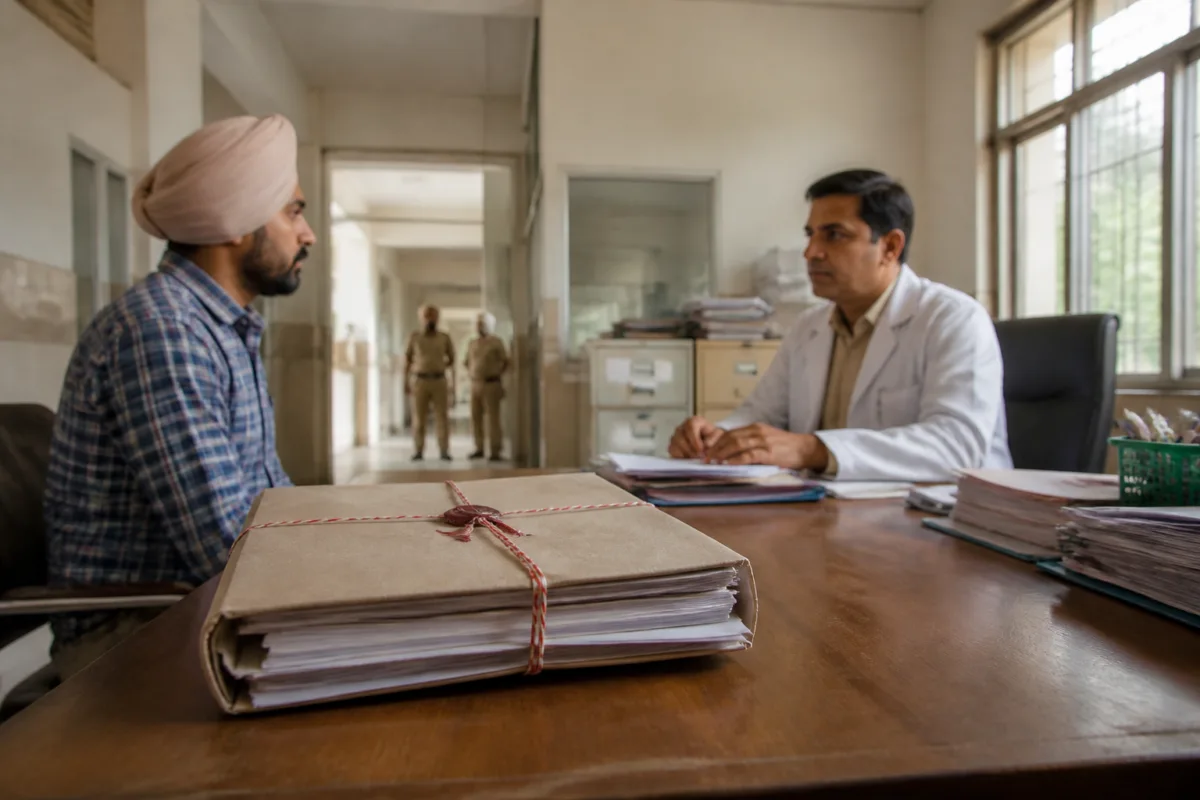
During the hearing, a medical officer appeared on behalf of the respondents and produced the complete official record in a sealed envelope, complying with the Commission’s earlier directions. After hearing the parties and examining the records, the Commission directed that the information sought in the RTI application be supplied. The sealed envelope was subsequently opened and the documents were provided to the appellant during the hearing.
This sequence is important because it shows that the dispute was not resolved simply by treating the information as either wholly private or wholly public. The records were examined in the context of the request, the institution that generated them and the stated legal purpose for which they were required. The Commission’s reasoning, as reported, places emphasis on the records’ official character and their connection with an ongoing criminal proceeding.
The order also draws attention to the role of government hospitals beyond routine treatment. Civil Hospital Kharar became part of a chain involving the police, medical officers, the RTI mechanism and the court process. Its doctors were not acting only as healthcare providers in the ordinary sense. They were also performing an institutional function through a Medical Board constituted after a police request.
That institutional position creates accountability obligations. When a document is prepared by public employees in a public facility and transmitted to an investigating officer, questions about its creation, contents and handling can affect the rights of people involved in a case. The Commission did not state that every medical record must be disclosed to every applicant. Its decision was tied to the circumstances presented before it, including the appellant’s demonstrated requirement for the documents in his defence.
The Commission relied on the Supreme Court’s 2011 judgment in The Institute of Chartered Accountants of India versus Shaunak H Satya. As described in the report, that judgment explained that the RTI Act seeks to harmonise transparency and accountability with the protection of other legitimate interests. That principle is central to the Kharar dispute. RTI administration is not only about expanding disclosure; it is also about applying exemptions in a manner that recognises competing rights and interests.
The order therefore has a significance beyond the individual records. It illustrates how public authorities can face difficulty when an RTI request involves information about another person but is also connected with the applicant’s legal rights. The initial response from the hospital treated the third-party aspect as a reason for withholding the material. The Commission’s eventual decision required a closer examination of the document’s official source and the purpose for which it was sought.
The case also demonstrates the importance of documentary custody. The respondents produced the complete record in a sealed envelope before the Commission. This allowed the Bench to examine the documents rather than decide the dispute only on a general description of their contents. The record included the final Medical Board opinion, the police communication that initiated the process and hospital or Board communications concerning the appellant’s appearance.
For public institutions, the practical issue is not merely whether a file exists. It is how the file is classified, who holds it, whether it contains information relating to more than one person and whether the requested material has a direct bearing on another legal process. The Kharar order indicates that these questions may have to be assessed together rather than through a single broad objection.
The decision also preserves the separation between information disclosure and adjudication of the underlying dispute. The Commission expressly clarified that it was not commenting on the merits of the criminal proceedings, the correctness of the Medical Board’s opinion or the innocence or guilt of any person. Those matters remained within the jurisdiction of the competent court.
This limitation is significant. Access to a document does not amount to a finding that the document is accurate, conclusive or favourable to the person who obtains it. Nor does an RTI order replace the evidentiary process before a court. The Commission’s role in this case was to decide whether the requested information should be disclosed under the circumstances placed before it.
That separation can help prevent two common misunderstandings about RTI disputes. First, disclosure is not the same as endorsement of the contents of a record. Second, an exemption dispute does not itself decide the underlying criminal allegation. The Commission’s order dealt with access to information, while the court proceedings will determine the legal issues arising from the FIR and cross daily diary report.
The case also underlines the importance of the second-appeal mechanism in the RTI system. The applicant had first sought information from the Civil Hospital, Kharar, and later pursued a second appeal before the State Information Commission after the information was not supplied. The Commission’s intervention created a forum where the competing claims could be examined and where the original records could be produced for scrutiny.
At the same time, the reported order does not establish how frequently similar requests are made to government hospitals, how long the earlier refusal lasted or whether the Commission has issued broader procedural directions to hospitals across Punjab. Those questions are not answered in the supplied material. The decision should therefore be read as an order based on the particular facts before the Commission, not as a universal ruling that all medical information connected to criminal cases must be released.
The larger urban governance question is how public institutions manage records that sit at the intersection of service delivery, policing, medical assessment and legal process. Government hospitals are often among the most visible points of contact between residents and the state. Their administrative records can influence investigations and court proceedings, while their handling of information affects public confidence in institutional accountability.
The Punjab case confirms that the existence of third-party information cannot, in every circumstance, end the inquiry. Authorities must also consider whether the material was created through an official process and whether the applicant has shown a specific and legally relevant need for access. It leaves intact the protection of legitimate privacy and the jurisdiction of the courts over the criminal case.
The next stage is not a further finding by the Information Commission on guilt or responsibility. It is the use of the disclosed documents, if relevant, within the pending proceedings before the competent court. The order’s immediate outcome is narrower but important: records created by a government hospital for a police-linked Medical Board process were supplied after the Commission found that withholding them could adversely affect the appellant’s ability to present material in his defence.

