


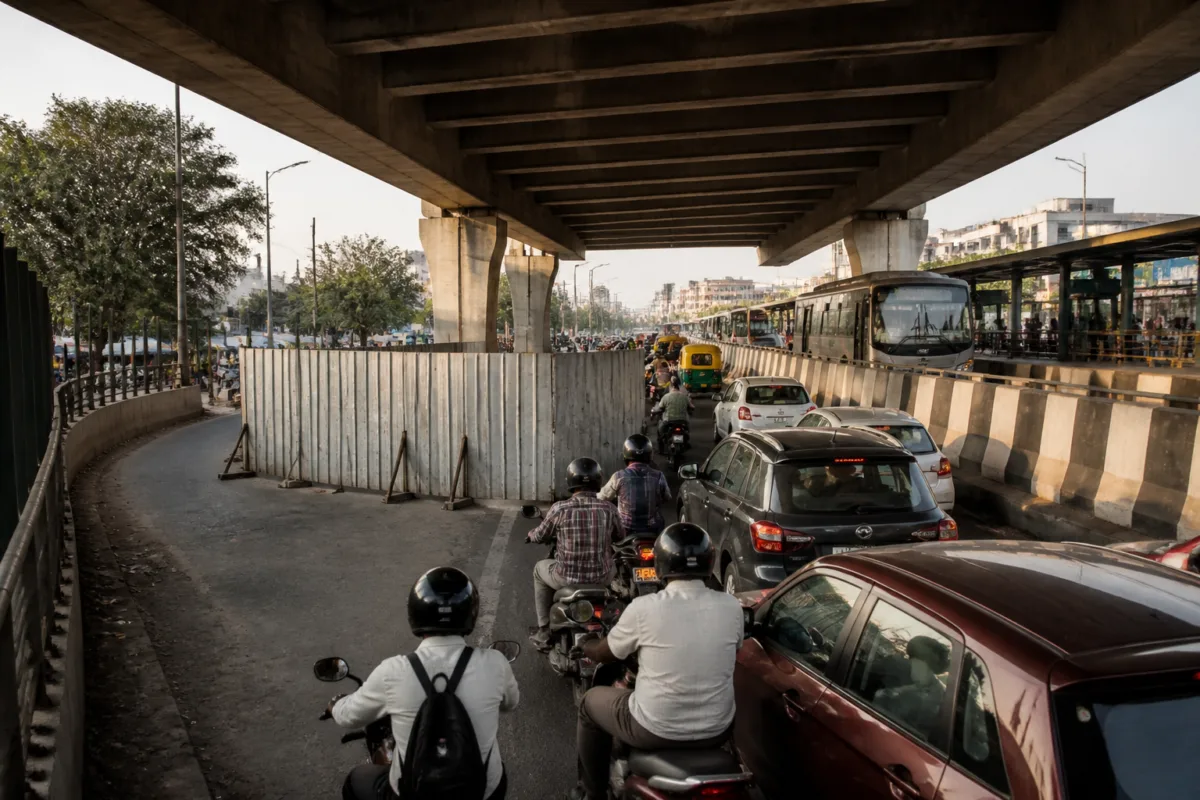
The closure of a turning cut beneath Isanpur Bridge in Ahmedabad has forced motorists to take longer detours or make risky turns through an open section of the BRTS corridor, according to a report by Sandesh. The changed traffic arrangement has created a daily conflict between private vehicles and buses using the dedicated route.
The cut was closed with metal sheets by the Ahmedabad Municipal Corporation and the traffic department as part of traffic regulation measures, the report said. The closure affects two-wheeler riders, auto-rickshaw users and car drivers who need to cross from one side of the road to the other.
With the direct turning movement no longer available, commuters are travelling farther before attempting to turn. Some drivers are reportedly entering the BRTS route at a point beyond the bridge where the corridor remains open, taking a turn from within the bus path to avoid the longer diversion.
That movement has created a potential collision point with BRTS buses approaching at speed. The report said the interaction between buses and private vehicles is occurring regularly, raising concerns over road safety for commuters, bus passengers and pedestrians in the area.
Local residents and people who regularly travel through the junction have criticised the closure, saying that the cut was blocked without a suitable alternative arrangement. Their concern is not only about additional travel time but also about the way an attempt to regulate traffic may be shifting unsafe movements into a corridor designed for public transport.
The incident highlights the operational challenge of closing a turning movement without simultaneously providing clear diversion routes, physical protection and enforcement. Where a BRTS corridor intersects with general traffic movements, the location and design of turns become critical to preventing vehicles from entering the bus path.
Sandesh reported that residents have called for traffic police personnel to be deployed at the location and for the authorities to reconsider the arrangement. The report warned that, without intervention, the continuing conflict between BRTS buses and vehicles could lead to a serious accident.
The supplied report does not specify when the cut was closed, whether a formal traffic order was issued, or what alternative route has been designated by the municipal and traffic authorities. The immediate next step sought by local residents is a coordinated decision on the cut, supported by on-site traffic management and a clearly marked alternative movement.

