


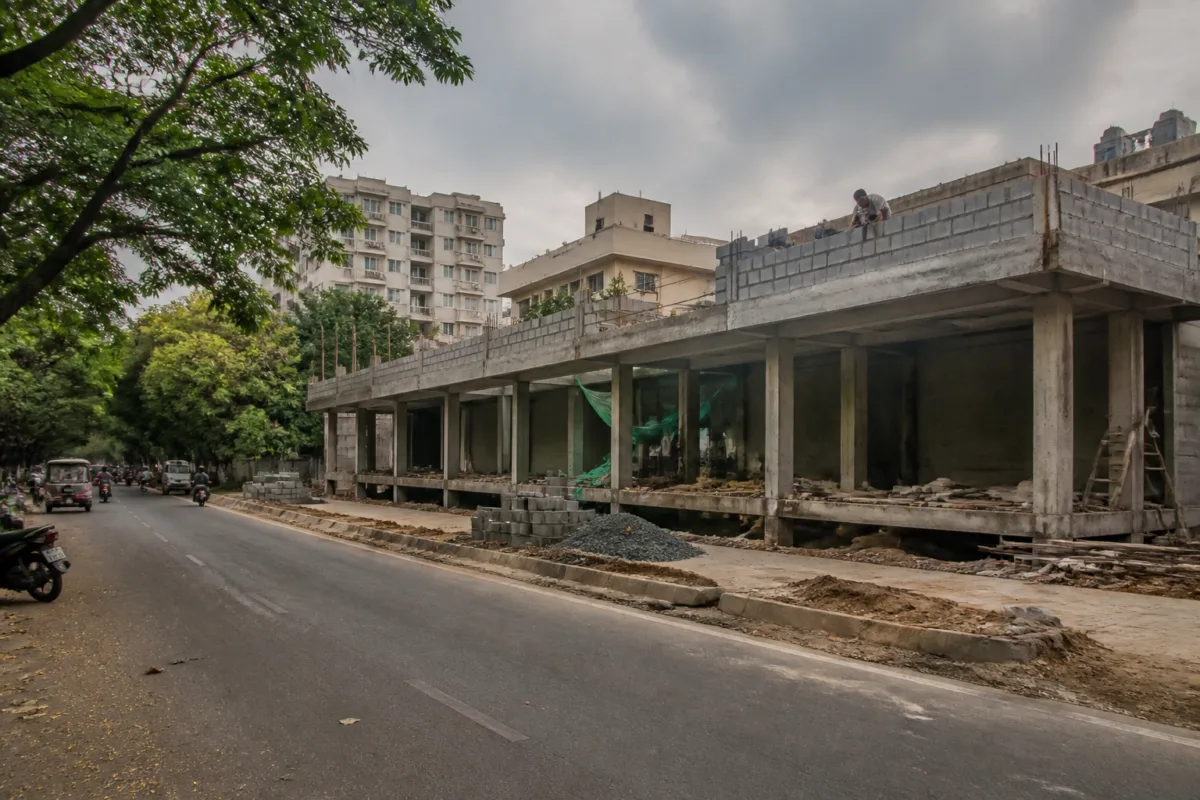
The delayed Adyar food court is more than a late civic amenity. It is an early test of how the Greater Chennai Corporation converts unused public property into revenue-generating urban infrastructure, and whether a public-private partnership can improve management without adding another layer of delay.
The facility on Indira Nagar 3rd Avenue was announced on July 7, 2025, with an opening target around Pongal 2026. That deadline was later moved to August, but the project is now expected to open only in 2027. More than a year after the announcement, construction is reported to be about 40% complete.
The project involves demolishing part of an unused shopping complex owned by the Corporation and rebuilding the site as a food court. Foundation and structural work began earlier this year. The estimated cost is ₹4.24 crore, with 30 shops planned across smaller 110 sq ft units and larger 220 sq ft units. The facility is also designed to include a common dining area, parking for 20 two-wheelers and 16 cars.
The delay matters because the project is built around a public asset that has already failed to produce its intended urban value. An unused shopping complex represents locked-up civic land and capital. Redevelopment can make such property useful again, but the transition from an existing structure to a functioning public-facing facility requires decisions on design, construction, operations, leasing and maintenance. Each stage becomes a potential source of delay if the institutional responsibilities are not aligned.
In the Adyar case, the Corporation has linked the delay to the 2026 election and the subsequent change in government. A senior GCC official told the Times of India that structural work on the shops is expected to be completed by December. However, the tendering process for the operating arrangement is expected to begin only in January 2027. This means that even after the physical structure is substantially complete, the facility may still require a separate commercial and administrative process before it can open.
That sequencing is central to understanding the project. The Corporation is not planning to rent individual shops directly to brands or franchises. Instead, it has opted for a revenue-sharing model under a public-private partnership, with the entire facility to be leased to a single operator. The stated rationale is that one operator will provide better management and generate higher revenue for the civic body.
The model changes the nature of the project from a straightforward civic construction exercise into a combined infrastructure and operating concession. A building can be completed through a construction contract, but a food court needs a functioning business structure: an operator, tenants or vendors, common-area management, cleaning, maintenance, parking control and revenue accounting. The decision to appoint one operator is intended to bring these functions under one management system. It also makes the tender a decisive milestone for the project’s eventual performance.
The choice has potential administrative advantages. Directly renting 30 separate units would require the Corporation to manage multiple commercial relationships, collect rents, enforce operating conditions and coordinate maintenance among individual occupants. A single operator could centralise these responsibilities. The official explanation is that this arrangement will improve management and increase Corporation revenue.
But the same structure places significant importance on the concession terms. The supplied information does not establish the proposed revenue-sharing percentage, lease duration, eligibility conditions, service obligations, maintenance standards or mechanisms for selecting individual food vendors. Those details will determine how the public asset is used and how much value returns to the Corporation. They will also determine whether the facility remains accessible to local users or becomes primarily a commercial destination shaped by the operator’s business model.
The delay therefore cannot be measured only in months between the original Pongal target and the revised 2027 opening. It also raises questions about how civic bodies plan projects whose construction and operations are interdependent. If the operating model is finalised late, the physical project may advance without a clear user, tenant mix or management framework. If it is designed too early without adequate market and site assessment, the tender may be harder to structure or attract suitable operators.
The project’s physical scale illustrates the limits and possibilities of this approach. Thirty shops, divided between 110 sq ft and 220 sq ft units, could support a range of food businesses, while the common dining area is intended to make the facility more than a row of rental spaces. Yet the available parking is limited to 20 two-wheelers and 16 cars. That capacity will shape how visitors and workers access the site, particularly because the food court is planned on an avenue in a built-up part of Adyar.
The parking provision also shows why small civic projects require urban planning decisions even when they do not involve major roads or transit systems. Food courts generate short-duration visits, deliveries, waste and peak-hour activity. Their performance depends not just on the building but on access, pedestrian movement, loading arrangements, sanitation and management of surrounding streets. The supplied project details confirm the provision of parking and a common dining area, but do not establish how traffic, deliveries or waste will be handled.
For the Corporation, the project is also part of a wider revenue strategy. Based on public response, the civic body is expected to consider food courts in other parts of Chennai to generate additional revenue. That makes the Adyar facility a potential pilot for a repeatable model. Its outcome will consequently be judged on more than whether it opens. The Corporation will need to assess construction cost, operating performance, revenue realised, maintenance quality and public use before replicating the format elsewhere.
The project’s history suggests that replication will require a clearer implementation framework. The announcement was made in July 2025, the original opening was expected by Pongal 2026, and the deadline was subsequently moved to August before the expected opening shifted to 2027. The source attributes the delay to the election and change in government, while the current plan places structural completion in December and tendering in January 2027. These milestones indicate that the project has moved through several timelines before becoming a functioning facility.
That pattern is significant for municipal administration because public projects are often evaluated at the announcement or construction stage, while the operational stage receives less attention. A food court requires continued management after inauguration. If the Corporation uses the Adyar project to develop more such facilities, the procurement documents and operating agreement will be as important as the building design. They will establish who carries responsibility for repairs, cleanliness, vendor management, common areas and revenue reporting.
The available evidence does not yet show whether the project has faced cost escalation, a change in design, contractor-related difficulties or disputes over land or procurement. It also does not establish whether the 40% completion figure refers to the entire facility or mainly to structural work. Those gaps matter because the expected 2027 opening depends on both construction progress and the later tendering process. The Corporation’s next formal milestones will therefore provide a clearer indication of whether the revised timeline is achievable.
The Adyar food court exposes a familiar institutional challenge: municipal bodies are being asked to create new revenue streams from existing land and buildings while also managing procurement, construction and public services. A public-private partnership can reduce the Corporation’s direct operating burden, but it does not remove the need for careful planning and oversight. Instead, it shifts the centre of administrative work towards tender design, contract monitoring and performance management.
What the evidence currently confirms is limited but important. The project remains incomplete at about 40%, its original opening schedule has been missed, and the Corporation now expects structural work by December followed by tendering in January 2027. The facility will contain 30 shops, a common dining area and defined parking capacity, and it is intended to operate through a single private partner under a revenue-sharing arrangement.
The next test will be whether those construction and tendering milestones are met, and whether the final operating agreement turns an unused civic property into a well-managed public facility. Until then, the Adyar food court remains not only a delayed project but also an unfinished experiment in municipal asset management.

