


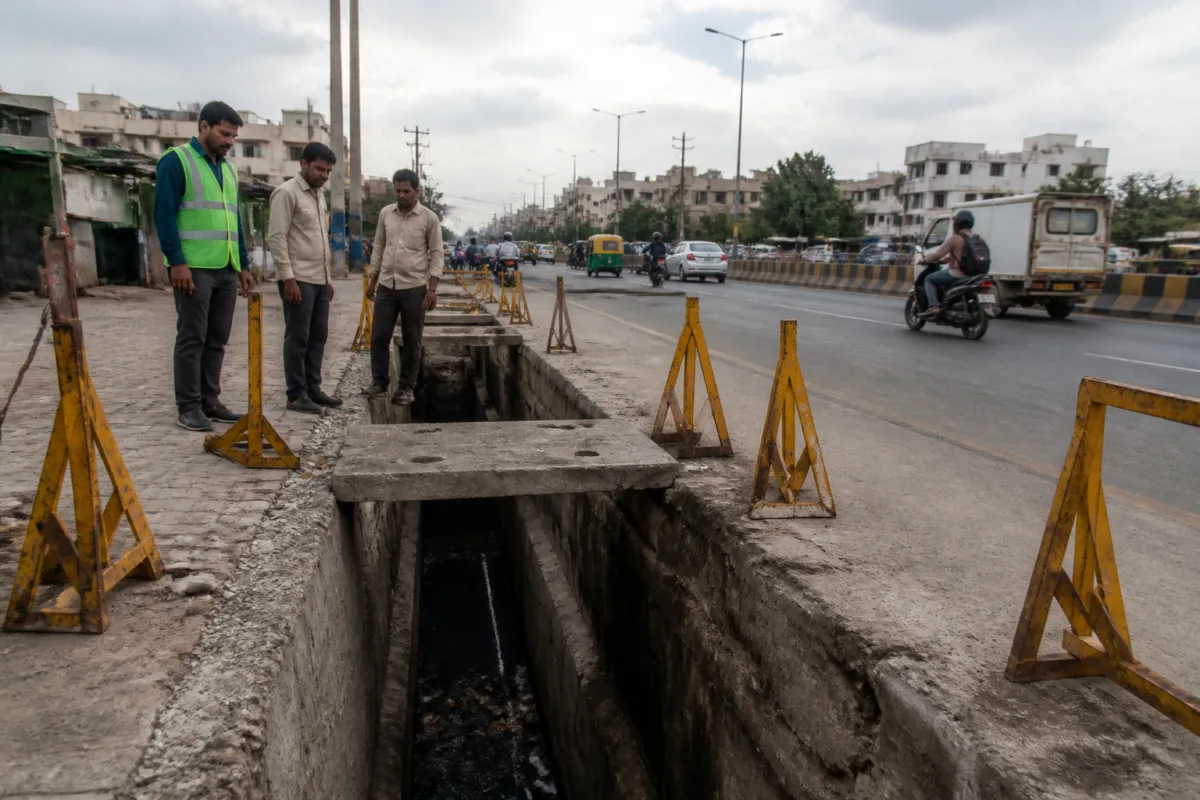
A 10-year-old visually impaired girl, identified in a Sandesh report as Manisha Salat, has reportedly been missing for about nine days after falling into an open drainage line on Ahmedabad’s Narol-Pirana Road. The case has moved beyond an individual tragedy: it raises questions about how a busy urban road was allowed to retain an uncovered and deep drain, how the search has been conducted, and why the site was later reportedly filled with soil.
The report says the girl fell into the drain and that authorities have not yet located her. It also says the drain at the incident site was subsequently covered with soil, intensifying concern among the family and local residents. The account does not identify the official who ordered the filling, explain whether the search was formally suspended, or provide a municipal or police statement. Those gaps matter because the condition of the site and the status of the search are central to understanding what happened.
The immediate facts, as reported, are stark. The incident occurred on the Narol-Pirana Road, described in the report as a busy route. The missing child is identified as Manisha Salat, and the report says she is 10 years old and visually impaired. Around nine days had passed without her being traced when the report was published. The family has expressed anger over what it considers a slow and negligent search, while local residents have demanded faster action and accountability for officials responsible for the road and drainage conditions.
The report also raises a specific operational question: whether the search was still continuing when the drain was filled. Covering an open drain may remove an immediate public hazard, but doing so at a location connected to an unresolved missing-person case can also alter the scene and make subsequent examination more difficult. The supplied report does not establish who took that decision, what technical assessment preceded it, or whether the area was inspected before being closed. These are questions that require answers from the Ahmedabad municipal administration and other agencies involved in the search.
Ahmedabad open drain safety is an administrative responsibility
Open drains are not merely maintenance defects. On a road used by pedestrians, vehicles and nearby communities, an uncovered drainage line becomes a direct public-safety risk. The risk is greater for children, older people and persons with disabilities, particularly where the edge of the drain is not clearly protected or visible. In this case, the source report specifically identifies the child as visually impaired, making the absence of physical protection and warning systems especially significant.
The report does not provide measurements of the drain, details of barriers, information about lighting, or records of earlier complaints. It therefore cannot establish whether the opening resulted from damaged covers, incomplete construction, routine maintenance, or a long-standing design condition. But the location described in the report is enough to frame the governance issue: a drainage asset alongside a busy road must be designed and maintained as part of the public realm, not treated as an isolated underground utility.
Responsibility for such conditions is usually distributed across departments and contractors, but fragmented responsibility does not remove accountability. A municipal drainage department may oversee the line, a roads division may control the carriageway and footpath, and contractors may be responsible for construction or maintenance. If the boundary between these roles is unclear, hazards can remain unresolved because each agency treats the problem as belonging elsewhere. The Sandesh report directly questions the role of the municipal drainage department and local administration, but the supplied material does not identify the precise chain of responsibility.
That institutional uncertainty is one of the most important aspects of the case. When a public hazard leads to a serious incident, the response should establish who inspected the location, who secured it, who initiated the search, and who recorded decisions taken at the site. Without a documented timeline, the public is left with competing impressions: that the drain was dangerous before the incident, that the search has been slow, and that the opening was filled before the child was found. The report presents these concerns, but official records are needed to confirm each part of the sequence.
The search and the site cannot be separated
A missing-person search following a suspected fall into a drain is both an emergency response and an investigation of infrastructure. The physical characteristics of the drain, its connections, flow direction and downstream access points would be relevant to the search. The report, however, does not state which agencies participated, what equipment was used, how far the drainage network was examined, or whether weather and water-flow conditions affected the operation.
Nor does it say whether the site was preserved for inspection before being filled. That omission is significant because the decision to close the opening has two separate dimensions. One is public safety: leaving a deep open drain beside a busy road could expose others to danger. The other is evidence and search integrity: any intervention at the site should be recorded, justified and coordinated with the agencies looking for the child. The report’s central concern is that the filling may have taken place while the child remained untraced. Whether that concern is factually correct can only be settled through an official account of the search and site-management decisions.
The family’s demand for quicker action and action against responsible officials reflects a wider feature of urban emergencies. Families often experience the response through visible activity: personnel at the site, machinery, barricades, updates and clear communication. When these are absent or not explained, distrust grows quickly. In this case, the report says the family and local residents are angry about the pace of the search and are seeking accountability. It does not record the administration’s response, leaving a major public-information gap.
A credible response would need to clarify the child’s last known location, the condition of the drain, the agencies notified, the timeline of the search, and the reason for filling the opening. It would also need to state whether the search remains active and what next steps have been authorised. These are not demands for commentary; they are basic facts required to assess whether the response has been proportionate to the incident.
What the case reveals about civic maintenance
The reported incident points to a recurring distinction in urban governance: cities often treat drainage as a buried engineering system, while residents encounter it as street-level infrastructure. A drain may be part of a larger network, but its opening, cover, edge and connection to pedestrian space determine whether it is safe. The public does not experience departmental boundaries. It experiences a road, a footpath, a dark stretch, a missing cover or an unprotected drop.
The report does not establish how long the drain was open or whether complaints had previously been made. It also does not provide evidence of a wider pattern across Ahmedabad. It would therefore be inappropriate to claim that the city’s entire drainage system is failing on the basis of this one account. The narrower and better-supported conclusion is that the reported condition at Narol-Pirana Road raises questions about inspection, hazard reporting and emergency closure procedures at a location that the report describes as busy.
Filling the drain after the incident, if confirmed, also raises a maintenance question. Closing one opening may address the immediate visual hazard while leaving the underlying drainage network, access requirements and inspection regime unresolved. A durable response would require the authority to document the intervention, inspect connected sections, assess other exposed points and communicate the safety status of the road. The supplied report does not say whether such a broader inspection has been ordered.
This is where the case becomes relevant to urban policy rather than only municipal negligence. Public infrastructure is safe only when design, maintenance, monitoring and emergency response operate together. A covered drain can become exposed; a temporary repair can fail; a road project can leave utility edges unprotected. The administrative question is not simply who should be blamed after an incident, but whether the system has a process for identifying hazards before they harm someone and for preserving accountability afterwards.
The unanswered questions
Several facts remain unresolved in the supplied account. It is not clear whether the child’s fall has been independently confirmed by authorities, although the report presents it as the incident under investigation. It is not clear when the search began, which agencies are participating, whether the drain connects to other channels, or whether any formal search update has been issued. The report also does not identify the officer or agency that decided to fill the drain.
These are material gaps, but they do not reduce the seriousness of the public-safety issue described. They define the next stage of reporting. The administration should provide a factual timeline, identify the responsible departments, explain the site decision and confirm the current search status. The municipal authority should also clarify whether the Narol-Pirana Road has been inspected for other open or inadequately protected drainage points.
The case confirms one immediate reality: an exposed drain beside a busy urban road can become a life-threatening hazard, and the consequences extend far beyond routine maintenance. What remains uncertain is the exact chain of events after the girl reportedly fell and whether the search and site response followed a documented protocol. Until those questions are answered, the incident will continue to stand as a test of Ahmedabad’s ability to connect civic maintenance with public safety and institutional accountability.

