


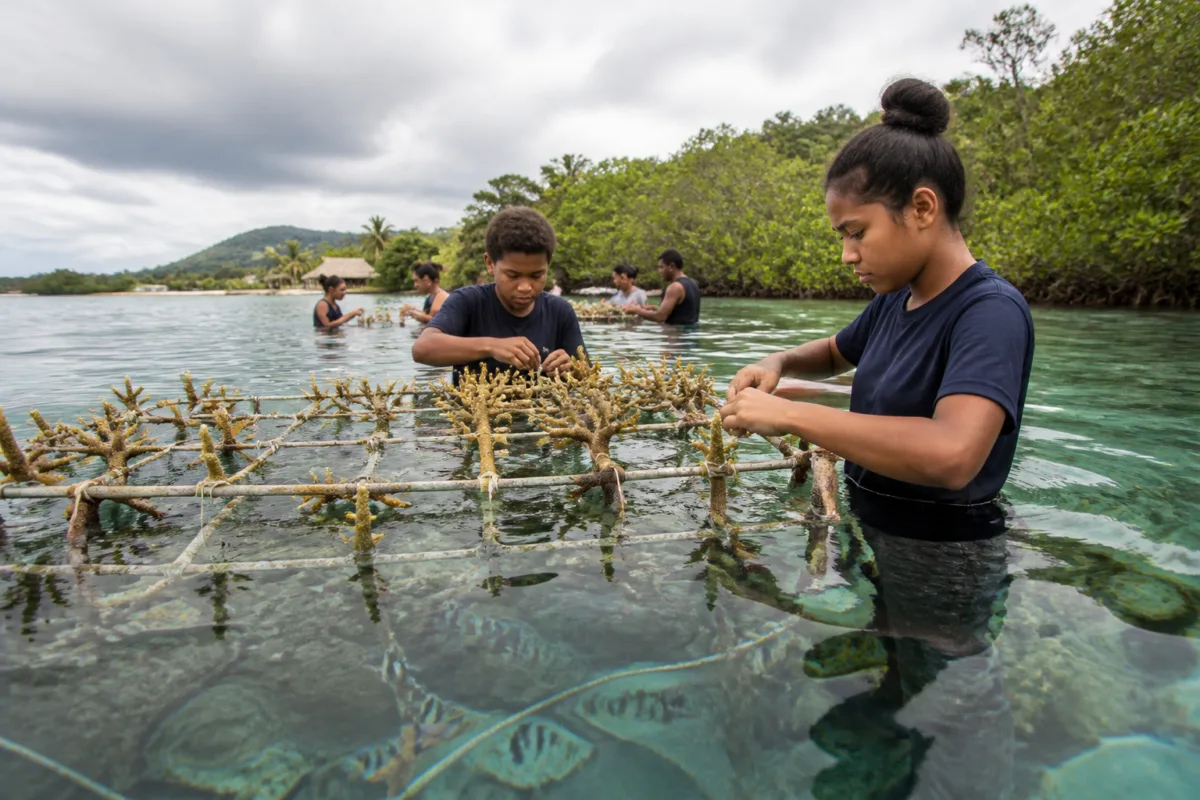
Naidiri Village’s recovery from a depleted fishery shows how local rules, youth-led conservation and coral restoration can work together as a form of coastal resilience. The Fiji community first protected part of its customary fishing grounds in 2009 after catches had become so small that residents feared there would be little marine life left for future generations. Seventeen years later, the protected area has expanded, fish and sharks have returned, and corals that survived extreme heat are being transplanted to cooler waters near Suva.
The experience is significant because it links three challenges that coastal communities increasingly face at the same time: declining fish stocks, damage to coral ecosystems and rising sea temperatures. Naidiri’s response did not begin as a large infrastructure project or a centrally designed conservation programme. It began with a decision by villagers to restrict access to a section of their customary fishing grounds and manage it collectively.
Manoa Duwai, who proposed the protected area, acted after a fishing trip yielded only tiny, juvenile fish. He recalled being able to catch a fish no larger than his palm and questioned what species would remain in the village’s fishing grounds in the future. His proposal to village elders covered an initial area of 30 by 40 metres within the reef.
The protected zone, known locally as a tabu area, produced visible results. Larger fish began using the protected reef and then spread into neighbouring waters. Over time, the village expanded the protected area to 280 by 240 metres. It also created a similarly sized area called “the fridge”, which is closed temporarily to allow fish stocks to build up.
This arrangement is more than a conservation boundary. It is a local management system that connects ecological recovery to food security and livelihoods. Naidiri has 147 residents, and the protected waters are intended to sustain the village over the long term. The temporary closure of the “fridge” also indicates that the community is managing access according to the condition of the fishery rather than treating fishing grounds as permanently open resources.
The village’s youth group has become central to that system. Formed in 2011, the group helps manage the tabu area and leads coral planting and wider ecosystem work. Joseva Kunagado, who is 21 and leads the youth of Naidiri Village, described how the work began with basic equipment. Young residents cut barrels in half, tied ropes to them and used them to transport corals, walking for about 20 minutes to reach planting sites before returning to the reef.
In 2023, the group planted 18,000 corals and 10,000 mangroves. Those figures demonstrate the scale of work that can emerge from a small community when conservation responsibilities are organised locally. They also show that the restoration effort is not limited to a single reef structure. Coral planting supports the marine habitat, while mangroves add another layer of coastal ecosystem protection.
The results have changed the relationship between the village and its marine environment. Fish species and invertebrates have returned, while sharks have been seen again around the protected area. Duwai said he became emotional when sharks returned this year, interpreting their presence as evidence that the ecosystem was recovering. For Kunagado, the arrival of tourists, researchers and university students has become a source of pride for the young people involved in the work.
Yet the restoration has not insulated Naidiri from climate stress. During a heatwave earlier this year, Duwai said water temperatures reached between 38 and 39 degrees Celsius. The high temperatures caused widespread bleaching among the thousands of planted corals. According to his account, about 20 per cent survived and are now regarded as “super corals” because they endured conditions in which most of the coral was expected to die.
That survival has made the site relevant beyond the village. Researchers are studying both the way Naidiri has protected its marine ecosystem and the characteristics of the corals that survived the heat. The surviving corals are not being treated simply as proof that restoration has succeeded. They are also becoming biological assets that could help other reefs withstand future warming.
Naidiri is now transplanting its heat-resistant corals into deeper, cooler waters near Fiji’s capital, Suva. The move reflects a shift from restoring one damaged site to spreading resilience across multiple locations. It also underlines a practical limitation of climate adaptation: protection in one place may not be enough when heatwaves affect large marine areas.
The village’s experience also raises an institutional question about who is able to manage coastal ecosystems effectively. In Naidiri, the system combines customary fishing grounds, decisions by village elders, a youth organisation and practical restrictions on access. The article does not describe a formal government programme or a large external funding mechanism. Instead, the evidence points to a community structure in which rules are created and enforced close to the resource being protected.
That proximity appears to have helped the conservation effort remain connected to everyday needs. The initial concern was not an abstract environmental target but the falling size and number of fish available to residents. The response was therefore framed around the future of the fishing ground and the village’s ability to continue depending on it.
The model is not automatically transferable. Naidiri’s customary fishing arrangements, population size and reef conditions form a specific social and ecological setting. The source also does not establish how much the restoration cost, how the protected zones are formally regulated, or whether the fishery’s recovery has been measured through a long-term scientific monitoring programme. Those gaps matter when assessing whether similar systems could be replicated elsewhere.
Even so, the evidence from Naidiri points to a broader understanding of coastal resilience. Physical protection is often discussed through seawalls, drainage systems and other engineered assets. Coral reefs and mangroves are different kinds of infrastructure, but they also shape the safety and economic conditions of coastal settlements. Their condition affects marine habitats, fisheries and the ability of communities to withstand environmental stress.
The coral work also shows why climate adaptation cannot be separated from local governance. Planting thousands of corals is only one part of the effort. The protected area, the temporary closure called the “fridge”, the youth group and the involvement of village elders create the management structure that allows restoration to produce wider benefits. Without rules around access, ecological repair could be undermined by the same pressures that damaged the fishery in the first place.
The heatwave adds another layer of complexity. Restoration alone does not guarantee survival when marine temperatures rise sharply. The reported survival of 20 per cent of corals suggests that future conservation could increasingly involve identifying species or colonies with greater heat tolerance, protecting them and moving them to sites where they have a better chance of surviving. But the source does not establish whether the surviving corals will remain resilient under repeated heat events or whether transplantation near Suva will succeed.
What Naidiri does confirm is that local conservation can produce visible ecological and social gains even after a fishery has deteriorated. A protected area that began at 30 by 40 metres expanded to 280 by 240 metres. Fish returned, sharks were observed again, and the village became a destination for researchers, students and tourists. The youth group’s work has also created a direct role for younger residents in managing a resource on which the community depends.
The larger urban and built-environment question is how coastal settlements can combine ecological systems with governance systems before climate damage becomes irreversible. Naidiri is a village rather than a city, but the pressure it faces is shared by coastal urban areas: warmer waters, stressed ecosystems, threatened livelihoods and the need to manage limited natural protection. Its experience suggests that resilience is not only a matter of building new defences. It also depends on protecting and rebuilding the natural systems that support communities.
The next stage will test whether Naidiri’s heat-resistant corals can survive after transplantation to deeper, cooler waters near Suva and whether the village can maintain its protected zones over time. For now, the evidence shows a community-led conservation system that has restored parts of a declining fishery while creating a living laboratory for adaptation to rising marine heat.

