


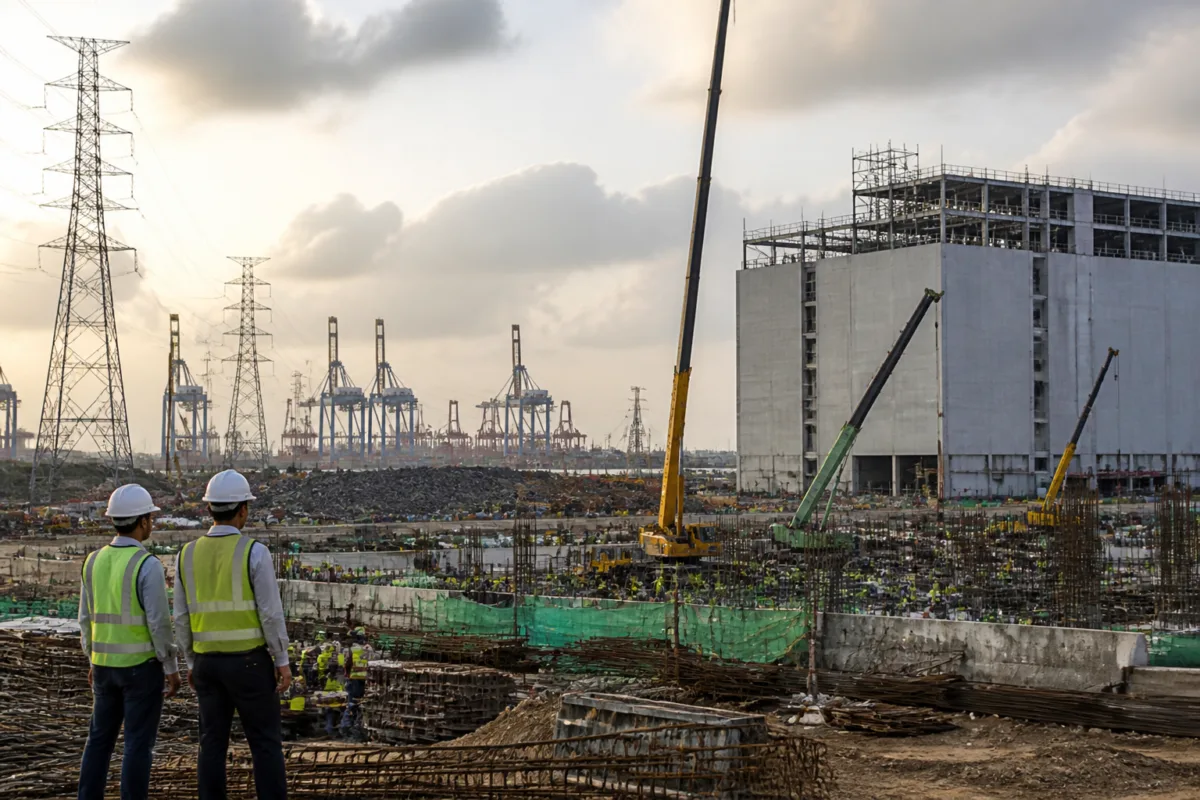
Adani Group plans to invest more than $120 billion over the next five to six years across infrastructure, energy and data centres, according to a Jefferies research note on the group’s annual investor conference. The proposed spending places ports, power, transmission, construction capacity and large-scale digital infrastructure at the centre of the conglomerate’s next expansion phase.
The group’s listed companies plan annual capital expenditure of ₹2 trillion to ₹2.2 trillion from FY27 to FY31, compared with ₹1.53 trillion in FY26. Based on the figures cited in the Jefferies note, that represents an increase of roughly 30 per cent to 44 per cent. The planned outlay is expected to support projects across several infrastructure-linked businesses rather than a single urban development programme.
Adani Group management told investors that it was seeking to keep net debt below 3.5 times earnings before interest, taxes, depreciation and amortisation. Jefferies, however, estimates that the aggregate net debt-to-Ebitda ratio of six listed Adani companies could reach 3.7 times in FY27 and FY28 before declining to 3.4 times in FY29 and 3.1 times in FY30. Including debt associated with the Ambuja Cement acquisition, the brokerage estimates the ratio at 4.0 times in FY27 and 3.9 times in FY28.
The difference between the group’s stated financial objective and Jefferies’ forecast is significant for infrastructure projects, which typically require substantial upfront investment and generate returns over extended periods. The report does not identify individual project costs or provide a project-by-project schedule, but it indicates that financing capacity and construction delivery will be closely linked to the pace of expansion.
Group Chief Financial Officer Jugeshinder Singh said net debt to Ebitda had declined from a peak of about 3.6-3.8 times during 2019-23. Management also cited lower borrowing costs, improved asset returns and a diversified funding base. Average borrowing costs were reported at about 7.5 per cent, down from approximately 10 per cent in 2019. The group said about 92 per cent of its portfolio companies were investment grade, against a target of 100 per cent.
Total debt stood at $43.2 billion at the end of September, with 91 per cent classified as long-term debt. Domestic banks accounted for 48 per cent of funding, followed by global banks at 23 per cent, global capital markets at 16 per cent and domestic capital markets at 8 per cent. Domestic bank loans had an average maturity of nine years, compared with about 2.5 years for global bank debt. The group also held approximately $8 billion in cash and raised around $3 billion in equity during July and August.
Data centres are one of the group’s major growth priorities. AdaniConneX, its data-centre venture, has reported a 1.2 GW order book and an additional 1 GW in reservations from existing customers. Established in 2021 with an initial target of developing 1 GW by 2030, the venture is developing five sites, each with the potential to reach 1 GW. The group has since announced a broader target of 5 GW of data-centre capacity by 2035.
Such facilities are infrastructure-intensive developments requiring land, reliable electricity, cooling systems, network connectivity and supporting construction. The scale cited in the report therefore makes execution capacity an important issue beyond financing. At the conference, management identified construction and execution capacity as the principal constraints on its expansion plans and said project-building capabilities had been centralised under Adani Infra.
The group expects about $120 billion in cumulative funds from operations over 10 years, broadly matching its planned capital expenditure, according to the report. That projection is a management expectation rather than a confirmed funding commitment. The report also records management’s defence of related-party transactions, including power supplies to cement plants and the use of ports to transport equipment for renewable-energy projects.
The expansion plans come as the group continues efforts to rebuild investor confidence after the January 2023 short-seller report and subsequent US legal and regulatory developments. The group has denied US allegations concerning an alleged $265 million bribery scheme linked to Indian solar-power contracts. Business Standard reported that the US Securities and Exchange Commission’s civil case was settled in May, with the group agreeing to pay $18 million in penalties without admitting wrongdoing, while the US Justice Department subsequently moved to dismiss the criminal indictment with prejudice.
For the built environment, the immediate significance of the plan lies in its potential scale across industrial, energy, logistics and digital infrastructure. The available report does not establish which specific cities or sites will receive investment, nor does it confirm construction timelines. Its clearest signal is that the group’s ability to convert a large capital-spending plan into operating assets will depend on long-term funding, project execution and the availability of construction capacity.

