


Vedanta Oil and Gas Ltd is offering 1.80 million standard cubic metres per day (mmscmd) of natural gas from its Rajasthan block through an electronic auction, setting up a market test for how much domestic pipeline-delivered gas buyers will pay over imported liquefied natural gas (LNG) benchmarks.
The three-month supply contract is scheduled to run from January 1 to April 1, 2027. According to a request for proposal dated November 20 and a draft gas sales agreement reported by the Press Trust of India, the auction will be held on December 14, with bidders required to quote a premium over the monthly average of Platts West India spot LNG prices.
The starting premium is zero, and bids must rise in increments of at least $0.05 per million British thermal units (MMBtu). The highest bids will receive priority until the available gas is allocated. The offered volume is equivalent to approximately 75,600 MMBtu per day, or about 6.8 million MMBtu over the 90-day contract period.
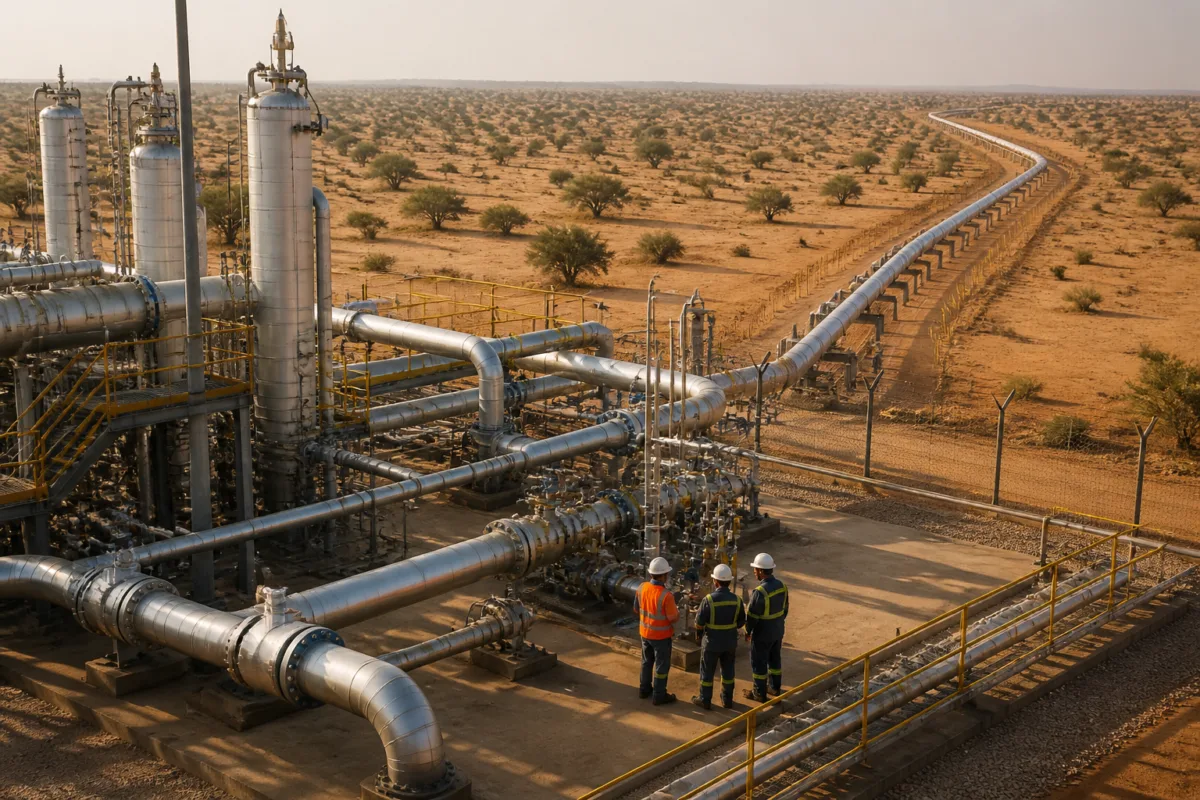
For India’s gas infrastructure, the auction is notable because the supply is connected to a functioning production, processing and transmission chain rather than being an isolated field sale. The gas will be produced from the RJ-ON-90/1 block in Rajasthan’s Barmer district, processed at the Raageshwari facility and transported through the Barmer-Pali section of the Mehsana-Bhatinda pipeline. That section is operated by GSPL India Gasnet and connects the supply to the Gujarat gas grid and the wider national network.
The block was awarded in 1995 under a production-sharing contract. Vedanta Oil and Gas and its units hold a 70 per cent participating interest, while state-run Oil and Natural Gas Corp. holds the remaining 30 per cent. Vedanta is acting as the representative of the sellers for the proposed sale.
The auction is being conducted under the government’s 2020 domestic gas marketing reforms and subsequent electronic-bidding guidelines. These reforms allow producers to discover market-based prices through competitive sales facilitated by agencies empanelled by the Directorate General of Hydrocarbons.
C1 India Pvt Ltd will conduct the online auction from 11 a.m. IST. Bidders can seek a minimum quantity of 150,000 cubic metres per day, which could allow as many as 12 buyers to obtain supplies if the entire volume is divided into minimum-sized lots. Allocation will proceed in descending order of the premiums offered. If bids are tied, priority will go to the bidder that submitted its offer earlier.
The eligibility conditions indicate that the sale is aimed at established gas consumers, traders or buyers with demonstrated market activity. Participants must show average gas consumption, sales or purchases of at least 100,000 cubic metres per day during the financial year ended March 2026 or the April-September 2026 period. Participants in two earlier tenders for the block are exempt from this requirement.
Bidders must also provide bank guarantees linked to the volume sought. The guarantee ranges from Rs 2 crore for quantities of up to 200,000 cubic metres per day to Rs 18 crore for the entire offered volume. Gas sales agreements are scheduled to be signed by December 23.
The draft agreement places substantial volume and payment obligations on buyers. They must pay for at least 90 per cent of their monthly contracted quantities, regardless of actual offtake. The minimum obligation is 80 per cent for fertiliser companies and their aggregators. Eligible shortfall quantities may be recovered as makeup gas for up to 10 days after the contract expires.
The draft also limits the remedy available to buyers if supply falls short. Where sellers deliver less than 80 per cent of a buyer’s nominated quantity, the buyer’s sole contractual remedy would be a credit equivalent to 10 per cent of the average gas price applicable to the shortfall.
Buyers would additionally have to provide security equivalent to 31 days of supply, valued at 110 per cent of the applicable price. Delayed payments would attract interest at the State Bank of India’s one-month marginal cost of funds-based lending rate for rupee payments, or six-month CME Term SOFR for dollar payments, plus five percentage points.
The sellers could suspend supplies on three days’ notice in cases of non-payment or expiry of the required bank guarantee. They could also terminate the agreement if buyers failed to secure pipeline transportation capacity by December 28. Buyers would bear applicable taxes and pipeline transportation charges, while ownership and risk would transfer at the delivery point at the outlet of the Raageshwari Gas Terminal.
The documents do not specify the proposed monthly price floor or ceiling. A provision allowing sellers to curtail supplies based on price priority if production falls is also bracketed, suggesting that some commercial provisions remain under discussion.
The outcome will therefore indicate more than the premium buyers are willing to pay. It will also show how market participants value domestically produced gas delivered through India’s pipeline network when compared with imported LNG, while leaving buyers exposed to international spot-price movements. For infrastructure-linked gas consumers, the auction’s importance will depend on the final commercial terms, the allocation of volumes and the ability of successful bidders to secure transportation capacity before the agreements take effect.

