


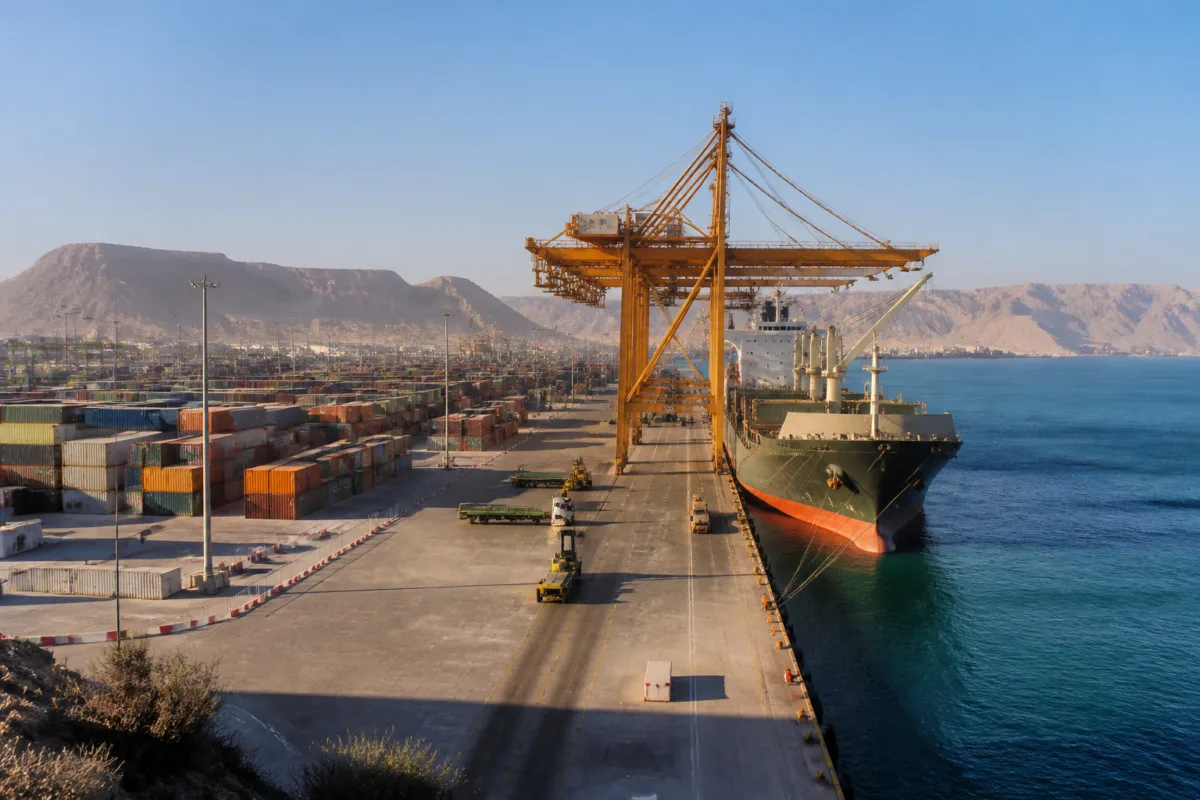
Adani Ports and Special Economic Zone’s incorporation of a company in Oman has intensified speculation that India’s largest private port operator could take over operations at Salalah Port, a major regional container transhipment hub. The reported development comes after the port’s existing operator disclosed that its concession agreements will not be extended beyond November 2028.
The company, Indian Ocean Gateway Terminal, was incorporated in the Sultanate of Oman on October 21, according to an October 22 regulatory filing cited by the Economic Times. The filing did not name Salalah Port or disclose the purpose of the new entity. APSEZ chief executive Ashwani Gupta subsequently said the company was evaluating more than 20 overseas assets for possible acquisition.
The connection between the Oman subsidiary and Salalah Port remains unconfirmed. Salalah Port Services Company SAOG, which has operated the port under a 30-year contract since 1998, informed the Muscat Stock Exchange on October 18 that it had received formal notification from Oman’s Ministry of Transport, Communications and Information Technology that its existing concession agreements would not be extended beyond their contractual expiry date of November 1, 2028.
That disclosure has provided the main basis for speculation about a possible APSEZ role. Industry sources cited by the Economic Times said the timing of the two developments suggested that APSEZ could be in discussions with the Oman government over the port’s future operation. One industry source said APSEZ and the Oman government were giving final touches to a possible agreement that could be announced shortly.
The report also states that the talks could not be independently verified and that the Oman government could not be reached for comment. APSEZ has not publicly confirmed that Indian Ocean Gateway Terminal was established to pursue Salalah Port, nor has it announced an agreement involving the facility.
The reported move is significant because Salalah Port is Oman’s largest port and an important container transhipment hub in the region. Its location gives it a role in international shipping networks connecting markets around the Indian Ocean and beyond. Any change in its operating structure would therefore involve more than a corporate acquisition; it would affect the management of a strategic logistics gateway and the commercial relationships built around it.
For APSEZ, a presence in Oman would extend an international expansion strategy that already includes operations or investments in Israel, Colombo, Tanzania and Australia, according to the report. The company has been assessing overseas assets as part of a broader effort to expand its global port and logistics business.
Gupta said during APSEZ’s earnings call that the company was evaluating more than 20 international assets. He said potential acquisitions would need to contribute to revenue and profit growth at a rate at least in line with APSEZ’s own growth. The company would also assess geopolitical and macroeconomic conditions, funding availability in the target market, and the quality of the local leadership team or partner.
Those criteria indicate that APSEZ’s international expansion is not being presented as a simple capacity-building exercise. The company is assessing whether a target asset can generate acceptable commercial returns while fitting its wider operating and funding requirements. Gupta also said that in developed markets APSEZ would examine the underlying business and cargo opportunities before deciding whether an asset offered adequate returns.
The company has previously evaluated Associated British Ports, described in the report as the United Kingdom’s largest port operator, but concluded that the asset did not meet its return requirements. That example underlines that APSEZ’s review of overseas opportunities does not automatically lead to an acquisition.
The Oman development also highlights the institutional structure behind port concessions. Salalah Port Services operates under agreements granted by the Oman government, and the Ministry of Transport, Communications and Information Technology has formally communicated that those agreements will end on their contractual expiry date. The next operating arrangement will therefore depend on decisions by the Omani authorities, the terms of any future concession and the selection process used for the port’s operation.
At present, the supplied report does not establish whether Oman has opened a formal tender, selected a preferred operator, negotiated directly with APSEZ or decided on a future concession model. It also does not provide details on the duration, financial terms or ownership structure of any possible agreement. These are material gaps because the commercial and operational implications of a port transition would depend on the final contract.
The 2028 expiry date provides a defined administrative milestone, but it does not itself confirm that a replacement operator has been chosen. The existing operator’s notification establishes that its concession will not be extended beyond November 1, 2028. It does not identify the next operator or explain how the transition will be managed.
For the regional logistics system, continuity will be an important issue as the concession approaches its end. Salalah Port’s role as a transhipment hub means that shipping lines, cargo owners, terminal workers, logistics providers and public authorities would all have an interest in an orderly operating transition. The available material does not state whether any transition planning has begun or whether the current operator will continue managing the facility until the concession expires.
The APSEZ proposal, if confirmed, would also need to be assessed against Oman’s strategic and regulatory priorities. The supplied report does not provide the government’s position, details of any negotiations or information on the policy objectives guiding the next concession. Until those details are disclosed, the incorporation of an Oman-based company should be treated as an indicator of possible interest rather than proof of a concluded transaction.
The immediate evidence consists of three linked but distinct developments: APSEZ incorporated Indian Ocean Gateway Terminal in Oman; APSEZ said it was evaluating more than 20 international assets; and Salalah Port Services disclosed that its existing concession would not be extended beyond 2028. The first two facts do not explicitly identify Salalah Port, while the third does not name a successor operator.
The central question is therefore not whether APSEZ has created an Oman entity, which the filing establishes, but whether that entity is connected to a binding or near-final agreement for Salalah Port. The Economic Times report attributes that connection to industry insiders while also noting that it could not independently verify the talks. APSEZ and the Oman government would need to provide formal confirmation before the reported deal could be treated as established.
The next decisive development will be an official announcement from APSEZ, the Oman government or the relevant port authority setting out the future operating arrangement. Until then, the 2028 concession expiry remains confirmed, while APSEZ’s reported involvement in Salalah Port remains subject to verification.

