India AI Led Infrastructure Vision Highlights Thane Connectivity
In a bid to translate upcoming transport investments into clearer urban value metrics, a major real estate developer has released an AI‑based visualisation that maps future connectivity corridors emanating from Thane and across the wider Mumbai Metropolitan Region (MMR). Titled Future Routes, Future Thane, the initiative uses artificial intelligence powered imagery and government‑approved project data to demonstrate how planned expressways, metro lines, tunnels and elevated links could reshape travel times, commuter experience and location attractiveness over the coming decade.
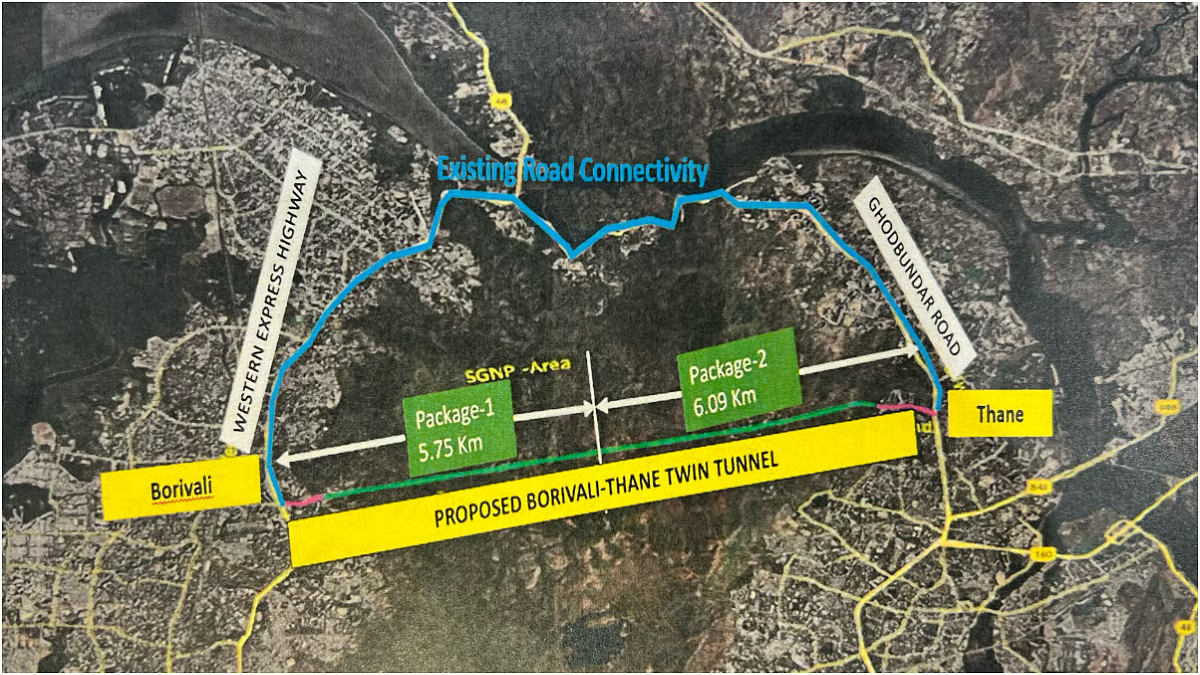
Anchored around the company’s ongoing Westgate residential project in central Thane, the visualisation synthesises publicly available data with generative imagery to illustrate multiple high‑impact infrastructure corridors — from the Thane‑Borivali Twin Tube Tunnel and Metro Lines 4 and 5 to the future elevated road to the Navi Mumbai International Airport and the Eastern Freeway extension — charting reductions in inter‑city and intra‑city travel times. For India’s largest metropolitan regions, where congestion and fragmented transport links have historically limited urban mobility and constrained property market valuations, such data‑driven mapping represents both a tool for informed homebuying decisions and a broader urban planning narrative. In Thane’s case, prospects of multi‑modal connectivity — from rail to road to air access — could strengthen its positioning as a residential and commercial node complementary to Mumbai’s core and satellite towns.
Urban mobility specialists note that visualising infrastructure impacts ahead of construction can demystify long lead times and help prospective residents and investors understand the trajectory of urban growth. “Connectivity is central to how households and businesses value locations,” says a senior planner in the Mumbai region. “Mapping future travel‑time gains — even in simulated form — helps quantify the premiums that new transport corridors might unlock.” Such tools can also steer debates on transport‑oriented development (TOD) and guide municipal planning on feeder networks, last‑mile access and transit‑integrated land uses. Critically, the AI‑enabled film departs from typical real estate communications that prioritise lifestyle imagery. Instead, it overlays transparent project timelines and projected benefits for individual infrastructure components, such as how Mumbai Metro Line 4 could reduce transit time between Thane and Wadala, or how the Eastern Freeway extension might streamline commuter flows on the city’s eastern periphery.
However, urban development analysts caution that such visualisations should be vetted against implementation realities. While government roadmaps and metro plans indicate ambitious expansion, delivery timelines can shift due to funding, land acquisition, environmental clearances and engineering challenges. As a result, the accuracy of future travel‑time scenarios remains contingent on execution. Independent planners suggest embedding such visual tools within dynamic dashboards updated with real‑time project progress and stakeholder feedback. From a broader perspective, the initiative reflects how digital and AI tools are being harnessed in India’s real estate and urban planning sectors to bridge information gaps and integrate infrastructure forecasts into investment and location strategy. This trend aligns with global shifts in which scenario planning and data visualisation inform both policy and private decision‑making in fast‑changing metropolitan regions.
As Thane and the wider MMR evolve under successive waves of infrastructure investment, transparent and accessible tools that illustrate potential transport futures may become indispensable for residents, developers and planners alike — offering evidence‑based insights into how connectivity influences urban growth, mobility patterns and livability outcomes.