


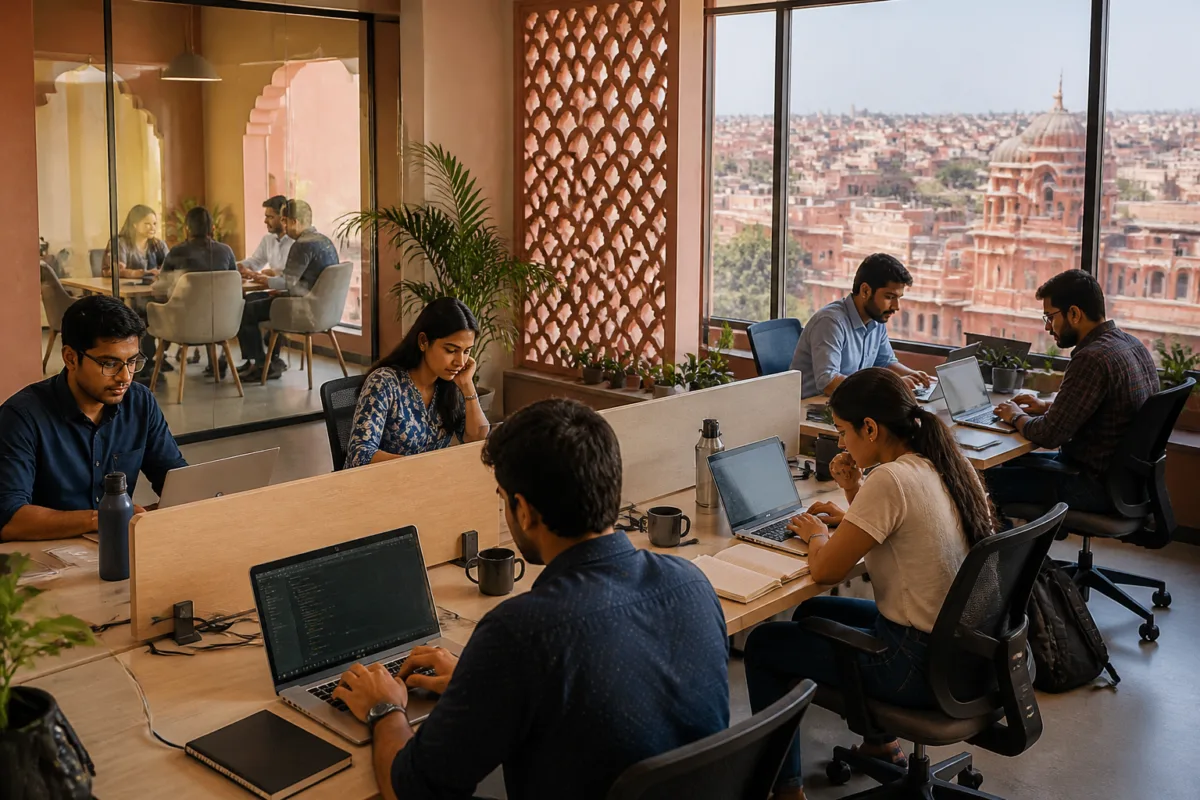
Jaipur is building a stronger startup ecosystem by combining relatively affordable office space, lower living costs and state-supported incubation, although limited access to investors and wider business networks remains a challenge, according to a report by Dainik Bhaskar.
The city’s office rents are reported at ₹50-120 per square foot per month, below those in major metropolitan markets. The cost advantage is encouraging some founders to consider Jaipur for their operations, even as Bengaluru, Delhi-NCR and Mumbai continue to offer deeper investor pools and more established startup networks.
A key piece of the city’s support infrastructure is the Bhamashah Techno Hub. The report describes it as having capacity for 700 startups and providing workspace, high-speed internet, mentorship and links to investors. These facilities position incubation space as an important part of Jaipur’s effort to attract and retain young companies.
The state’s startup policy also offers financial support to early-stage ventures. According to the report, eligible startups can receive an idea grant of up to ₹2.40 lakh. It also cites a provision of ₹60,000 for companies with women founders holding more than 50% of the ownership. The report does not provide the policy document or details of eligibility and disbursement conditions.
Lower residential costs are another factor in the city’s appeal. Citing Numbeo, an online crowdsourced database, the report says Jaipur can be up to 10.8% cheaper than Delhi. It places the average monthly rent for a one-bedroom flat at about ₹10,000. Such comparisons can support recruitment and employee retention, but the figures may vary by neighbourhood, housing quality and market conditions.
The report also cites TeamLease data to state that Jaipur has a better employee retention rate than Bengaluru and Delhi-NCR. It links this advantage to lower costs, which may allow companies to offer a more manageable standard of living to employees. No underlying retention figures or methodology are provided.
Jaipur’s next challenge is to expand beyond low operating costs and incubation capacity. The report identifies access to funding and angel investors as a major constraint and argues that startups should not depend only on local investors. It points to opportunities in agritech, artificial intelligence and creative industries, including music, dance and other arts and culture-related businesses.
The report also recommends building angel networks through larger startups, introducing upskilling courses in colleges and expanding founder meetups. These measures would connect the city’s physical startup infrastructure with talent development and investment networks.
For Jaipur, the broader urban question is whether affordable space and public support can translate into a durable innovation economy. The city has advantages in workspace and living costs, but sustained growth will depend on stronger links between incubators, educational institutions, investors and companies operating at scale.

