


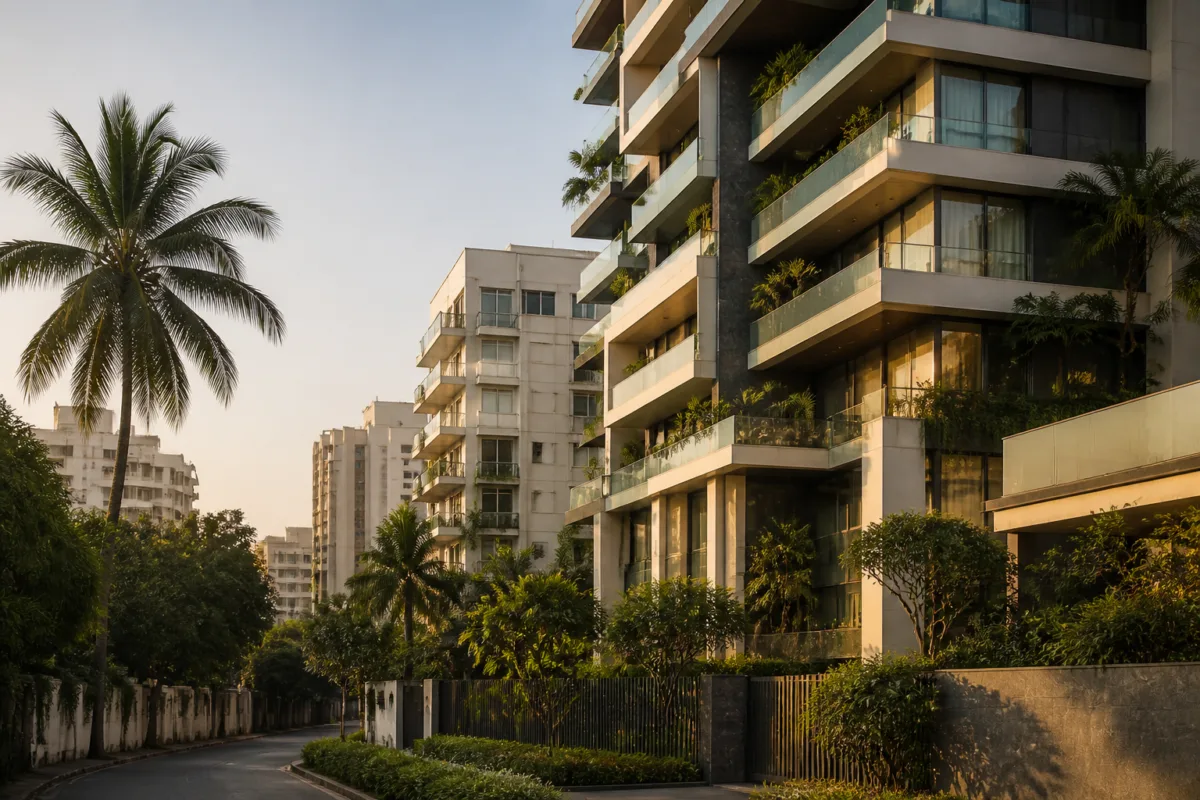
Mumbai’s luxury housing market is seeing stronger interest in larger residences, with affluent buyers placing greater emphasis on space, privacy, flexibility and the quality of everyday living, according to a report by The Realty Today.
The trend is increasing the prominence of three- and four-bedroom homes in the premium segment, although the report does not suggest that larger configurations have become the preferred choice for every buyer. Location and connectivity continue to influence purchasing decisions, particularly in established neighbourhoods where land is constrained and social infrastructure is already developed.
Data cited in the report from the Mumbai Luxury Housing Report for H1 2026, published by India Sotheby’s International Realty and CRE Matrix, shows that transactions for homes priced at ₹10 crore and above reached ₹18,512 crore during the first half of 2026 across the primary and secondary markets.
Within Mumbai’s primary luxury market, apartments measuring between 2,000 sq. ft. and 4,000 sq. ft. accounted for 58% of luxury home sales, according to the report. Homes larger than 4,000 sq. ft. represented 11% of transactions but contributed more than a quarter of the total transaction value. This indicates that larger residences, while a smaller share by volume, have a significant influence on the value of the high-end market.
A separate national indicator points in the same direction. The Realty Today cited Anarock’s H1 2026 Homebuyer Survey, which found that the preference for four-bedroom and larger homes across India increased from around 3% in H1 2024 to nearly 5% in H1 2026. The survey is not specific to Mumbai’s luxury segment, so it cannot by itself establish the scale of demand in the city. Read alongside the Mumbai transaction data, however, it provides wider context for the growing interest in larger homes.
The reported shift reflects the changing role of a luxury residence. Larger homes can allow family life, work, entertaining and personal activities to take place within the same dwelling while providing greater separation between spaces. The report also identifies natural light, ventilation, openness and privacy as increasingly important elements of perceived housing quality in a densely developed city such as Mumbai.
Developers are responding with larger-format residences in premium locations. The report cites Godrej Properties’ Godrej Skyshore in Versova, which offers three- and four-bedroom residences, as well as Godrej Bandra Bay and Visava by Viceroy, which offer four- to five-bedroom configurations. These projects illustrate the availability of larger homes in Mumbai’s premium market, although their pricing, design and buyer positioning differ.
The report also refers to DLF’s The Westpark in Andheri West. According to the company, the project’s first phase, comprising 416 residences, sold out within a week of its July 2025 launch and generated sales of more than ₹2,300 crore. DLF is preparing to launch the project’s second phase.
Aakash Ohri, managing director and chief business officer of DLF Homes, said buyers were placing greater emphasis on the size and functionality of their residences. He also linked the preference for larger homes to changing lifestyles, family structures and the importance of privacy, while noting that spacious housing has traditionally attracted interest among affluent buyers in Mumbai.
Rajat Khandelwal, group chief executive officer of Tribeca, said demand for open and well-ventilated residences reflected a wider change in how luxury is defined. He pointed to features such as three- and four-side-open layouts, private elevators, dedicated access and column-and-beam-free designs as part of this shift.
The market response creates a planning and development challenge. In established Mumbai neighbourhoods, larger homes require developers to balance unit sizes with land costs, project economics and the need to retain the advantages of a well-connected address. Larger residences may command strong value, but their viability depends on whether buyers consider the additional space worth the premium associated with location and design.
The reported trend therefore extends beyond a simple preference for more bedrooms. It suggests that, at the upper end of Mumbai’s housing market, buyers are evaluating homes through a combination of area, privacy, ventilation, flexibility and access to established urban infrastructure. The available data indicates growing relevance for larger-format residences, while leaving the scale of this shift across the broader city market unresolved.

