


A Delhi-NCR civic roundup reported on November 23 highlights changes in housing, road connectivity, public transport access, sewerage, heritage conservation and municipal services across the region. The developments involve the Delhi Development Authority (DDA), National Highways Authority of India (NHAI), Delhi Metro Rail Corporation (DMRC), Delhi Jal Board, Municipal Corporation of Delhi (MCD) and New Delhi Municipal Council (NDMC).
The DDA has opened registration and booking for 446 middle-income group flats under its Khushhaal Parivar Aawas Yojana, according to the report. The homes are spread across Loknayakpuram, Jahangirpuri and Narela, with 133 flats in Loknayakpuram, 17 in Jahangirpuri and 296 in Narela. Prospective buyers have been directed to the DDA website for details.
The housing scheme is one of the few developments in the roundup with an immediate transaction opportunity for residents. However, the report does not provide the flat prices, unit sizes, eligibility conditions or the booking deadline. Those details would need to be checked against the DDA’s official information before applicants make decisions.
Regional road connectivity is also under planning. The NHAI’s detailed project report for linking the Delhi-Katra Expressway directly with Urban Extension Road-2 (UER-2) is reportedly in its final stage. The proposed connection would use an elevated road between the Delhi-Katra Expressway near Jhajjar in Haryana and UER-2 near Sector 38 in Rohini.
The reported alignment passes through or near Nilothi village and Ladrawan in Jhajjar, followed by Punjab Khore, Jonti and Karala in Delhi. The final alignment has not yet been decided. The detailed project report is expected to be prepared by February 2027, according to the report.
If implemented as described, the link would allow vehicles travelling from the Delhi-Katra Expressway to access UER-2 more directly. The report says this could improve access towards Punjab and Katra for residents of Delhi, Ghaziabad and Noida. The extent of any travel-time or congestion benefit cannot yet be assessed because the alignment and final design remain pending.
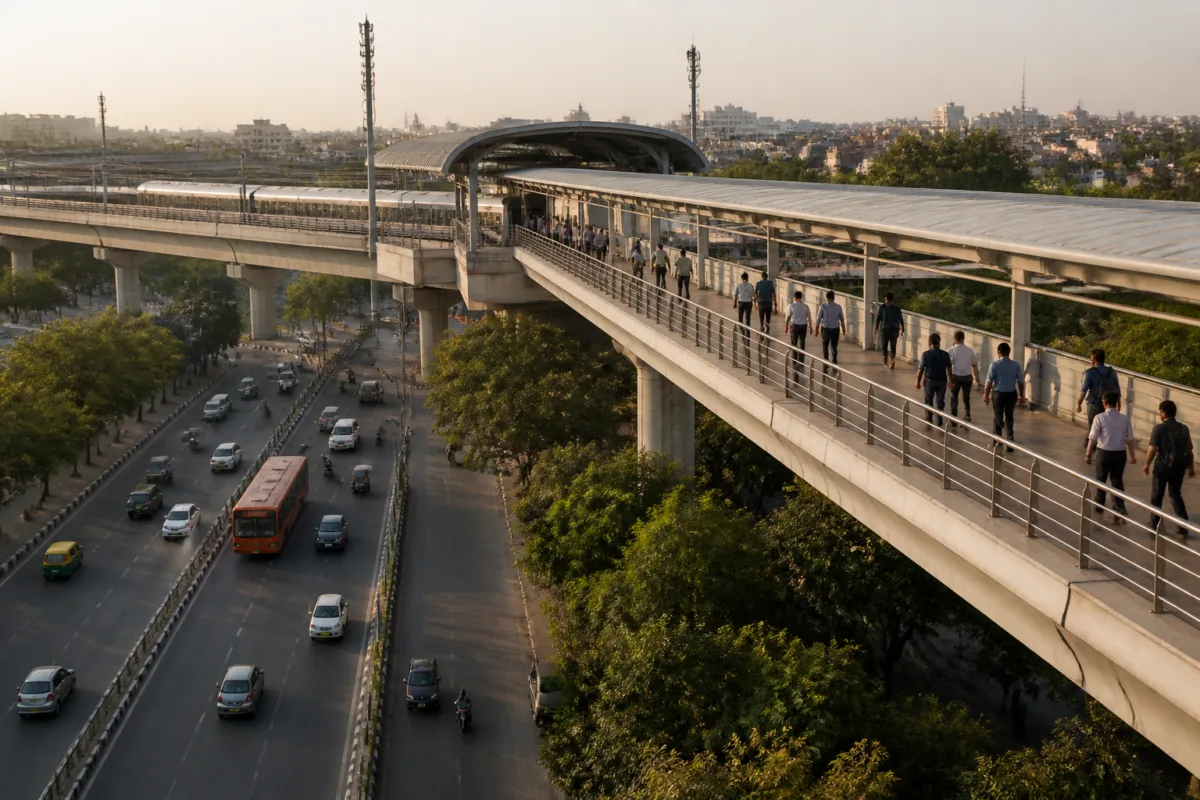
A completed access improvement has been reported at Dhaula Kuan. The DMRC has connected the Public Works Department’s foot overbridge across the highway with the concourse level of the Airport Express Line’s Dhaula Kuan station. The connection has recently been opened to passengers.
Previously, passengers approaching from the opposite side of the highway had to cross using the foot overbridge, descend its stairs, walk about 200 metres and then climb another set of stairs to reach the station concourse, according to the report. The new connection is intended to remove that additional outdoor walk and provide a more direct interchange between the foot overbridge and the station.
Sewerage infrastructure is being expanded in Khera Khurd in Narela. The Delhi Jal Board is reportedly developing a new sewer network at a cost of Rs 113 crore. The project includes sewer lines ranging from 300 mm to 630 mm in diameter, along with household connections to the network.
The stated objective is to improve the disposal of wastewater from homes. The report does not specify the project’s completion schedule, the number of properties to be connected or the present sewerage arrangements in the locality. These details will be important in assessing the project’s eventual service impact.
Municipal property-tax collection is another item in the roundup. Under the reported ‘Sunio-2 One Plus Seven’ scheme, taxpayers can pay the current financial year’s basic property tax and the basic tax for the previous seven financial years. The report says dues from before 2019-20, along with related interest and penalties, can be waived under the scheme, which is effective until December 31.
The terms described in the report make the measure relevant both to households seeking to regularise outstanding dues and to municipal revenue administration. Taxpayers should confirm the applicable conditions and payment process with the concerned civic authority before relying on the reported waiver.
In Old Delhi, the MCD’s standing committee has reportedly approved a proposal to transform Shri Narayan Haveli near Lahori Gate into a cultural centre and museum. The civic body is expected to sign a memorandum of understanding with the Indira Gandhi National Centre for the Arts for the development, operation and maintenance of the property.
According to the report, the haveli was built in 1929 and was restored in 2004. It had also been used as the Walled City Museum. The proposed reuse places the property within the wider challenge of conserving Shahjahanabad’s historic buildings while keeping them accessible for public and cultural use. The report does not provide a project cost, execution schedule or details of the proposed museum’s programming.
The NDMC has separately announced plans to attach QR codes to trees planted under its ‘Ek Ped Maa Ke Naam’ campaign. The codes are expected to provide information on a tree’s species, planting date and the name of the person who planted it. The campaign is being conducted in different parts of New Delhi every Sunday, and the reported announcement was made during its 50th Sunday event in B.K. Dutt Colony.
The QR-code initiative could create a basic public record for newly planted trees, but the report does not explain how the information will be updated, who will maintain the database or whether residents will be able to report damaged or missing trees. Those operational details will determine whether the system functions as more than an identification label.
The roundup also reports special trains from Delhi-area stations to meet short-term passenger demand. A train between Shakurbasti and Godda is scheduled to operate through November 25 in one direction and November 26 in the return direction. Another special service is scheduled between Delhi and Gorakhpur on November 24 and 25, with the reported timings covering overnight journeys. Passengers should verify the latest schedules with Indian Railways before travelling.
Taken together, the reported measures show activity across different layers of Delhi-NCR’s urban system: housing supply, metropolitan access, regional highways, wastewater networks, property-tax administration, heritage reuse and civic asset tracking. Their public value will depend on delivery beyond announcements—particularly the final road alignment, sewer connections, housing terms, heritage project schedule and maintenance arrangements for the tree database.

