


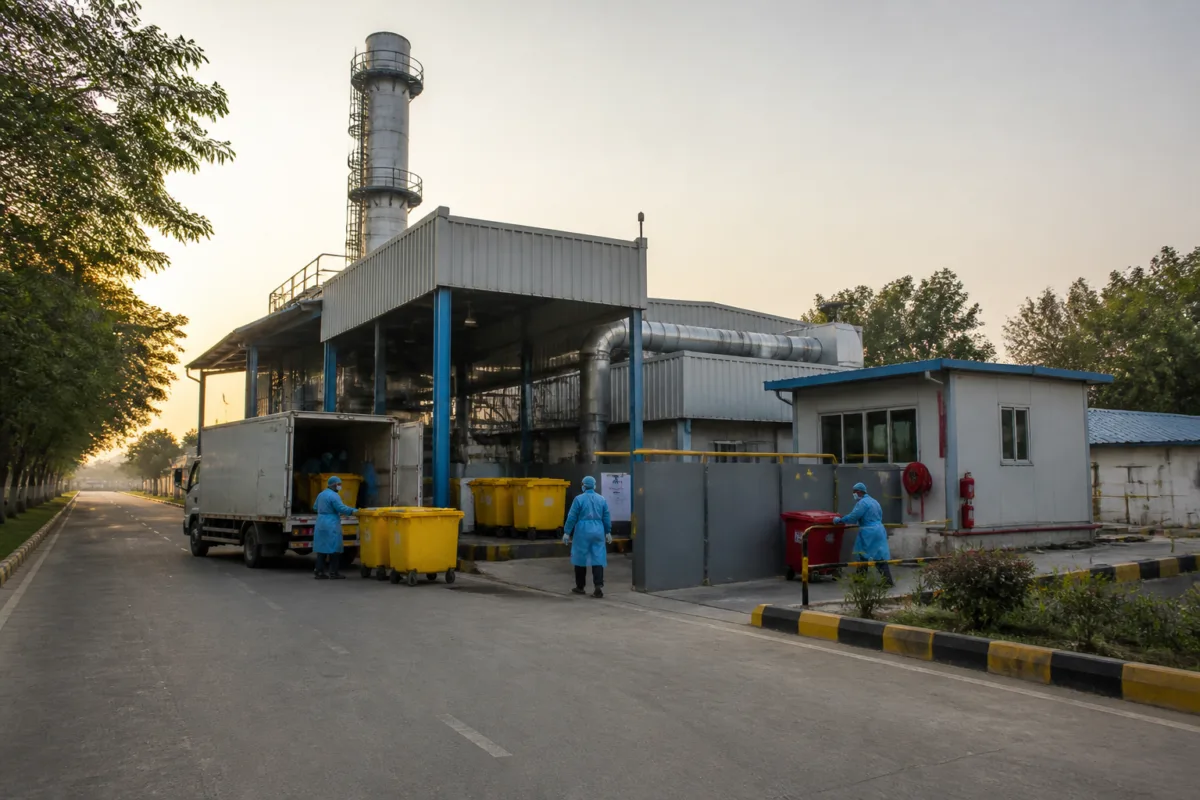
Delhi’s biomedical-waste treatment system is facing a compliance and capacity challenge after inspections found environmental-rule violations at both of the city’s common biomedical-waste treatment plants, according to a report filed by the Delhi Pollution Control Committee (DPCC) before the National Green Tribunal (NGT).
The findings relate to inspections conducted on 25 March at the facilities on GT Karnal Road and in Nilothi. The DPCC subsequently issued show-cause notices and imposed environmental compensation on both operators on 10 April. A follow-up inspection on 27 July found that one plant had corrected the deficiencies, while the other continued to have significant problems.
The GT Karnal Road facility, operated by Biotic Waste Solution, handles waste from about 4,500 healthcare facilities and has a stated capacity of 34 tonnes a day. The DPCC said the operator had addressed all 11 deficiencies identified during the initial inspection.
The Nilothi facility, operated by SMS Waste Grace, is described in the report as Delhi’s largest biomedical-waste treatment plant. It serves 6,391 healthcare units across seven revenue districts and has a capacity of 28.8 tonnes a day. Three of the 12 deficiencies identified earlier remained unresolved during the follow-up inspection, the DPCC told the tribunal.
The inspection team reported dense black smoke from the plant’s chimney, leakage in the mist eliminator and gas-cooling system, and mixed waste bags in the unloading area. It also found that treated water from the effluent treatment plant outlet appeared grey rather than transparent and that the inlet flow meter was missing.
Following the inspection, the DPCC issued another show-cause notice to SMS Waste Grace on 14 September, proposing closure action. In its response, the company said the black smoke was part of the normal waste-removal process and attributed the mixing of waste to incorrect segregation by hospitals. The operator also claimed that its emissions were within prescribed standards.
The DPCC’s report further recorded alerts relating to temperature and carbon dioxide on the online emission-monitoring systems of both plants. The committee issued directions to address the issue on 19 October. The available report does not state the final outcome of the proposed closure proceedings against the Nilothi operator.
The compliance concerns are unfolding alongside an expansion plan for Delhi’s biomedical-waste infrastructure. On 7 October, the DPCC issued a tender for two new common biomedical-waste treatment plants intended to meet projected requirements up to 2031. One proposed facility would serve eastern, north-eastern, old and central Delhi, while the other would cover western, south-western and outer-northern Delhi.
The proposed plants are also intended to reduce the load on the Nilothi facility, which has been operating on an extended lease since April 2020. This makes the issue more than a question of individual plant compliance: Delhi’s treatment network must maintain environmental safeguards while continuing to process waste generated by thousands of healthcare units.
The inspection findings also underline the importance of segregation at healthcare facilities, monitoring systems and reliable treatment-plant equipment. The operator’s response places responsibility for mixed waste on hospitals, while the DPCC’s observations identify conditions within the plant, including equipment leaks, missing measurement infrastructure and smoke emissions. The available report does not resolve how responsibility will be apportioned or whether the stated corrective measures have been completed.
For Delhi, the immediate administrative tasks are enforcement of the pending notice, verification of corrective action and development of additional treatment capacity without weakening environmental controls. The DPCC’s proposed two-plant procurement addresses future capacity, but the inspection record indicates that existing facilities remain central to the city’s waste-management system until those projects are commissioned.

