


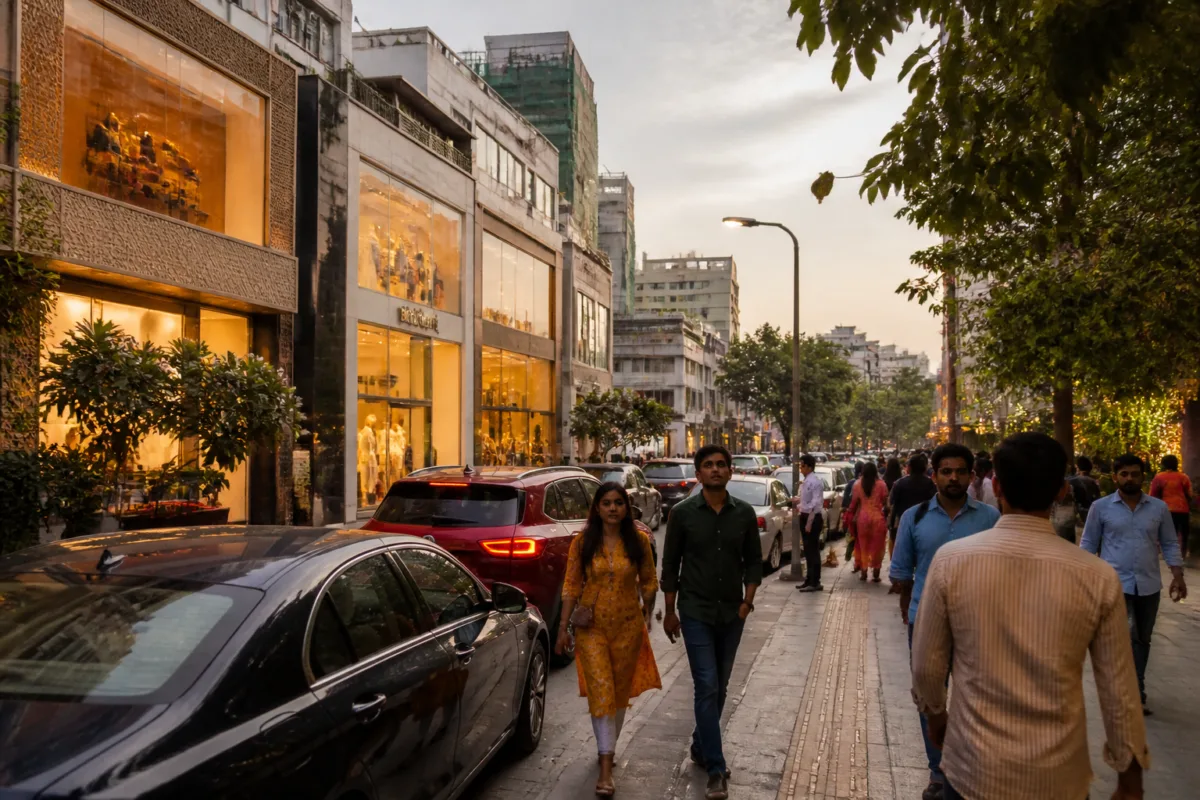
Hyderabad’s shopping streets are gaining visibility in regional retail rankings, but the more important story lies beneath the list: the city’s premium consumption is spreading across distinct neighbourhood markets rather than concentrating in a single dominant high street. Cushman & Wakefield’s Main Streets Across the World 2026 report places Jubilee Hills, Banjara Hills and Himayatnagar among Asia-Pacific’s leading retail locations, giving Hyderabad three entries in a ranking that measures prime retail rents.
Jubilee Hills is the new entrant, ranking 51st in the Asia-Pacific list with prime retail rents of Rs 250 per square foot per month. Banjara Hills and Himayatnagar share the 52nd position, with rents of Rs 230 and Rs 225 per square foot per month, respectively. The figures do not make Hyderabad the most expensive retail market in India, but they show that several of its neighbourhoods have developed sufficient commercial value to be tracked alongside established high streets across the region.
That distinction matters because a city’s retail hierarchy is also a record of how its urban economy is organised. Retail rankings capture the price that businesses are willing to pay for well-located frontage, visibility and access to customers. They do not measure the entire property market, nor do they establish that every shop in a neighbourhood commands the quoted rent. Instead, they identify the premium segment of the market: the most sought-after retail space in locations where brand presence, customer footfall and neighbourhood reputation reinforce one another.
The latest ranking suggests that Hyderabad’s high-street economy is becoming more geographically diverse. In the previous edition cited in the report, Banjara Hills and Himayatnagar were included, while Jubilee Hills was not. Jubilee Hills’ entry therefore represents an expansion of the city’s recognised premium retail geography rather than a simple reshuffling of names.
The three locations also illustrate that “high street” is not a single urban format. Banjara Hills is associated with upscale shopping along roads such as Road No. 1, Road No. 2 and Road No. 12. Its retail mix includes designer boutiques, premium fashion labels, jewellery showrooms, restaurants and cafes. These uses give the neighbourhood a lifestyle-oriented character in which shopping is combined with dining and leisure.
Jubilee Hills, particularly around Road No. 36 and Road No. 45, has developed a related but distinct profile. The area includes designer studios, fashion boutiques, beauty and wellness outlets, home décor stores, cafes and restaurants. Its appearance in the latest list indicates that the neighbourhood’s premium retail identity has become sufficiently visible to be reflected in a regional comparison.
Himayatnagar represents a different form of commercial strength. Its high street includes clothing and jewellery stores, footwear outlets, bookstores, electronics shops and eateries. The area serves customers across a wider range of budgets and retains a busy, mixed retail character. Its inclusion alongside Banjara Hills and Jubilee Hills shows that high-value retail streets need not all follow the same luxury-led model. Some derive their importance from brand exclusivity, while others depend on variety, familiarity and sustained everyday demand.
This is one of the most useful readings of the Hyderabad entries. The ranking does not describe three identical shopping districts. It identifies three commercially important streets with different customer bases and retail identities. Their common feature is the ability to attract businesses willing to pay a premium for a visible urban location.
The numbers also place Hyderabad within India’s wider retail geography. Delhi’s Khan Market remains the country’s most expensive high street in the ranking, with prime retail rent of Rs 1,875 per square foot per month. It ranks 24th globally and 25th in the Asia-Pacific list, and the report cited by Siasat says its rent increased 14 per cent year on year. Mumbai’s Linking Road ranks 33rd in the Asia-Pacific list at Rs 1,175 per square foot per month.
The gap between these figures and Hyderabad’s quoted rents is substantial. Khan Market’s reported prime rent is 7.5 times Jubilee Hills’ figure, while Linking Road’s is 4.7 times higher. That comparison places Hyderabad in an emerging premium tier rather than at the top of India’s high-street market. Its importance is therefore not that it has overtaken Delhi or Mumbai, but that multiple Hyderabad neighbourhoods have achieved regional visibility at the same time.
The comparison also cautions against treating rent rankings as a straightforward league table of cities. Retail rents reflect local purchasing power, customer volumes, competing destinations, street configuration, available frontage and the type of brands seeking space. A lower rent can coexist with a strong retail ecosystem if the market offers a broader customer base or more varied uses. Conversely, a high rent can reflect scarcity and prestige without representing the overall performance of a city’s retail sector.
For Hyderabad, the spread across three neighbourhoods points to a polycentric consumption pattern. The supplied report does not provide citywide retail data or explain the precise causes behind the rent changes. It does, however, show that premium shopping is not limited to one location. Banjara Hills and Jubilee Hills provide a western Hyderabad cluster associated with luxury and lifestyle retail, while Himayatnagar represents a busy central high street with a broader mix of goods and services.
That pattern has implications for how the city’s commercial districts function. When retail activity is concentrated in several established neighbourhoods, consumers and businesses do not depend on one central shopping destination. Different streets can serve different markets, from premium fashion and jewellery to everyday family shopping, electronics and food. This diversity can make the urban retail system more resilient, although the available source does not provide evidence to measure resilience or compare vacancy levels among the three areas.
It also raises questions about the relationship between retail rents and the public realm. The value of a high street is not created only inside shops. It depends on how easily customers can reach the area, how long they can remain there, how streets accommodate pedestrians and vehicles, and whether surrounding uses support activity throughout the day. The Cushman & Wakefield ranking measures prime retail rents, but the supplied material does not include data on footfall, parking, public transport, road capacity or pedestrian infrastructure. Those factors remain important but cannot be quantified from the report available here.
The institutional dimension is equally significant. High-street rents are shaped by private leasing decisions, but the conditions that make a street commercially attractive are also connected to urban administration. Land-use permissions, building regulation, road management, parking arrangements, public-space maintenance and traffic operations influence the experience of a retail district. The ranking itself does not assign responsibility for these factors or assess the performance of Hyderabad’s civic institutions. It simply provides a market signal that certain streets are attracting premium commercial demand.
That signal should therefore be read carefully. A rise in recognised retail value can benefit property owners and strengthen neighbourhood identities, but it can also change the composition of local commerce. Higher rents may favour larger brands or businesses with stronger balance sheets, while smaller retailers may face greater pressure if leases are renewed at higher rates. The supplied report does not establish that displacement is occurring in Jubilee Hills, Banjara Hills or Himayatnagar, so that possibility should not be presented as an observed outcome. It is, however, a structural question that accompanies any increase in prime commercial rents.
The same caution applies to the relationship between retail rankings and broader urban prosperity. Hyderabad’s inclusion in the list signals visibility in the Asia-Pacific retail market, but it does not by itself prove that all residents are benefiting from the city’s premium consumption economy. A high-end shopping street can coexist with a much wider city in which commercial conditions vary sharply by neighbourhood. The three locations represent important parts of Hyderabad’s retail system, not the whole of it.
The strongest evidence in the report is therefore geographic and comparative. Jubilee Hills has entered the ranking; Banjara Hills and Himayatnagar remain included; and their quoted prime rents range from Rs 225 to Rs 250 per square foot per month. At the national level, Delhi’s Khan Market and Mumbai’s Linking Road command much higher reported rents. Hyderabad is visible in the regional hierarchy, but it remains below India’s most expensive retail destinations.
The larger urban question is how Hyderabad will manage the transition from recognised premium neighbourhoods to a more mature, multi-centre retail system. The ranking confirms that the city has several commercially differentiated high streets. It does not yet establish how rents, access, public infrastructure, tenant mix and customer demand are changing together. Future editions of the ranking, along with local data on vacancies, footfall and street conditions, will be needed to show whether Hyderabad’s growing retail prominence reflects a broad-based urban shift or a rise in value limited to selected prime stretches.

