


Questions over Pune Police’s decision to fly two theft accused from Kolkata to Pune have moved beyond the cost of two air tickets. The episode has exposed a wider administrative test: when an investigation crosses state borders, how clearly are urgency, court deadlines, transport choices and public expenditure documented?
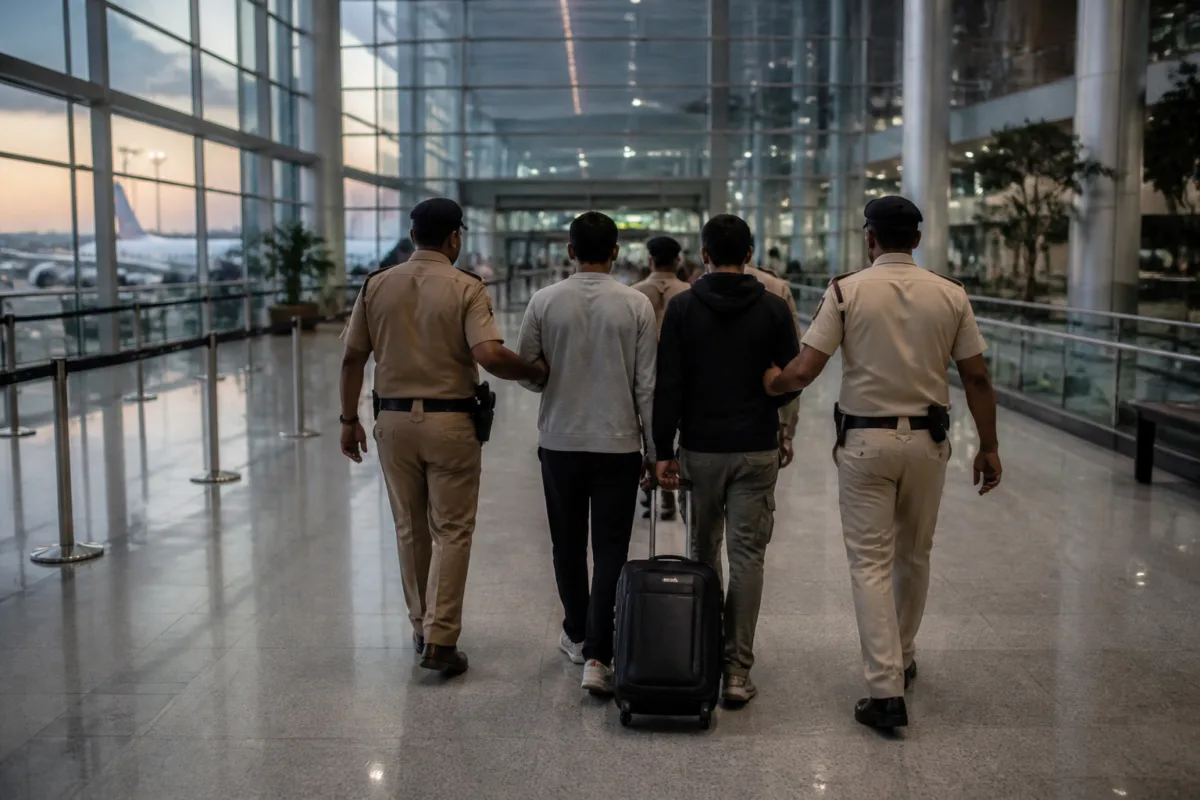
A Faraskhana police team comprising an assistant police inspector and three personnel brought the accused to Pune by air on November 4. The usual mode for long-distance escorts is train, according to the report. The police team has said it missed its booked train and chose air travel because little time remained to produce the accused before court. That explanation, however, has not yet been independently verified in the supplied material.
The department is seeking paperwork to establish the circumstances, according to a senior police official who spoke to Pune Times Mirror on condition of anonymity. The unresolved questions include whether train tickets were actually booked, how much time remained under the transit warrant, whether senior officers were consulted before the flight was booked, and how the expense was recorded.
The underlying investigation involves two separate cases. Lalan Mandal, an artisan at a jewellery shop in Ganesh Peth, was accused of stealing about 17 kilograms of silver ornaments and bars valued at around Rs 40.80 lakh. The shop owner allegedly examined CCTV footage and found Mandal leaving the premises with a large bag in the early hours. A case was registered at Faraskhana police station.
The second accused, Prabanjan Shanti Dolai, was traced in a case involving 1,850 grams of pure gold valued at approximately Rs 2.59 crore. A jewellery businessman from Raviwar Peth had allegedly entrusted the gold to Dolai for making ornaments. Dolai allegedly neither returned the gold nor delivered the finished jewellery, leading to a suspected misappropriation case against him and his manager.
During the investigation, police learnt that both accused had fled to Kolkata. A team was sent outside Maharashtra to trace them. That interstate pursuit is an important part of the administrative context. Bringing an accused back after an arrest is not simply a matter of selecting the fastest available transport. It involves court permissions, a transit warrant and a deadline for production before the appropriate court in the home state, the official said.
A transit warrant gives police a specified period within which an accused arrested in another state must be produced before the court in the home state. The official’s account indicates that the team believed the remaining period was short. If that account is established by the warrant, court records and travel documents, the decision to use air travel could be assessed as an emergency operational measure rather than a routine preference.
But the existence of a time constraint would not, by itself, answer the financial-accountability question. The report does not establish the total fare paid for the Kolkata-Pune journey, whether government funds were used, whether approval was obtained before booking, or which budget head carried the expense. These details matter because emergency powers still require a record of the emergency, the decision-maker and the public money spent.
The senior official said emergency expenditure during an investigation can be met through the investigation fund. The same official also said that if the expenditure is later found to be unjustified, or if the reasons provided are not established, the concerned officers may have to bear the cost from their salaries. This suggests that the system recognises a distinction between expenditure that is urgent and defensible and expenditure that is merely convenient.
That distinction depends on documentation. A train booking, the time at which the team missed the train, the remaining validity of the transit warrant, the availability of flights and the approval trail could collectively show whether air travel was necessary. Without those records, the public is left with two competing accounts: the team’s explanation of limited time and the absence, so far, of disclosed evidence showing how the decision was authorised.
The case therefore illustrates how a seemingly small operational decision can become a governance issue. Police investigations require mobility, coordination and spending, particularly when accused persons move across state borders. Yet the use of public funds cannot be judged only by whether a team ultimately brought accused persons back. It must also be judged by whether the decision followed procedure and whether the expenditure can be audited afterwards.
The institutional chain is especially important here. The investigation team appears to have made the transport choice, while questions remain about whether senior officers were informed. The department is now seeking relevant paperwork. That places the focus on internal review rather than on the arrest effort itself. The police team’s work in tracing the accused outside Maharashtra has been acknowledged, but operational success does not remove the need to explain how the return journey was selected and paid for.
There is also a court-process dimension. The official’s explanation links the flight decision to the time available for producing the accused before the appropriate court. That means the verification cannot be limited to police accounts or ticket records. The transit warrant and related court permissions would establish the formal deadline, while travel bookings and internal communications could show whether the deadline was genuinely at risk.
The available report does not say whether the department has completed its review or whether any officer has been asked to reimburse the cost. It also does not disclose the air fare, the date and time of the missed train, the flight details or the names of officers who approved the expenditure. Those are not minor omissions: they are the facts needed to distinguish an unavoidable expense from an avoidable one.
The broader lesson is not that police teams should never use air travel. A faster mode may be justified when a court deadline leaves no practical alternative. The administrative requirement is that the reason must be recorded contemporaneously, supported by documents and linked to the legal deadline. If the expenditure is charged to an investigation fund, the accounting entry should make the purpose and authorisation clear.
For citizens, the issue is ultimately about confidence in the routine use of public money. The sums involved in the alleged theft cases are substantial, but the value of the air tickets is not disclosed. Accountability applies regardless of whether the expense is large or small because repeated discretionary decisions across investigations can create an opaque spending culture if they are not documented and reviewed.
The Pune episode remains unresolved on the evidence supplied. The police have offered an explanation based on a missed train and limited time under the transit warrant, while the department is checking the paperwork. The decisive next steps are verification of the travel claim, confirmation of the court deadline, disclosure of the expenditure and determination of whether the required approval and accounting procedures were followed.

