


India’s rice surplus has become large enough to expose a contradiction at the centre of the country’s food system: policies created to prevent hunger are now supporting production far beyond domestic demand, while the costs of procurement, storage and subsidies continue to rise. A Reuters review of government communications and interviews with officials and scientists shows how a successful production strategy is creating new fiscal, agricultural and federal tensions.
The scale of the change is striking. India’s rice output is forecast to reach a record 154 million tons in 2025/26, up 50% in a decade, while domestic consumption is estimated at 107 million tons. Exports have doubled over the same period to 22.3 million tons in 2025, giving India about 40% of global rice trade. The country’s success as a rice exporter, however, has not removed the financial burden on the state. Rice subsidies account for more than two-thirds of the federal food subsidy bill, which has more than doubled in a decade to 2.28 trillion rupees in 2025/26.
That outcome is rooted in the history of India’s food security system. In the 1960s, the country struggled to produce enough grain and even encouraged citizens to skip dinner one day a week because harvests were inadequate. The government subsequently developed a procurement and support-price structure designed to assure farmers of a market and maintain stocks for public distribution. The system helped India move away from dependence on uncertain supplies and became a central part of the country’s agricultural economy.
The same architecture now operates in a very different production environment. Crop science has improved yields and allowed rice cultivation to expand into areas that were previously considered too vulnerable to floods. The Swarna-SUB1 variety, released commercially in 2009, combined the flood tolerance of the FR13A variety with the high-yield characteristics of Swarna. Its spread has helped transform eastern states that once faced repeated harvest losses.
In Bihar, rice production rose 182% over 15 years to 8.75 million tons in 2025/26. In neighbouring Odisha, output increased 50% to 10.2 million tons. Chandramohan Yadav, a farmer in Bihar’s flood-prone Kosi region, told Reuters that his village once struggled to produce enough rice for household consumption. It now produces more rice than residents can eat. This is a genuine agricultural gain for farmers exposed to unpredictable flooding, but it also demonstrates how a technological breakthrough can intensify pressure on a procurement system designed for a different era.
Researchers are continuing to develop varieties that combine flood and drought tolerance. Estimates cited by Reuters from scientists and government officials suggest that new varieties could add at least 10 million tons to output over the next five years. A NITI Aayog report seen by Reuters projected total production of 171 million tons by 2036, while domestic demand would rise only to 110 million tons. The gap between those figures is the central policy problem: the production system is becoming more capable, but the domestic market is not expected to expand at the same pace.
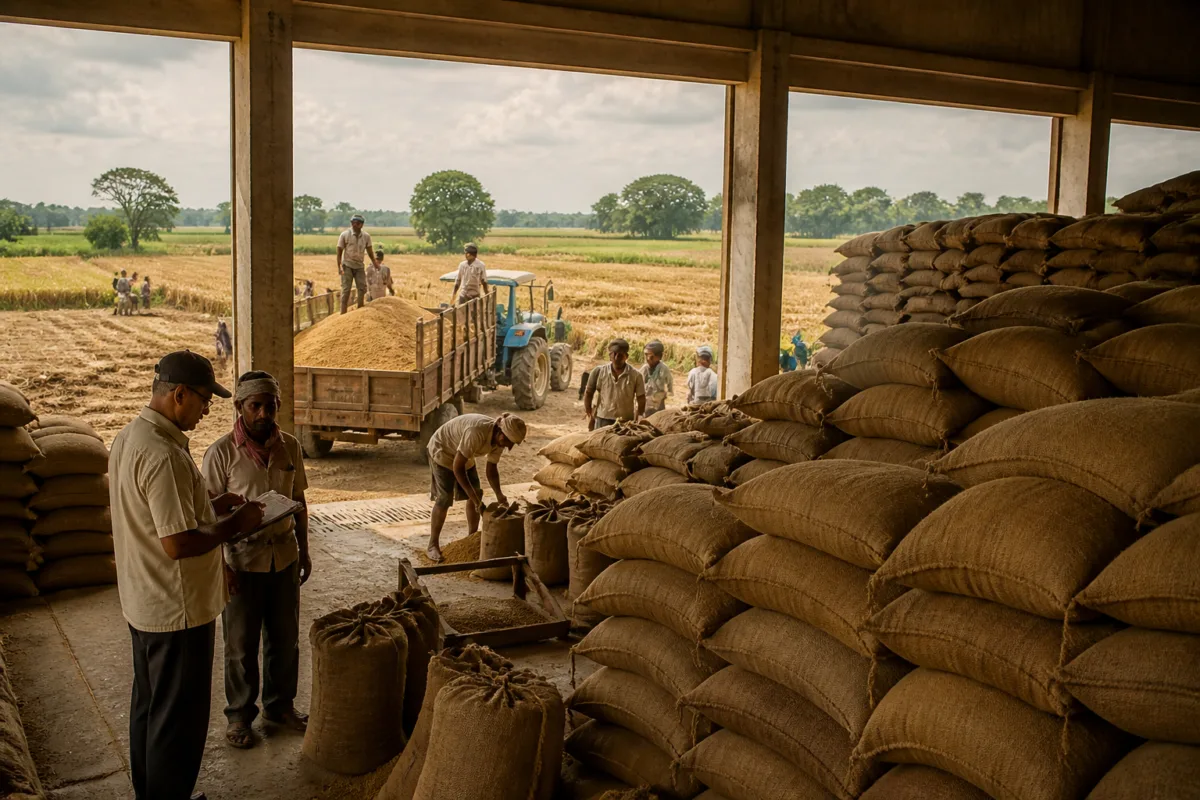
The surplus is already visible in government warehouses. Public rice stocks reached a record 55.47 million tons on October 1, more than four times the stated target. Private storage is also under pressure. Navin Aggarwal, a private miller in Odisha, told Reuters that his facilities had run out of space while government agencies had not lifted rice already purchased from his mill. Punjab Chief Minister Bhagwant Mann wrote to the federal government on September 29 asking it to move 600,000 tons of government-purchased rice from local storage to other warehouses, warning that delays could affect procurement of the new harvest.
The storage problem is not simply a question of building more warehouses. It reflects a mismatch between procurement and offtake, as well as regional imbalances in where rice is produced, purchased and stored. The federal food ministry said in September that it planned to add 13.1 million tons of storage capacity. That expansion may reduce immediate congestion, but it does not by itself resolve the question of how much rice the state should continue buying, at what price, and for which use.
The fiscal pressure extends beyond food subsidies. Rice-producing states often offer bonuses on top of the federal Minimum Support Price, making the crop more attractive to farmers. These payments reinforce production even when national stocks are already high. The federal food ministry has approached the finance ministry three times in two years seeking action against state bonuses, according to government sources cited by Reuters. A January 9 letter from the finance ministry’s Department of Expenditure urged states to align incentives with national priorities and warned that water-intensive rice was straining groundwater resources.
The dispute illustrates the administrative difficulty of changing agricultural incentives in India. The federal government controls key elements of procurement, food distribution and national subsidy policy, while state governments influence farm economics through bonuses and local procurement decisions. States also face direct political pressure from farmers. The 2020-21 farm protests, driven partly by fears that agricultural reforms would weaken the Minimum Support Price system, ended with the repeal of the farm laws in November 2021. Any attempt to reduce rice support therefore involves not only budget management but also the political economy of rural livelihoods.
The opportunity cost is becoming clearer in trade data. India imported oilseeds and pulses worth $22.7 billion in 2025, a 120% increase over the past decade, while rice exports generated $12 billion, according to trade ministry data cited by Reuters. Experts also say rice requires more fertiliser than oilseeds and pulses. The fertiliser subsidy bill is expected to exceed 3 trillion rupees in 2026/27, four times its level a decade ago, according to an estimate from the fertiliser ministry.
These figures do not establish that rice production alone caused the entire increase in fertiliser expenditure or imports. They do show, however, why officials are questioning whether current incentives are aligned with national needs. A crop that receives strong price support, state bonuses, procurement guarantees and subsidised inputs can remain attractive to farmers even when the country needs more production of other crops. Redirecting land towards pulses or oilseeds would involve its own risks, including farmer income uncertainty and the need for reliable markets, but the existing rice system is making that shift harder.
India’s export position adds another layer of complexity. The country’s rice is sold at a discount of about $110 a ton to benchmark Thai rice, which traded at around $497 per ton in mid-November. Rival exporters including Thailand, Vietnam and the United States have complained that Indian subsidies place pressure on international prices. The United States has raised concerns about India’s rice subsidy, while India has rejected accusations of dumping and said its US exports consist of higher-priced premium basmati rice. Thailand appealed for cooperation with India and Vietnam in 2025 as prices weakened.
Exports provide an outlet for excess production, but they also expose the domestic subsidy system to international scrutiny. Ashok Gulati, an agricultural economist and former government adviser on crop prices, told Reuters that taxpayers were effectively subsidising foreign consumers when surplus rice was sold abroad. That criticism focuses on the difference between the original purpose of food subsidies and their current consequences: the system was built to secure food for Indians, but part of the production it supports is now moving into global markets.
The government has attempted to find additional uses for surplus rice, including directing some stocks towards ethanol production. Yet rising stock levels indicate that these outlets have not eliminated the procurement imbalance. The problem is therefore institutional as much as agricultural. India has developed strong capacity to produce rice, but the agencies responsible for pricing, procurement, storage, distribution, trade and crop diversification are not operating towards a single clearly aligned production strategy.
The evidence supplied in the Reuters investigation confirms the scale of the surplus, the growth of eastern rice production, the rising cost of subsidies, the pressure on storage and the conflict between central and state incentives. It does not establish how quickly the government will change procurement rules, whether state bonuses will be reduced, or how farmers would be compensated for moving into other crops. Those issues remain unresolved.
India’s rice story is therefore no longer only one of agricultural success. It is a test of whether a food-security system created during scarcity can be recalibrated without undermining farmer incomes, public distribution or rural political stability. The developments that deserve close monitoring are the proposed storage expansion, the future of state-level bonuses, the pace of stock liquidation, the use of rice for ethanol and any policy shift towards pulses and oilseeds. The central question is how India can preserve the gains of its rice revolution without allowing the machinery that created abundance to become a permanent fiscal and environmental burden.

