


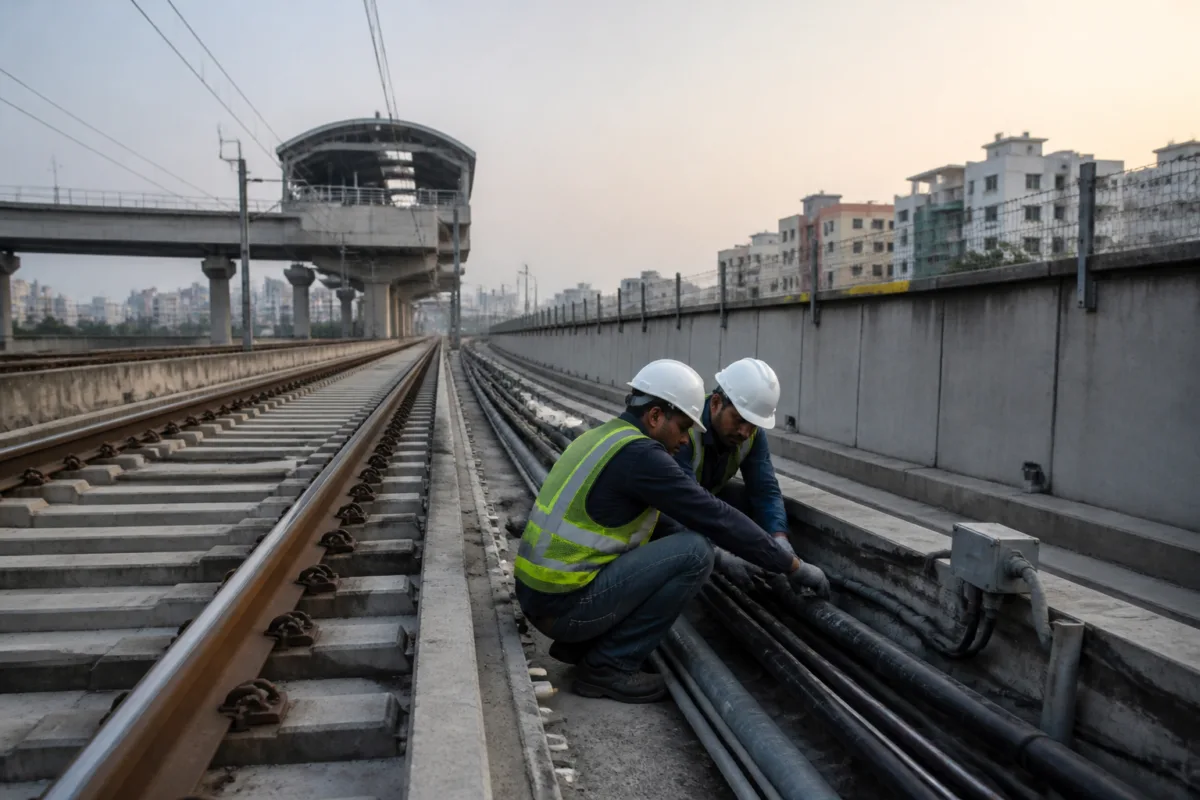
The cutting of three signalling quad cables on the Delhi Metro’s down line between Shaheed Sthal and Welcome stations in Ghaziabad did not result in a prolonged service breakdown, but it exposed how a targeted intrusion into a restricted rail corridor can threaten the safety architecture behind one of Delhi-NCR’s most important public services. According to a complaint filed by a Delhi Metro Rail Corporation employee, the damage caused 15 track circuits to drop before an emergency arrangement restored their operation.
The incident took place at about 3:56 am on November 8, when a signalling controller informed the control room that 15 track circuits had suddenly and permanently dropped, according to the report carried by Live Hindustan. DMRC staff reached the site after the technical alert and inspected the affected stretch. The inspection found that unidentified persons had entered the metro track area without authorisation and cut three quad cables at three separate points on the down line.
The police case was registered at Nandgram police station on November 16 on the basis of the complaint by Ompal, a DMRC junior engineer in the signalling and telecommunications department. The complaint identifies the Delhi Metro as a major public transport system for Delhi-NCR, carrying approximately 7 million to 8 million passengers a day. The scale of that daily dependence is central to understanding why damage to a signalling installation is not simply a matter of property loss or a routine maintenance failure.
A metro railway depends on signalling to maintain separation between trains and to communicate whether sections of track are occupied. The complaint says track circuits provide information about the presence and position of trains on the track. When the circuits drop, the operating system receives an indication that normal detection has been disrupted. In this case, 15 circuits were affected at the same time after the cables were cut.
The available report does not establish that a train entered an unsafe section or that an accident occurred. It does, however, record the DMRC employee’s warning that damage to the signalling cables could affect the safety arrangements for train operations. The significance of the event therefore lies in the vulnerability it revealed: a small number of physical cuts at separate locations were sufficient to disrupt a large number of track circuits.
The response also shows the difference between technical recovery and permanent restoration. After the damage was detected, the DMRC signalling team reached the location and created an emergency temporary arrangement from the outdoor side of the system. The affected track circuits were then normalised, allowing metro movement to continue without the disruption that passengers might otherwise have faced. The complaint states that a detailed inspection and permanent repair of the cables were to be carried out later.
That sequence places the incident within a wider infrastructure question. Urban rail systems are often experienced by passengers as trains, platforms and stations, but their safety depends on less visible assets located along the corridor. Cables, track circuits, control equipment and communications links form an interconnected operational layer. A failure in that layer may not be visible to passengers until it affects service frequency, train movement or safety procedures.
The Ghaziabad case is particularly relevant because the alleged intrusion occurred between stations rather than inside a passenger facility. Stations generally provide a visible point of access, while open or less visible stretches of elevated, at-grade or corridor infrastructure must be protected through a combination of physical barriers, surveillance, patrols, maintenance inspections and operational alerts. The supplied report does not provide details of the security arrangements at the affected section, whether cameras recorded the entry, or whether the cables were protected by additional physical measures. Those gaps remain part of the investigation rather than established facts.
The police investigation is examining how unidentified people entered the restricted track area and why the cables were cut. The report says authorities are considering whether the act was carried out by miscreants or whether there was a planned motive. That distinction has not been resolved. At this stage, the confirmed institutional response is the registration of a case against unknown persons and the continuation of the investigation under the Nandgram police.
The complaint’s description of the cable damage also matters for the question of resilience. The three cables were cut at three different locations, and the resulting failure affected 15 track circuits. The report does not state whether the circuit arrangement had a single point of failure, whether backup signalling routes were available, or how long the emergency configuration remained in place. It does show that the operating system detected the abnormality and that DMRC staff were able to restore normal functioning through a temporary arrangement.
For passengers, the immediate impact appears to have been contained. The report says the emergency arrangement prevented disruption to metro movement and inconvenience to travellers. That outcome should not obscure the operational chain that made recovery possible: detection by the control room, deployment of technical staff, physical inspection, identification of cable damage, temporary restoration and subsequent police action. Each step involved a different institutional responsibility, linking the metro operator’s engineering systems with law enforcement and corridor security.
The incident also illustrates why infrastructure protection cannot be assessed only through visible service interruptions. A metro line may continue running while a hidden vulnerability is being repaired. In this case, service was normalised after the track circuits were restored, but the report indicates that a detailed inspection and permanent cable repair were still pending. The difference between restoring an operational indication and completing permanent physical repairs is therefore important, even though the supplied material does not provide a final status for that work.
Delhi Metro’s daily ridership, cited in the complaint as roughly 7 million to 8 million passengers, means that the consequences of failures can extend beyond the immediate site. A technical incident on one corridor can affect passenger movement, staff deployment and network operations. The Ghaziabad episode did not become a reported mass disruption, but it demonstrates how the reliability of a large urban transport network depends on assets that most users never see and on response procedures that must work under pressure.
The evidence currently confirms four points: three quad signalling cables were cut at separate locations on a restricted down-line section; 15 track circuits dropped; DMRC staff established an emergency arrangement and restored normal operation; and a police case was registered against unidentified persons. It does not yet confirm the identity, motive or security method of the people involved, nor does it establish whether the incident was an isolated act or part of a wider pattern.
Those unanswered questions will determine the next stage of the story. The Nandgram police must establish how access to the track area was obtained and who caused the damage, while the DMRC’s technical assessment must clarify the condition of the cables and the completion of permanent repairs. Until those steps are documented, the Ghaziabad incident is best understood as a serious signalling infrastructure breach that was contained operationally but remains unresolved as a security investigation.

