


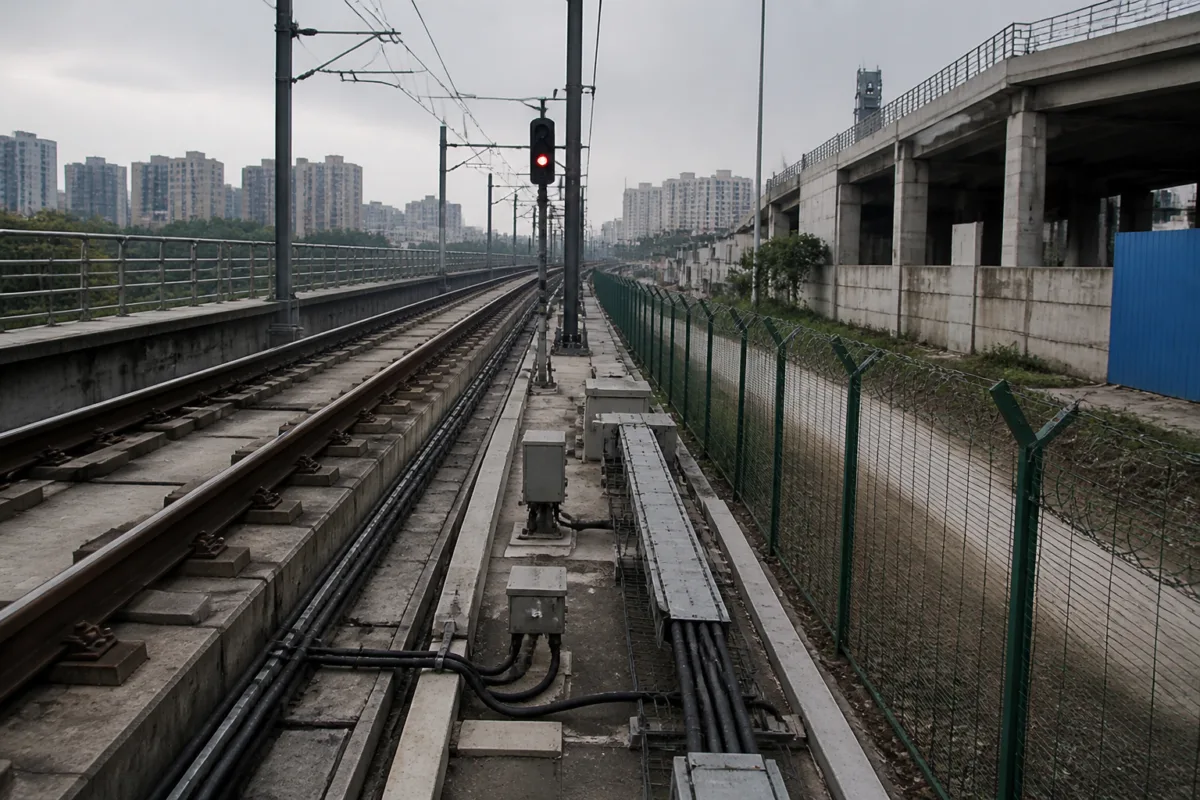
The cutting of three signalling cables between Shahid Sthal and Welcome stations has exposed how a physical breach in a restricted metro corridor can quickly become a network-wide safety concern. According to a complaint filed by a Delhi Metro Rail Corporation (DMRC) employee, the damage caused 15 track circuits on the down line to drop before staff created an emergency arrangement and restored normal operations.
The incident was reported to have occurred at about 3:56 am on November 8, when a signalling controller informed the control room that 15 track circuits had permanently dropped. DMRC personnel reached the affected section and inspected the track. The complaint stated that unknown persons had entered the track area without authorisation and cut three quad signalling cables at three separate locations.
The report, published after a case was registered, places the incident at the intersection of two systems that cities often treat separately: transport safety and physical security. A metro line is not protected only by trains, stations and control rooms. Its functioning also depends on thousands of less visible components installed along or beside the right of way. When those components are accessible to unauthorised people, the security of the passenger system becomes dependent on the ability to detect, isolate and repair damage before trains are exposed to unsafe conditions.
A track circuit is part of the signalling arrangement used to detect whether a section of track is occupied and to communicate information about train position. The complaint said the damage to the cables affected the operation of 15 such circuits. That does not establish that a train was placed in immediate danger, but it does show why signalling failures are treated differently from ordinary service disruptions. A loss of signalling information can require operational restrictions, manual intervention or emergency procedures while the affected section is assessed.
The account also shows the role of fail-safe behaviour in railway signalling. The track circuits dropped when the cables were damaged, alerting the control system to a problem rather than allowing the line to continue operating as though all equipment were functioning normally. The available report does not provide the detailed operating protocol used after the failure, the speed restrictions imposed, or the duration of the disruption. It does, however, record that DMRC signalling staff established a temporary arrangement from the outdoor side and restored the affected circuits.
That emergency response limited the immediate operational impact, according to the complaint. The same complaint said that a detailed inspection and permanent repair of the cables was to be carried out later. This distinction is important. Restoring a circuit or creating a temporary arrangement can bring a service back to normal, but it does not by itself answer how the damaged infrastructure was reached, whether all affected equipment was secure, or whether similar access points remain vulnerable.
The location is significant because Shahid Sthal and Welcome stations form part of the Red Line corridor connecting Delhi with Ghaziabad. The incident therefore involved an inter-city urban transport system rather than an isolated industrial railway siding. The DMRC employee’s complaint described the metro as a major public transport system for Delhi-NCR and stated that it carries approximately 70 to 80 lakh passengers daily. That passenger scale was included in the complaint and is not independently established in the supplied report, but it illustrates the operational consequence of even a localised infrastructure failure.
The police process began after the complaint was submitted. ACP Nandgram Jiyauddin Ahmad was quoted as saying that a case was registered at Nandgram police station on November 16. The investigation is examining how unknown people entered the restricted track area, why the cables were cut and whether the act was carried out by miscreants or formed part of a planned conspiracy. At the time of the report, no suspect or motive had been identified.
This sequence creates a clear institutional chain. DMRC is responsible for operating and maintaining the metro infrastructure and for reporting damage to public property. The police are responsible for investigating the alleged unauthorised entry and cable cutting. The signalling and control teams manage the immediate technical response. The incident can be fully understood only when these functions work together: detection identifies the failure, engineering teams contain the operational risk, security systems examine the breach, and investigators determine whether criminal action occurred.
The available account does not say whether the section was covered by cameras, patrols, fencing, intrusion alarms or other forms of surveillance. It also does not identify whether the three damaged cable locations were above ground, below ground or accessible from an adjoining public area. These details matter because the security response would differ depending on the physical design of the corridor. Without them, it is not possible to determine whether the event reflects a gap in fencing, a maintenance access vulnerability, inadequate monitoring or another condition.
The incident nevertheless raises a structural question for expanding metro networks: how is security managed outside stations, where passenger-facing surveillance is usually more visible? Metro stations have controlled entrances, staff, ticketing systems and platform procedures. Open or semi-open stretches of elevated, surface-level or boundary-adjacent track depend on a different security model. Signalling cables, power equipment and communication systems may be distributed along these stretches, making asset protection part of the transport operator’s core safety function.
It also highlights the difference between operational resilience and physical prevention. DMRC staff were able to identify the track-circuit failure and create an emergency arrangement, which indicates a response mechanism for signalling disruption. But the report does not establish whether preventive controls failed, whether the damage was detected immediately after it occurred, or how long the cables had remained compromised before the controller received the alert. A resilient system needs both rapid recovery and barriers that reduce the likelihood of intrusion or damage in the first place.
The police case may provide the missing details. Investigators can establish the route used to enter the restricted area, identify the tools or methods involved, examine nearby surveillance footage and determine whether the cable cutting was opportunistic or deliberate. DMRC’s permanent inspection can establish the full extent of the damage and whether temporary restoration left any residual maintenance requirement. Neither the supplied report nor the complaint gives a final account of those steps.
For passengers, the immediate event ended with the reported restoration of the affected track circuits rather than a prolonged public disruption. For the transport system, however, the more important issue is what the investigation and technical inspection establish about access to critical signalling assets. The incident confirms that a single physical intrusion can affect multiple track circuits, while the available evidence does not yet establish the motive, the security weakness that enabled entry or the long-term corrective action.
The next milestones are therefore the police investigation into the November 8 cable cutting, the permanent inspection and repair of the affected signalling cables, and any official explanation of how unauthorised access to the restricted track area occurred. Until those findings are available, the case remains a documented signalling infrastructure breach with restored operations but unresolved questions about corridor security and asset protection.

