


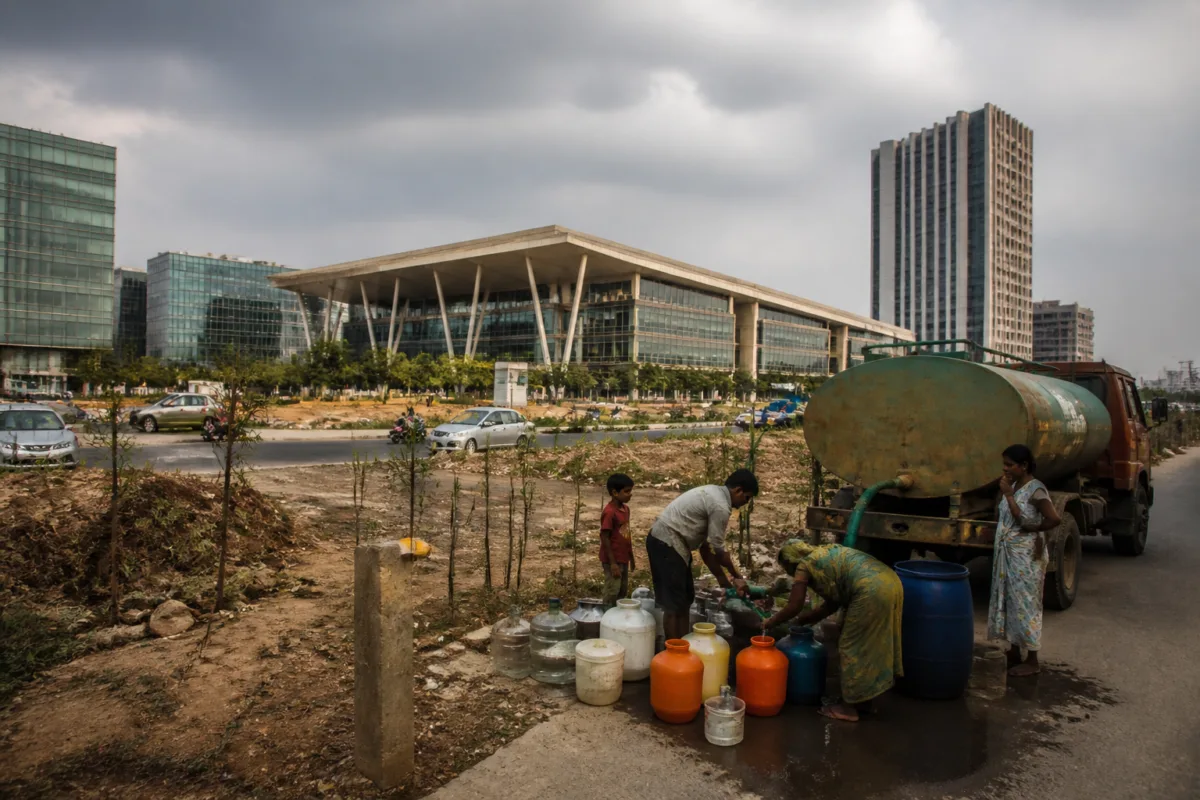
A public demand to postpone Telangana’s Global Investment Summit has exposed a difficult urban governance test: how should a state allocate scarce water, energy and administrative capacity when drought conditions are already affecting households, institutions and businesses? A group of 400 citizens, environmentalists, scientists, academics, civil-society representatives and people’s organisations has urged Chief Minister A Revanth Reddy to defer the event, scheduled from December 7 to 9, arguing that its planned scale conflicts with the government’s own warnings about an extended water crisis.
The controversy is not only about whether a three-day summit should proceed. It is about the relationship between exceptional events and everyday urban systems. A large investment gathering can be presented as an economic and administrative priority, but it also creates a concentrated demand for hotel rooms, food services, sanitation, transport, electricity and official attention. When water supply is already being rationed in parts of Hyderabad and drought has been formally recognised across the state, the question becomes whether the state can host the event without weakening its response to the wider emergency.
The open letter, dated November 17, recalls the chief minister’s October 15 warning that the El Niño crisis could resemble the Covid-19 pandemic in its effects. The chief minister had appealed to farmers to avoid paddy cultivation and shift towards less water-intensive crops. He also warned that Telangana could face a prolonged water crisis until July 2027, with electricity availability becoming a serious concern. The situation, according to the warning cited in the letter, could remain critical for the next eight to ten months.
Those statements establish the policy context in which the summit is being judged. The government has not treated the situation as a routine seasonal shortage. The source report says schools and colleges were given holidays, government hostels sent children home because of a shortage of water, and parts of the information technology sector were planning to shift towards working from home. In Hyderabad, several areas were reportedly receiving water once every three to four days.
The state’s administrative response also provides a formal indicator of the scale of the problem. A government order issued on October 24 declared 365 mandals across 31 districts drought-hit, according to the letter. That decision matters because drought classification is not simply a description of dry conditions. It signals that the government has identified a crisis requiring coordinated intervention across rural administration, local bodies and line departments.
Against this backdrop, the summit’s reported operational requirements have become the centre of the criticism. The letter, citing media reports, says that around 4,000 dignitaries from across the world are expected to attend and that they will be provided with world-class facilities. The signatories argue that such an event would intensify demand for accommodation, banquets, kitchens, laundry, sanitation, transport and electricity.
The issue is not that every delegate’s individual consumption can be assumed to be excessive. The structural concern is concentration. A large group of visitors accommodated and serviced over a short period requires systems to deliver water, power, mobility and hospitality simultaneously. Those systems are the same ones that residents, hospitals, schools, businesses and public institutions depend on. During normal conditions, the additional demand may be manageable. During a declared drought, the allocation of that capacity becomes a public policy question.
The letter also objects to the proposed Climate Conclave on El Niño, Climate Change and Drought as part of the summit. The signatories describe the session as ironic because, in their view, the event would discuss climate stress while creating additional pressure on resources during an active crisis. That criticism reflects a broader challenge for climate governance: climate discussion is increasingly being integrated into investment and development events, but the credibility of such discussions depends on whether the event itself is aligned with the immediate resource constraints being discussed.
The administrative question may be as significant as the resource question. The letter cites an official press release saying that one government officer would be assigned to each of the 4,000 delegates. The signatories argue that this could divert officials from drought mitigation and from the work of helping people manage water shortages. They have asked district and mandal administrations, municipal and panchayat bodies and line departments to focus fully on drought response rather than guest facilitation.
This does not establish that the summit would necessarily prevent relief work or that every assigned official would otherwise be engaged in a specific drought operation. The source material does not provide a government estimate of the number of officials to be deployed, the event’s water budget, its energy demand, or the measures planned to offset those demands. Those missing details are important because they would allow the competing claims to be assessed on more than principle.
The dispute therefore exposes an information gap in the planning of large public events during a crisis. If the government proceeds, the public interest would lie in knowing how water supply, electricity, sanitation, transport and official deployment will be managed. The source report does not say whether the administration has published such an operational plan. Without those figures, the debate is being conducted through broad claims about insensitivity and emergency, rather than through a transparent assessment of resource use.
There is also a question about the role of Hyderabad within the state’s drought response. The city is the location of the reported water-supply disruption and the centre of the state’s technology and investment economy. At the same time, the government’s drought order covers 31 districts and 365 mandals. The summit thus sits at the intersection of two priorities: maintaining Telangana’s investment profile and managing a crisis that extends far beyond the capital.
That tension is visible in the criticism of the Bharat Summit held on November 13 and 14. Civil-society groups argue that the earlier event added to pressure on scarce resources. The source material does not provide a quantified assessment of the Bharat Summit’s consumption or administrative footprint, so the allegation cannot be independently measured from the available evidence. But its inclusion in the letter shows that the concern is not limited to one event. It is about whether the state’s calendar of high-profile gatherings is being reconciled with emergency administration.
The government’s earlier public warnings make the contradiction sharper. On one side, farmers have been asked to change cropping choices because of water stress, and citizens have been told that the crisis could continue until July 2027. On the other, the state is preparing an international gathering that depends on a high level of hospitality and public coordination. These are not automatically incompatible objectives, but they require explicit prioritisation and disclosure.
The controversy also highlights the limits of treating drought as a rural issue. The cited impacts include urban water rationing, possible changes in IT-sector operations, school and college closures, and pressure on hostels. These are city-system consequences. They affect not only agricultural production but also labour, education, housing, public health, business continuity and municipal service delivery.
A consultation organised by civil-society organisations, unions and activists on the El Niño crisis is expected to submit additional measures for tribal, rural and urban contexts to the government, according to the report. That planned submission could broaden the policy discussion beyond the postponement request. It points towards a distinction between immediate crisis management and longer-term resilience planning, although the source material does not yet detail the proposed measures.
The available evidence confirms that Telangana is dealing with a formally recognised drought situation and that the chief minister has publicly described the coming months as critical. It also confirms that a sizeable civic group has asked for the investment summit to be postponed because of its expected demands on water, energy and administrative machinery. What remains unestablished is the summit’s precise resource requirement, the government’s mitigation plan and whether officials have assessed the event against the state’s drought-response priorities.
Those are the facts that will determine whether the summit becomes merely a contested public event or a test of crisis governance. The next significant development is the state government’s response to the open letter and whether it publishes operational details showing how the December 7–9 gathering will be conducted without compromising drought relief and urban water management.

