


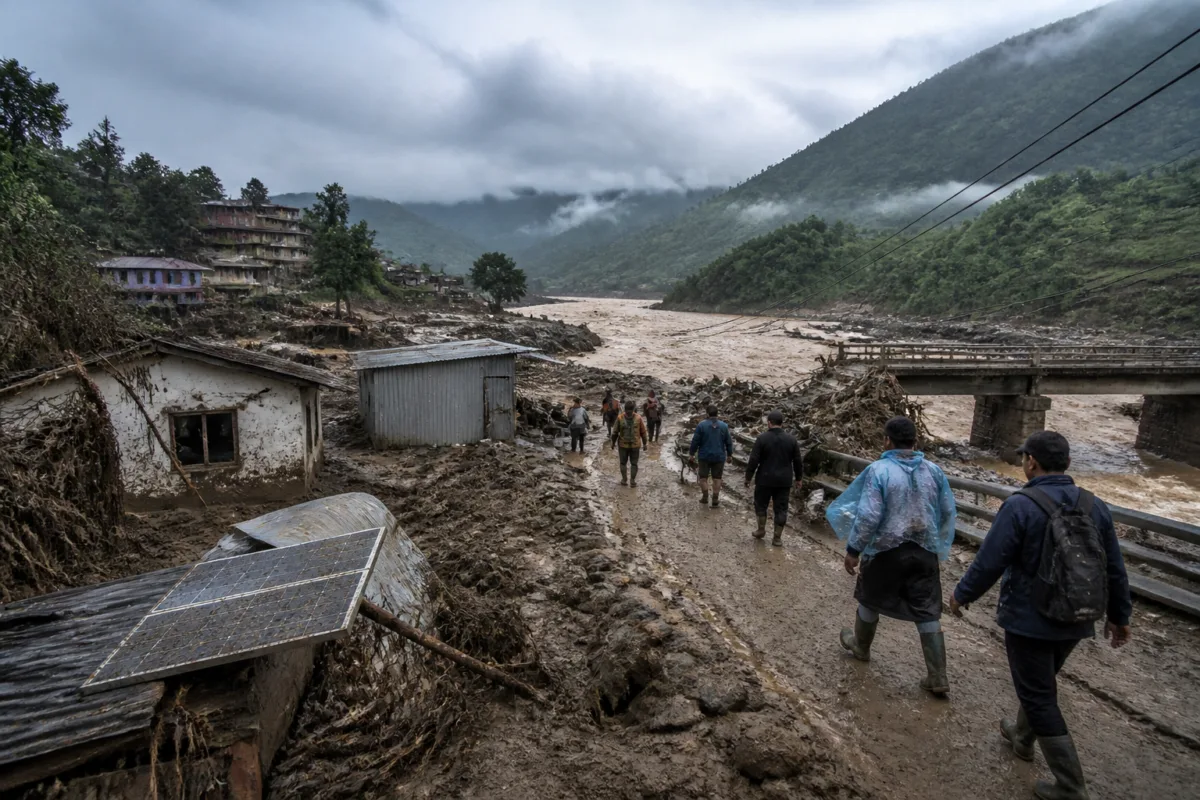
Nepal’s push for Himalayan climate resilience at COP31 is rooted in a crisis already visible on the ground. In Nuwakot and surrounding areas, deadly floods in August washed away villages, damaged bridges and buried homes, power lines, vehicles and solar panels along the Trishuli River. Survivors remain in makeshift shelters, dependent on donations for drinking water and food while they wait for decisions about land, housing and reconstruction.
The immediate destruction exposes a larger problem: mountain disasters are becoming an infrastructure and governance challenge that local recovery systems cannot manage alone. Nepal’s delegation at the United Nations climate summit in Turkey is arguing that international sympathy must be converted into predictable financing, faster disbursement and a permanent focus on the risks facing mountain regions.
Nepal’s Foreign Minister Shisir Khanal said the country wanted a dedicated programme on mountains and climate change so that mountain risks are reflected in international climate action, including funding decisions. “After the disaster, we received an outpouring of sympathy. This is the time to put sympathy into the system,” Khanal said at the talks, according to the Associated Press report published by Deccan Chronicle.
That demand came after Nepal and Bhutan sought a dedicated negotiating agenda item on warming in mountain regions. Their proposal did not make the cut at COP31. The outcome illustrates the institutional difficulty facing mountain countries: the risks are geographically concentrated, but their consequences extend across borders and affect populations far beyond the communities where disasters begin.
The Hindu Kush Himalaya is a critical regional infrastructure system even though much of it is not built infrastructure. Glaciers and snow feed rivers on which nearly 2 billion people depend for drinking water, farming and electricity, according to the International Centre for Integrated Mountain Development, or ICIMOD, based in Kathmandu. Changes in the region therefore affect settlements, agriculture, hydropower and downstream urban economies.
The climate threat is not limited to gradual changes in water availability. The report says warming can destabilise mountain slopes as glaciers retreat and frozen ground thaws. Floods carrying rock, ice and debris can cross borders within minutes. Communities downstream may have little time to respond, particularly when early-warning systems face funding cuts.
This creates a distinctive planning problem. In a conventional flood response, authorities may focus on drainage, embankments, evacuation routes and the rebuilding of damaged structures. In Himalayan settlements, the hazard can combine intense flooding with landslides, glacial instability, damaged bridges and the isolation of entire communities. A road or bridge failure is not merely a transport disruption when it also cuts off access to food, drinking water, medical services and reconstruction material.
The conditions in Nuwakot show how that disruption becomes a housing and land crisis. Farmers who lost homes and agricultural land are living in temporary shelters without clarity about where or when they can rebuild. Along the Trishuli River, partially buried power lines, solar panels, cars and homes indicate that recovery involves more than replacing individual buildings. It requires decisions about safe locations, public infrastructure, energy access and the future viability of settlements exposed to repeated hazards.
The human consequences remain unresolved. Lakchin Bahadhur Tamang, a 45-year-old hydropower plant worker, told the Associated Press that survivors feared being left without sufficient drinking water once aid organisations and other helpers departed. His account points to the gap between emergency relief and durable recovery. Donations can sustain communities immediately after a disaster, but they do not by themselves establish permanent water systems, restore transport connections, secure land tenure or finance safer reconstruction.
That gap is central to the debate around the loss and damage fund. The fund was established three years ago to compensate developing nations hit hard by climate-fuelled disasters, but the report says it does not have nearly as much money as required and is slowed by bureaucracy. Experts cited in the report say that more funding and faster disbursement are essential for more efficient recovery as climate disasters become more frequent and severe.
For countries such as Nepal, the speed of financing is as important as the total amount. A delayed allocation can leave households in temporary shelters through multiple seasons, prolong the closure of roads and bridges, and prevent local authorities from making decisions about reconstruction. The supplied report does not provide the fund’s current financial total, a specific allocation for Nepal or a timetable for disbursement. It does, however, identify the administrative delay as a major obstacle to recovery.
The policy question is also connected to the limits of temperature targets. Global average temperatures are expected to surpass 1.5 degrees Celsius above pre-industrial levels over the coming years, according to the report. That threshold was established in the 2015 Paris Agreement. Discussions continue to focus on reducing emissions and potentially returning below the threshold, but the report notes that this would require reductions in greenhouse gas emissions that the world has not achieved.
Pam Pearson, director of the International Cryosphere Climate Initiative, warned against treating temperature rise as easily reversible. Snow and ice can disappear rapidly, while recovery can take centuries or millennia, she said. “There is no negotiating with the melting point of ice,” Pearson said. The implication for urban and infrastructure planning is direct: adaptation cannot be postponed on the assumption that future emissions reductions will quickly restore mountain conditions.
The evidence presented at COP31 points towards several linked administrative needs. Authorities must monitor unstable slopes and dangerous glacial lakes, share information across borders in real time, coordinate early-warning systems and secure international funds. These are not isolated technical tasks. They require cooperation between national governments, local administrations, river-basin authorities, infrastructure agencies, climate institutions and international finance mechanisms.
Early-warning systems are particularly important because the risks move through connected landscapes. A hazard that begins with glacial or slope instability can become a flood downstream, affecting villages, roads, hydropower assets and urban centres. If warnings are not shared across borders or if local communities lack reliable communication and evacuation infrastructure, the existence of scientific monitoring does not necessarily translate into safety.
The institutional challenge is compounded by the political visibility of disasters. Nepal’s Foreign Minister said mountain regions often receive sympathy after a disaster, but the country is seeking to place mountain risks inside the rules and decisions governing climate action and finance. That is a shift from treating each flood as a humanitarian emergency to recognising a continuing regional risk that requires standing systems, budgets and responsibilities.
Pema Gyamtsho, director general of ICIMOD, described repeated Himalayan disasters as recurring “wake-up calls” and asked what it would take for governments to act. The question captures the difference between recognition and implementation. The risks are increasingly documented, but the affected communities still face damaged infrastructure, uncertain housing and dependence on short-term assistance.
The broader urban question is how downstream settlements and regional economies will absorb instability originating in mountain environments. The Hindu Kush Himalaya supports water, food and electricity systems serving nearly 2 billion people. That dependence means the resilience of remote villages, transport links and mountain infrastructure is connected to the functioning of towns and cities far beyond Nepal’s flood-affected districts.
The COP31 debate confirms that Himalayan climate resilience is not only a conservation or rural development issue. It is also a question of housing security, infrastructure continuity, energy supply, water governance and cross-border risk management. What remains uncertain from the supplied report is whether negotiators will create a dedicated mountain programme, how the loss and damage fund will address Nepal’s needs and whether faster disbursement mechanisms will be agreed. Those decisions will determine whether future disasters continue to produce temporary relief and prolonged displacement, or whether recovery systems can match the scale of the risk.

