


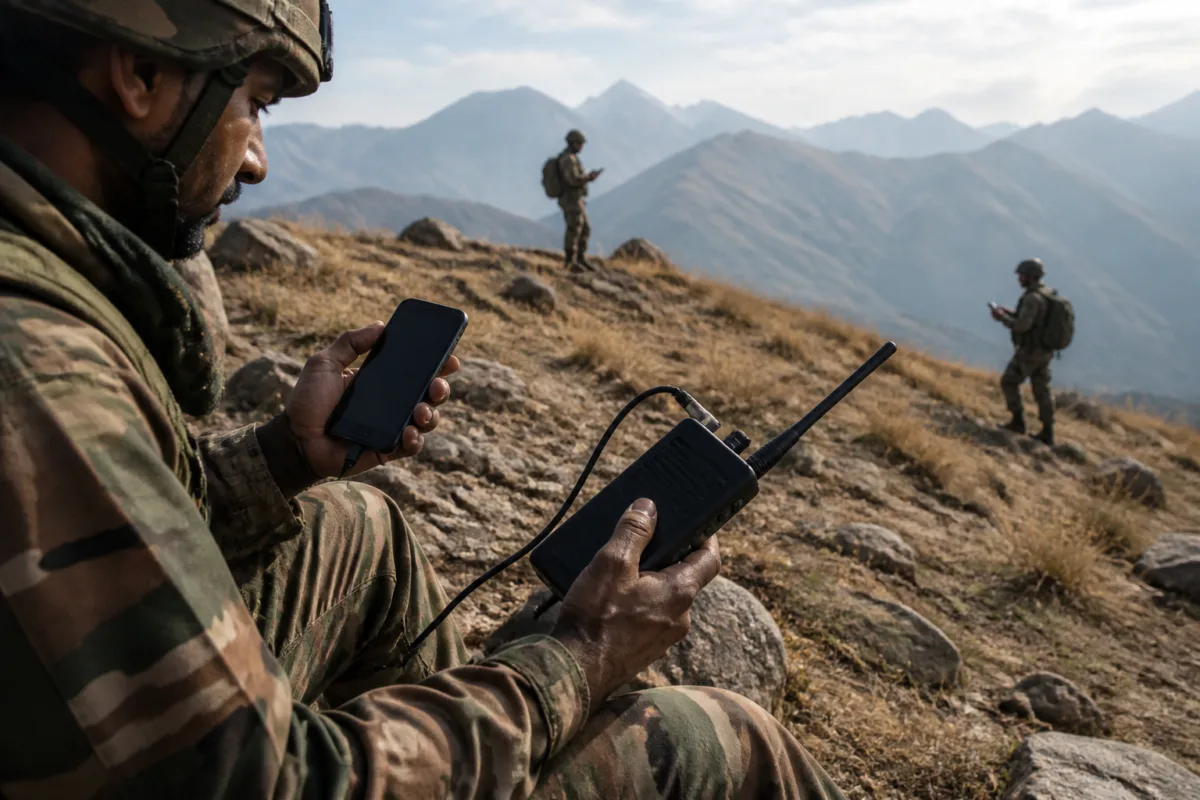
A student startup from BITS Pilani’s Hyderabad campus is developing a pocket-sized radio that could help soldiers communicate and share live location data in areas without mobile towers, satellite links or SIM cards, while costing a fraction of comparable imported systems, according to the Times of India.
Krathveil, founded by third-year dual-degree students Samarth Alok Srivastava and Shresth Prakash Singh, has developed Krath Control, a radio weighing less than 180 grams. The device pairs with a soldier’s phone and connects with other nearby radios through an encrypted mesh network.
The Army is currently reported to be importing similar systems from the United States at about Rs 2 lakh per unit. Krathveil is targeting a price of around Rs 40,000, potentially creating an indigenous alternative for infrastructure-independent voice and data communication.
Unlike conventional voice radios, which allow soldiers to communicate but do not provide location visibility, Krath Control is designed to place an entire section on a single live map. The founders said the system can form an encrypted network in which each radio connects to nearby devices. If one radio or node drops out, the network can automatically identify another route for communication.
The founders said the radios could potentially bridge distances of more than 100 km without relying on communication towers, satellites or SIM cards. They said a single hop between two hilltops could cover more than 100 km, although the system is yet to undergo further field assessment.
The device was recently assessed by two Indian Army units for infrastructure-independent communication at the sub-unit level, along with situational awareness capabilities. The assessment identified requirements to increase power output and improve the antennas.
Samarth said the prototype currently uses a low power output of 156 milliwatts because of the team’s limited budget. The Army has asked the startup to increase this to 1 watt. The antennas used in the initial version also need to be upgraded, he said.
An Army official from Ranchi said the service currently meets this requirement through an imported commercial system and that there had been no Indian alternative. The official described Krathveil’s system as promising and said the Army would welcome a user assessment as it matures.
Krathveil was incorporated in May, with Shresth joining as co-founder in July and taking charge of technology operations. The startup has been recognised by the Department for Promotion of Industry and Internal Trade and is seeking incubation at the PIEDS.
The company plans to develop an upgraded version incorporating the Army’s suggestions over the next two to three months. It will then submit the device for another assessment, according to the report.

