


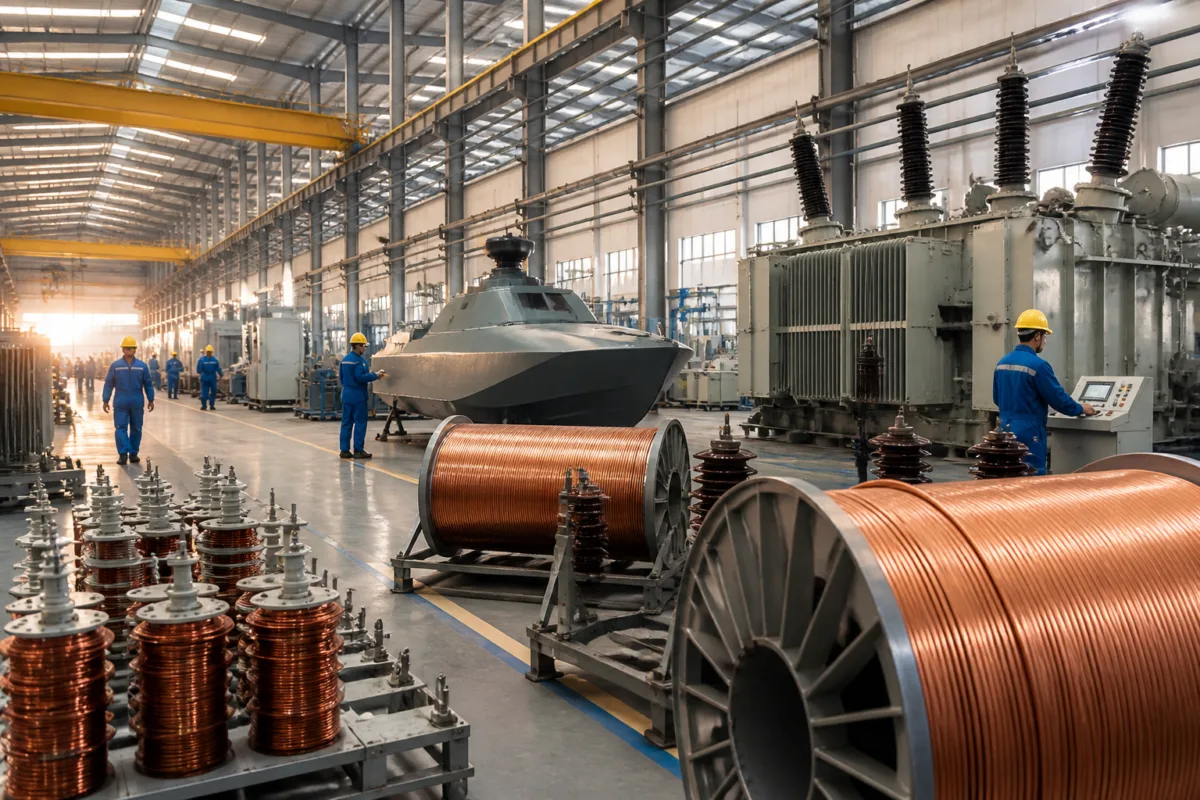
ValueQuest’s decision to commit ₹775 crore to three Indian companies is more than a private investment announcement. The portfolio brings together transformer components, precision manufacturing and autonomous defence systems—three industrial capabilities that sit behind the infrastructure and strategic systems India is trying to build domestically.
The Mumbai-based investment firm has committed to invest in Sagar Defence Engineering and Rational Engineers, while including its recently announced investment in TASE Global. According to Business Standard, the combined commitments to the three companies total ₹775 crore. ValueQuest manages about $3.31 billion across public and private markets, while its private equity platform manages more than ₹6,000 crore, including co-investments.
The investment mix is significant because it cuts across different layers of the industrial system. Rational Engineers supplies specialised copper winding conductors and insulation solutions used in power and distribution transformers. TASE Global operates a precision engineering and manufacturing platform in India and the United States, serving original equipment manufacturers and Tier-1 suppliers in medical technology, aerospace, defence and industrial applications. Sagar Defence Engineering develops unmanned and autonomous systems for maritime and other defence uses.
Together, these businesses point to three different requirements of industrial expansion: the physical components needed to extend electricity networks, the production quality required to serve demanding global customers, and the technological capabilities needed for strategic autonomy. The source material does not establish the size of the companies’ operations, their investment valuations, employment numbers or the specific capacity that the new capital will add. But it does show where the investor sees long-term opportunity: in companies that provide specialised capabilities rather than only high-volume production.
That distinction matters for infrastructure. Electricity transmission and distribution are often discussed through the scale of generation capacity, substations, lines and electrification programmes. Yet the reliability and expansion of those systems also depend on less visible industrial inputs. Transformer manufacturers and their suppliers require specialised conductors, insulation systems and other precision components. Rational Engineers operates in this layer of the power system, supplying products for transmission, distribution and electrification applications.
An investment in such a company does not automatically translate into new substations or improved electricity supply. The available information does not specify new facilities, production targets, customer contracts or project timelines. Its relevance is instead connected to the manufacturing base that supports power infrastructure. A stronger domestic supplier ecosystem can be important to infrastructure delivery, but the Business Standard report does not provide evidence to measure how this particular commitment will affect costs, lead times or network capacity.
The same separation between industrial capability and immediate infrastructure outcomes applies to TASE Global. The company serves global original equipment manufacturers and Tier-1 suppliers from operations in India and the United States. Its capabilities include complex machining, specialised manufacturing processes and precision assemblies. These are production functions that support other companies’ products rather than infrastructure assets visible to the public.
For Indian cities and industrial regions, this part of the portfolio raises a question about where value is created in the built environment. Large infrastructure projects depend on contractors, equipment manufacturers and specialist suppliers operating across several tiers. The ability to produce complex components to the standards required by global customers can determine whether domestic firms remain low-value vendors or move into more capable positions in international supply chains. The source report identifies that ambition, but it does not establish whether TASE Global has secured new contracts or how much additional capacity the investment will create.
Sagar Defence Engineering represents a different part of the same industrial argument. The company specialises in unmanned and autonomous systems for maritime and other defence applications. ValueQuest has linked the investment to increasing adoption of autonomous technologies and India’s effort to develop defence capabilities domestically. These systems are not civilian urban infrastructure, but they belong to the wider strategic manufacturing ecosystem in which advanced engineering, software, electronics and precision production overlap.
ValueQuest’s stated investment process also provides context. The firm said the commitments followed 12 to 18 months of pipeline development, thematic research and engagement with entrepreneurs. Aniket Dharamshi, co-founder and managing partner, said the firm was focused not on the pace of capital deployment but on identifying businesses where it could build conviction and contribute to their next phase of growth. He also said ValueQuest aimed to help portfolio companies scale, strengthen organisational capabilities and institutionalise governance.
This emphasis on governance is important because industrial expansion is not only a question of funding. Companies supplying power, aerospace, defence or medical-technology customers must typically manage quality systems, production consistency, compliance and delivery relationships. ValueQuest’s stated role goes beyond providing capital, although the report does not specify the governance changes, operational support or performance targets agreed with any of the three companies.
The investment strategy also reflects a broader shift in how India’s industrial opportunity is being described. ValueQuest founder and chief investment officer Ravi Dharamshi said global supply chains were realigning and that technological sovereignty had acquired strategic importance. He argued that the opportunity was not simply for India to manufacture more, but for Indian companies to develop technology, capabilities and customer relationships that could make them globally competitive.
That formulation places capability, rather than output alone, at the centre of the investment case. It also links industrial policy to the everyday systems that depend on manufacturing depth. Power infrastructure requires specialised equipment. Urban development relies on reliable electricity and complex supply chains. Defence production requires advanced components and systems integration. Global manufacturing relationships require firms that can meet demanding technical and organisational standards.
However, the announcement should not be read as proof that India’s infrastructure bottlenecks have been resolved or that domestic manufacturing has become globally competitive across the board. The supplied report contains no data on import substitution, export growth, production volumes, order books, project execution or customer concentration. It also does not identify the amount committed to each company, the form of the investment or the implementation schedule.
The ₹775 crore figure therefore describes the scale of ValueQuest’s combined commitment, not a government infrastructure allocation or a guaranteed expansion of public assets. The distinction is material. Private capital can support companies that supply infrastructure and strategic industries, but the effect on citizens depends on whether that support results in additional capacity, reliable delivery, competitive pricing and successful customer relationships.
The announcement does establish a clear direction in ValueQuest’s private equity platform. The firm said it was continuing to build SCALE Fund II, described as its third investment vehicle for partnering with emerging Indian companies across sectors, following the investment and realisation experience of SCALE Fund I. The three commitments are presented as part of that effort to back businesses positioned within India’s industrial transformation.
For the urban economy, the key issue to monitor is whether this capital moves from corporate balance sheets into measurable industrial capability. Relevant milestones would include new manufacturing capacity, stronger supplier networks, additional power-sector customers, higher-value engineering work and evidence of successful integration with global original equipment manufacturers. None of those outcomes has yet been established in the announcement. What is clear is that the investment thesis is focused on the industrial foundations behind infrastructure and strategic production, rather than on a single visible urban project.

