


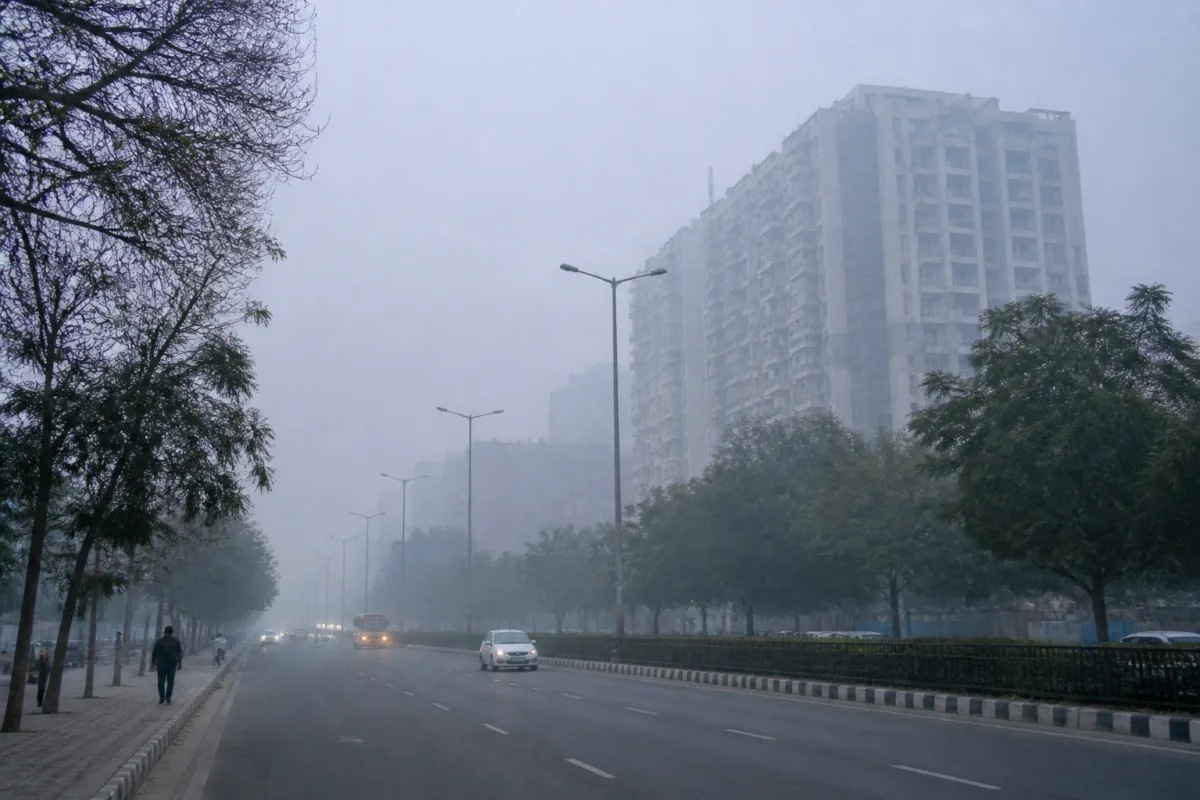
Delhi recorded its coldest morning of the season so far on Tuesday, with the minimum temperature at Safdarjung falling to 11.6 degrees Celsius as the India Meteorological Department forecast moderate fog and the city’s air quality remained in the poor category.
The Safdarjung reading was 0.7 degrees Celsius below the seasonal normal and was also the lowest minimum temperature recorded in the capital this month. The station is used as Delhi’s reference weather observatory for several official temperature assessments.
Temperatures varied across the city’s monitoring stations. Palam recorded a minimum of 12.3 degrees Celsius, which was 0.6 degrees below normal. Lodhi Road recorded 12 degrees Celsius, one degree above normal, while Ayanagar reported 12.6 degrees Celsius, 0.1 degrees below normal. The Ridge recorded the highest minimum among the listed stations at 14.6 degrees Celsius, or 1.1 degrees above normal.
The maximum temperature is expected to settle at 27 degrees Celsius, according to the IMD. Moderate fog has also been forecast during the day. The combination of lower morning temperatures and fog is part of the seasonal weather pattern affecting visibility and daily conditions across the capital, although the supplied weather update does not indicate any transport disruption.
Delhi’s air quality index stood at 238 at 8 am, placing it in the Central Pollution Control Board’s poor category. Data was recorded from 58 monitoring stations across the city. Of these, 32 stations reported poor air quality, 16 recorded moderate air quality and 10 fell in the very poor category.
Sirifort recorded the worst air quality among the monitoring locations, with an AQI of 333. Under the CPCB classification, an AQI of 0 to 50 is considered good, 51 to 100 satisfactory, 101 to 200 moderate, 201 to 300 poor, 301 to 400 very poor and 401 to 500 severe.
The station-level variation shows that air quality conditions were not uniform across Delhi on Tuesday morning. While the citywide reading placed Delhi in the poor category, Sirifort was already in the very poor range, and the majority of reporting stations were classified as poor. The data provides a location-wise snapshot of how pollution levels differed across the capital at the time of measurement.
The latest readings also place the morning’s weather and air-quality conditions in separate but simultaneous monitoring systems: the IMD recorded the season’s lowest minimum temperature at Safdarjung, while the CPCB’s network captured pollution levels across 58 stations. Further changes will depend on subsequent temperature, visibility and air-quality readings issued by the two agencies.

