


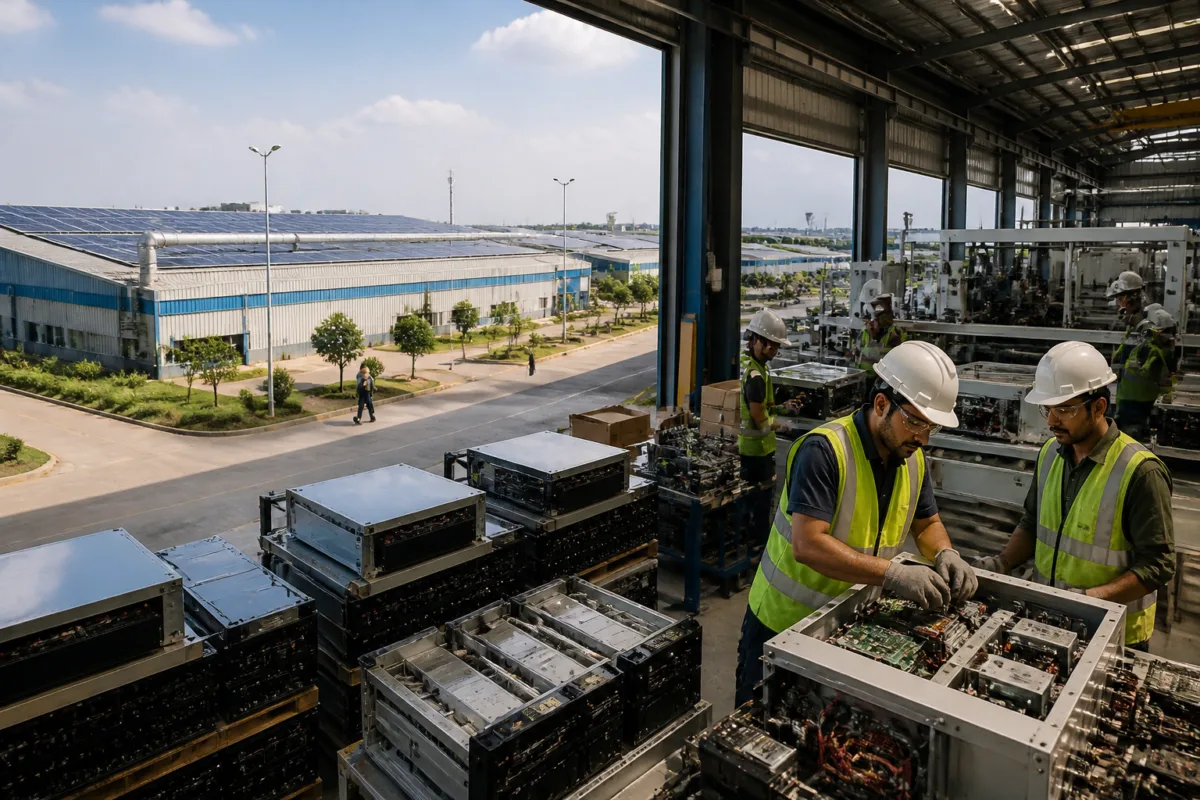
Fujiyama Power Systems’ latest expansion is a reminder that India’s rooftop solar transition depends on more than installing panels on homes and commercial buildings. It also requires a domestic industrial base for inverters, batteries, solar cells, cables and other power-electronics components. The company’s recent results and manufacturing plans show both the scale of that opportunity and the operational risks that come with rapid capacity building.
The company, which sells solar inverters, batteries and related products under the UTL Solar brand, reported revenue from operations of Rs 13,068 million in Q2 FY27, up 130.1 per cent from Rs 5,679 million in the corresponding quarter a year earlier. EBITDA rose 116.4 per cent to Rs 2,229 million, while profit after tax increased 111.2 per cent to Rs 1,329 million, according to the report carried by NDTV Business.
Those numbers point to strong demand for the equipment that sits behind distributed electricity generation. Rooftop solar systems require more than photovoltaic modules. They need inverters to convert electricity, storage systems where backup is required, batteries, power-management equipment and a network of associated components. A manufacturer operating across these categories is therefore positioned closer to the wider energy system than a company making a single product.
At the same time, the quarterly figures also show that rapid growth does not automatically translate into improving margins. Fujiyama’s EBITDA margin fell to 17.1 per cent in Q2 FY27 from 18.1 per cent a year earlier. Its profit margin declined to 10.2 per cent from 11.1 per cent. Revenue also fell 2.9 per cent sequentially from Rs 13,457 million in Q1 FY27, while EBITDA declined 12.5 per cent.
The figures matter for cities because distributed solar is ultimately an infrastructure question. The performance of rooftop systems depends on the reliability and availability of equipment, the ability to integrate generation with the electricity network and the economics of storing or exporting power. The supplied report does not establish how much of Fujiyama’s output is being used in residential, commercial or industrial installations, but its manufacturing mix indicates that the company is building capacity for a broader solar and energy-storage market.
The company’s first-half performance was stronger than its quarterly sequential trend. Revenue in H1 FY27 increased 127.6 per cent to Rs 26,525 million from Rs 11,653 million a year earlier. EBITDA rose 128.7 per cent to Rs 4,777 million, and the EBITDA margin remained broadly stable at 18 per cent compared with 17.9 per cent in the corresponding period. Normalised PAT increased 128.4 per cent to Rs 2,981 million from Rs 1,305 million.
Reported profit, however, was affected by a fire at the company’s tubular battery manufacturing plant in Bawal, Haryana, in May 2026. The facility had a capacity of 1.3 GWh. Fujiyama made a provision of Rs 1,436 million for the loss, reducing the post-tax impact on profit to Rs 1,074 million. The company has filed an insurance claim for the full carrying value of the damaged assets and expects the claim to be resolved and realised during FY27, according to the report.
This episode highlights an important but often overlooked feature of urban energy infrastructure: resilience begins in the supply chain. A rooftop solar project may be installed locally, but its ability to operate depends on manufacturing plants, component suppliers, logistics networks and replacement capacity located elsewhere. A fire at one factory can therefore affect production economics and capacity plans even when the end-use asset is spread across many cities.
Fujiyama is attempting to reduce that exposure by expanding and diversifying its manufacturing footprint. During Q2 FY27, it commissioned a 2 GW power-electronics facility at Ratlam in Madhya Pradesh. The plant produces solar inverters, UPS systems and related products, taking the company’s total power-electronics capacity to 4.1 GW.
The Ratlam expansion is significant because inverters are central to the conversion and management of electricity generated by solar systems. Their performance affects how solar power is delivered to homes, businesses and the grid. The source does not provide data on utilisation, customer mix or reliability performance at the new facility, so the effect of the added capacity on actual rooftop deployment remains unestablished.
The company is also increasing lithium-ion battery manufacturing capacity at Ratlam from 2 GWh to 3 GWh. Once commissioned, its overall lithium-ion battery capacity will reach 3.5 GWh. Storage is becoming increasingly relevant to distributed energy systems because electricity generation from rooftop solar varies through the day. However, the supplied material does not specify the proportion of this capacity intended for rooftop systems, utility-scale projects, backup applications or other uses.
A 1.2 GW solar-cell manufacturing facility is another major part of the expansion. Fujiyama is investing around Rs 350 crore in the Ratlam project and expects it to be commissioned by Q1 FY28. The facility would take the company’s total solar-cell manufacturing capacity to 2.2 GW. The report links the project to upcoming domestic manufacturing requirements for solar installations, although it does not identify the specific regulatory provisions, implementation dates or procurement mechanisms involved.
The company is also setting up a 1 GWh tubular battery plant at Hathras in Uttar Pradesh. The facility requires an investment of around Rs 20 crore and is expected to be commissioned by Q3 FY27. It is intended to replace the capacity lost in the Bawal fire and reduce Fujiyama’s dependence on external battery suppliers. This is a direct example of how manufacturing redundancy can become part of business continuity in an energy-equipment market.
Fujiyama has further increased its stake in Gio Energy and Gio Cable to 50 per cent. These entities plan to manufacture solar ribbons, junction boxes, cables and electric-vehicle seats from FY28. If implemented, the arrangement would expand the company’s presence beyond finished systems into the components that connect generation equipment to the wider electrical and mobility ecosystem.
The broader strategy is vertical integration. Management believes that producing more components in-house can improve margins by replacing purchases from external suppliers. That approach can provide greater control over procurement and production, but the current evidence does not establish whether the new plants will operate at sufficient scale, whether their output will meet demand or how much capital will be required before they contribute to earnings.
Motilal Oswal has described the Q2 performance as a strong beat against its estimates. Revenue of Rs 13.1 billion exceeded its estimate of Rs 10 billion, while EBITDA of Rs 2.2 billion was above its Rs 1.9 billion estimate. Adjusted PAT of Rs 1.3 billion also exceeded its Rs 1.1 billion estimate. The brokerage maintained a Buy rating and a target price of Rs 500, compared with a reference market price of Rs 357 in its report. It valued the company at 20 times estimated FY28 earnings per share.
Those projections are market expectations, not established outcomes. The report identifies several factors that investors and urban-infrastructure observers would need to monitor: the company’s ability to commission new plants on schedule, the recovery of insurance proceeds after the Bawal fire, margins during the expansion phase and the extent to which internal manufacturing reduces dependence on outside suppliers. The Q2 margin decline and sequential fall in revenue show why capacity announcements alone cannot be treated as proof of operating success.
The urban significance of the expansion lies in this gap between deployment targets and industrial capability. Rooftop solar is experienced by citizens as a panel, inverter, battery or lower electricity bill, but the system is supported by a chain of manufacturing and logistics decisions. Capacity in solar cells, power electronics and storage can influence how quickly equipment is available and how dependent the market remains on external suppliers. Yet the supplied report does not provide city-level installation data, customer outcomes, electricity-network impacts or evidence of reduced costs for consumers.
What the evidence confirms is narrower but still important. Fujiyama is growing rapidly, expanding manufacturing capacity across several solar and storage categories, replacing lost tubular-battery capacity and seeking greater control over its component supply chain. The evidence does not yet establish how these investments will affect rooftop adoption, urban electricity reliability or consumer affordability. Those questions will depend on plant commissioning, capacity utilisation, financial performance and the eventual connection between manufacturing output and actual installations.
The next milestones identified in the report are the expected commissioning of the Hathras tubular-battery plant by Q3 FY27, the Ratlam solar-cell facility by Q1 FY28 and the planned manufacturing activity of Gio Energy and Gio Cable from FY28. The company’s insurance claim for the Bawal plant and the performance of its expanded facilities will determine whether its industrial strategy can convert strong reported growth into durable energy-infrastructure capacity.

