


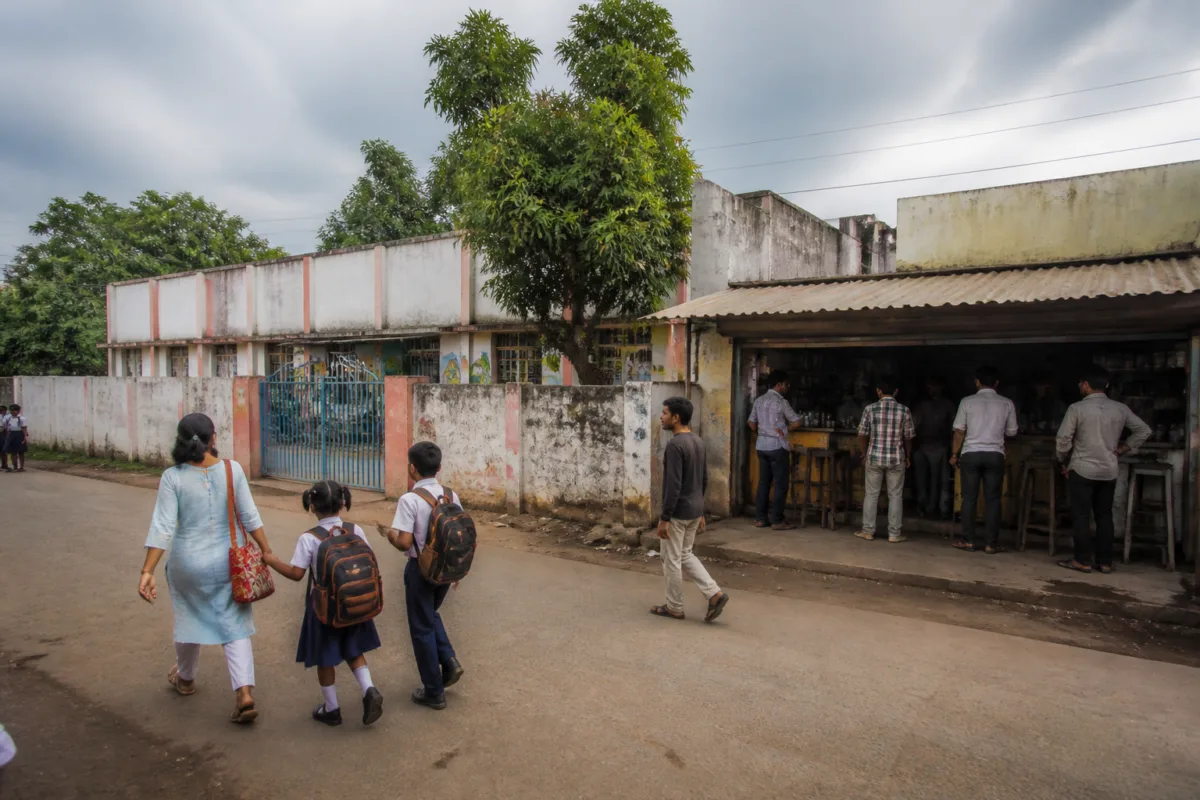
The Madhya Pradesh liquor shop rules are facing a legal challenge after the state government told the Madhya Pradesh High Court that primary schools are not covered by the 100-metre restriction on liquor outlets. The dispute centres on a shop in Sanjeevani Nagar, Jabalpur, which the district collector said was 53 metres from a primary school.
The case is more than a question about one outlet. It shows how a small change in the definition of a protected institution can alter the way public space is regulated around children, schools and commercial activity. It also places the responsibility for balancing excise revenue, licensing and neighbourhood safety within a chain of decisions involving the state government, the district administration and the courts.
The state’s position, recorded during a public interest litigation hearing, is that the excise rules were amended in 2023. According to the government’s reply, the amended rules removed primary schools from the category of educational institutions around which liquor shops cannot operate within 100 metres. The restriction continues, as described in the court proceedings, for middle schools, high schools, higher secondary schools, colleges and girls’ hostels.
That distinction is central to the dispute. The distance between the Jabalpur shop and the primary school is not in question in the material available on the case: the district collector put it at 53 metres. The disagreement is over whether that distance has legal significance when the nearby institution is a primary school. Under the state’s interpretation of the amended rules, it does not amount to a violation.
The petitioner, Ajay Patel, has presented the issue differently. His public interest litigation says that a school and a liquor shop are operating under the same roof and alleges that this conflicts with excise provisions that prohibit liquor outlets within 100 metres of educational institutions and religious places. Patel told the court that he had first approached the district collector seeking relocation of the shop but received no action, leading him to move the High Court.
This sequence is important because it reveals how location-based regulation works in practice. A distance rule may appear straightforward, but enforcement depends on at least three prior decisions: which institutions qualify for protection, how the distance is measured and which authority acts when a resident challenges an outlet. In this case, the first question has become the legal centre of the dispute because the state says the 2023 amendment excludes primary schools.
The district collector’s response also illustrates the difference between physical proximity and regulatory violation. The collector acknowledged that the shop was 53 metres from the school but maintained that it did not breach the amended rules. The administration’s position therefore relies not on the outlet being more than 100 metres away, but on the school falling outside the protected category. That interpretation is now being contested before the High Court.
The case places the 2023 amendment under scrutiny because it changes the practical meaning of the 100-metre safeguard. Before considering the amendment’s wider consequences, however, the legal record must establish what the rule actually says, why primary schools were removed from the relevant category and whether the amendment is consistent with other legal protections cited by the petitioner. The supplied court report does not provide those reasons or the text of the amendment.
That absence is significant for public understanding. The reported facts establish the change in the rule and the competing positions, but they do not establish the government’s policy rationale. It is therefore not possible, on the available material, to conclude whether the exclusion was intended to address a licensing gap, simplify administration, respond to a broader excise policy or serve another purpose. The court proceedings will have to clarify that question if the challenge proceeds.
The institutional structure is clearer. The state government frames the applicable excise rule. The district collector responds to complaints and represents the local administration’s position on the outlet’s compliance. The High Court examines the legal challenge and can require the parties to address whether the amended definition is valid. The petitioner’s request to amend the petition specifically to challenge the exclusion of primary schools moves the dispute from an individual relocation request towards a wider examination of the rule itself.
The court had earlier directed the district collector to hear the petitioner and decide on his representation after seeking the state government’s response. During the later hearing, petitioner’s counsel Surendra Verma referred to High Court orders in several states and challenged the amendment excluding primary schools from the definition of educational institutions for liquor-shop regulation. The division bench, led by Chief Justice Alpesh Y Kogje and comprising Justice Vivek Jain, allowed the petitioner time to amend the petition and deferred the hearing by two weeks.
The numbers in the case provide a compact picture of the regulatory conflict. The general restriction discussed in the proceedings is 100 metres. The reported distance between the Jabalpur outlet and the primary school is 53 metres, leaving a 47-metre difference between the location and the threshold. Yet that difference has no immediate legal effect under the state’s stated interpretation because the school is not included in the protected category after the 2023 amendment.
The case also demonstrates why urban regulation cannot be understood only through maps and measurements. A school, a commercial outlet and the surrounding neighbourhood occupy the same physical environment, but different departments may view that environment through separate mandates. The excise administration focuses on licensing rules, the district administration on implementation and representations, and the court on the legality of the rule and the decisions made under it. The dispute arises where those responsibilities overlap.
For residents, the administrative route described in the case matters as much as the final legal outcome. Patel first sought action from the district collector and then approached the High Court after alleging that no action followed. The report does not establish why the representation was not acted upon, whether any inspection took place before the litigation or whether alternative locations were considered. Those details would help determine whether the dispute reflects a failure of enforcement, a disagreement over legal interpretation or both.
The case also leaves unanswered whether the same amended rule applies uniformly across Madhya Pradesh and how many existing liquor outlets are located near primary schools. No statewide data, licensing inventory or explanation of the amendment’s implementation is included in the supplied material. Without that information, the Jabalpur shop cannot be treated as evidence of a broader pattern. It can, however, be treated as a test of the rule’s consequences in a specific urban setting.
The court’s next consideration will therefore be consequential for the legal framing of the dispute. The petitioner has been allowed to amend the petition to directly challenge the exclusion of primary schools, and the hearing has been deferred by two weeks. Until the court examines that challenge, the available record supports two established conclusions: the state says primary schools are outside the 100-metre prohibition, and the petitioner disputes the validity of that position.
What remains unresolved is whether the 2023 amendment can withstand that challenge and what directions, if any, the court may issue regarding the Jabalpur outlet. The next hearing will determine whether the dispute remains focused on one shop or develops into a broader examination of how Madhya Pradesh defines and protects educational spaces under its excise rules.

