


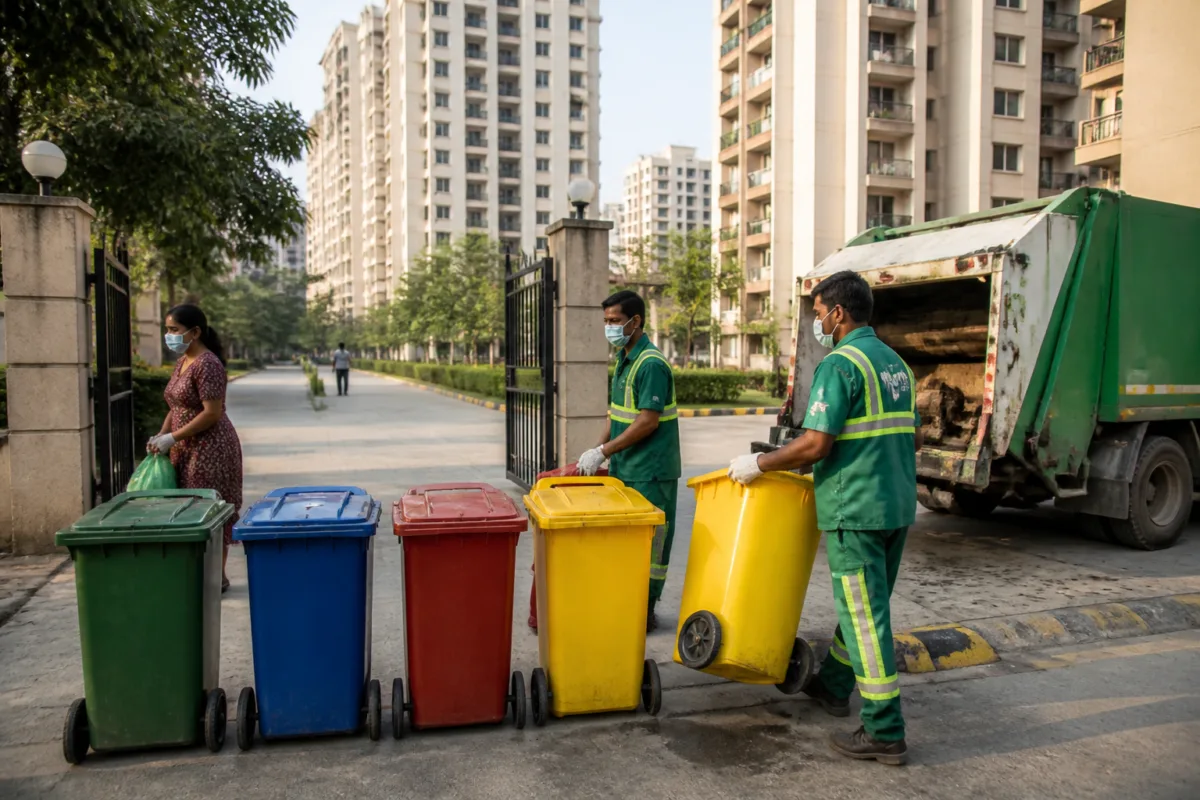
Gujarat’s four-bin waste segregation rollout is moving from a cleanliness campaign to a state-wide test of how urban India manages waste. The Solid Waste Management Rules, 2026 require households to separate wet, dry, sanitary and special-care waste before handing it to door-to-door collection vehicles, while urban authorities are expected to provide complete collection coverage and monitor what happens after the waste leaves the doorstep.
The rules came into force on April 1, 2026, according to the Gujarat urban development and urban housing department, which said implementation has been intensified across the state. The department’s announcement places four-way segregation at the centre of the programme, alongside 100% door-to-door collection, bulk processing and greater public participation.
That combination is important because household segregation is only one part of a municipal waste system. A resident can separate waste correctly, but the system still has to collect the streams without mixing them, send them to appropriate facilities, process wet waste and transfer dry, sanitary and special-care waste through authorised channels. The policy therefore links an individual household action to a chain of municipal and institutional responsibilities.
The four categories also indicate a more detailed approach than the traditional wet-and-dry division. Wet waste generally enters a different processing pathway from dry waste, while sanitary and special-care waste require separate handling. The supplied department statement does not specify the processing facilities or city-wise capacity available for each stream. That leaves implementation, rather than the wording of the rule, as the central question for municipalities and residents.
### From collection targets to processing responsibility
The department said the rules mandate 100% door-to-door waste collection across urban areas. This sets a basic service expectation for urban local bodies: waste should be collected from households rather than relying primarily on roadside disposal points or informal accumulation areas. Yet collection coverage alone does not establish whether waste is being segregated, transported separately or processed effectively.
The rules place a specific responsibility on bulk waste generators, including residential complexes, hotels, institutions and offices. Establishments with a built-up area of 20,000 square metres or more, daily water consumption of at least 40,000 litres, or solid waste generation of 100 kilograms or more per day fall within the stated thresholds. These criteria bring large housing societies, commercial premises and institutional campuses into the operational core of the waste system.
Bulk waste generators are required to process wet waste on their premises and dispose of dry waste through registered or authorised agencies, the department said. This changes the relationship between large establishments and municipal bodies. Instead of treating every waste stream as a municipal collection obligation, the framework assigns part of the processing responsibility to the premises where waste is generated.
For urban local bodies, that arrangement can reduce the volume requiring centralised collection and processing. However, the statement does not provide data on how many bulk generators are covered, how many are already processing wet waste on site or what enforcement measures will apply to establishments that do not comply. Those details will determine whether the thresholds function as a practical management tool or remain largely regulatory provisions.
### A wider administrative network
Gujarat has designated elected representatives as “Lead Facilitators” to increase compliance and public participation. District-level special cells headed by collectors have also been formed to oversee implementation and monitoring. The structure brings together elected representatives, district administration, municipal officials, sanitation workers, collection staff and supervisors.
This is a significant administrative design because waste management is experienced locally but governed through multiple layers. Door-to-door collection is visible at neighbourhood level, while enforcement, monitoring and inter-agency coordination often sit with municipal and district authorities. The special cells are intended to provide an oversight mechanism above routine collection operations, although the department statement does not detail their staffing, powers or reporting schedule.
The government has conducted state-level and regional workshops for elected representatives, municipal officials and other personnel involved in waste management. Awareness programmes have been organised in schools, colleges, residential societies and neighbourhoods, with teachers, students, sanitation workers, door-to-door collection staff and supervisors included in the campaign.
The range of participants reflects the fact that segregation cannot be sustained through public messaging alone. Residents need to know what belongs in each category, collection workers need systems that preserve separation, and municipal officials need the ability to identify and address failures. Including sanitation workers and collection staff in training is particularly relevant because they operate at the point where household behaviour meets municipal service delivery.
### Monitoring the gap between rules and reality
The department said sanitation marshals are monitoring cleanliness in high-footfall areas. Students have been provided practical workbooks to encourage cleanliness habits, while parameters prescribed by the Supreme Court have been integrated into the Swachhta Samiksha Kendra portal for monitoring and review.
These measures combine physical enforcement, behavioural education and digital monitoring. They also reveal three different ways in which the state is approaching compliance. Sanitation marshals address visible public-space conditions, school workbooks focus on long-term behaviour, and the portal is intended to create a monitoring record for administrative review.
The available information does not state which indicators are being tracked on the portal or whether data will be published city by city. Without such information, it is difficult to assess whether monitoring measures are recording the number of households segregating waste, the quantity collected in each stream, processing outcomes or complaints resolved. The distinction matters because a clean street does not necessarily prove that the waste system is functioning throughout its chain.
The government said sanitation-related complaints can be lodged through a WhatsApp helpline and that nearly 99% of complaints are addressed within the stipulated 24-hour period. The helpline number provided by the department is 76228 80000. This gives residents a defined channel for reporting problems, while the response-rate claim provides an administrative performance measure.
At the same time, the figure concerns complaints addressed within a stated period, not necessarily the quality or permanence of the resolution. A complaint may be closed after a collection vehicle arrives, while recurring overflow, mixed collection or inadequate processing capacity may require a different form of monitoring. The department statement does not provide the total number of complaints, their categories or independent verification of the 99% figure.
### The urban system behind four bins
The policy’s numbers show how responsibility is distributed. Households face a four-way segregation requirement. Urban authorities face a 100% collection mandate. Bulk generators face on-site wet-waste processing and authorised disposal obligations. District administrations are expected to oversee implementation through special cells, while elected representatives are assigned a facilitation role.
This distribution can make the system more resilient if each part performs its function. It can also make accountability harder if failures occur between institutions. For example, a household may segregate waste, but if the collection vehicle mixes the categories, the original effort is lost. A bulk generator may process wet waste, but dry waste still requires an authorised agency and a traceable route. A municipal body may report collection coverage, while the final processing outcome remains unclear.
The policy therefore shifts the focus from the amount of waste collected to the quality of the entire waste pathway. The source material does not provide state-wide quantities of waste, processing capacity, landfill diversion figures or city-level compliance rates, so the operational performance of the rollout cannot yet be measured from the announcement alone. What is established is the framework of duties and the administrative machinery being created around it.
The thresholds for bulk waste generators also make large premises an important testing ground. A residential complex or institution that crosses any one of the stated limits must manage part of its waste more directly. This could reduce pressure on municipal systems, but it also requires consistent inspection, authorised service providers and clear consequences for non-compliance. The department’s statement does not specify those consequences.
### What Gujarat’s rollout will reveal
Gujarat’s programme is ultimately a test of whether a state can turn waste segregation from a household instruction into a coordinated urban service. Its success will depend on the links between public participation, collection logistics, on-site processing, authorised disposal, complaint handling and administrative monitoring.
The government has framed the campaign through “Our Waste, Our Responsibility” and “My Gujarat, Clean Gujarat”. It has also introduced “My City, Clean City” awards for municipal corporations and municipalities to encourage improvements in sanitation and waste management performance. These initiatives create public recognition and participation mechanisms, but the supplied material does not establish how municipalities will be assessed or whether the awards will be based on independently verifiable performance data.
For residents, the immediate change is straightforward: waste must be separated into four categories before collection. For municipalities, the obligation is more complex. They must provide universal door-to-door collection while ensuring that segregation is preserved, bulk generators are brought into compliance, complaints are resolved and monitoring systems capture more than visible cleanliness.
The rollout confirms a broad institutional push to reorganise urban waste management in Gujarat. What remains to be established is whether the four streams are being handled separately across cities, how many bulk generators are meeting their obligations, and whether the state’s monitoring and complaint data can demonstrate sustained improvement. Those indicators will show whether the new rules have changed the waste system or only expanded the campaign around it.

