


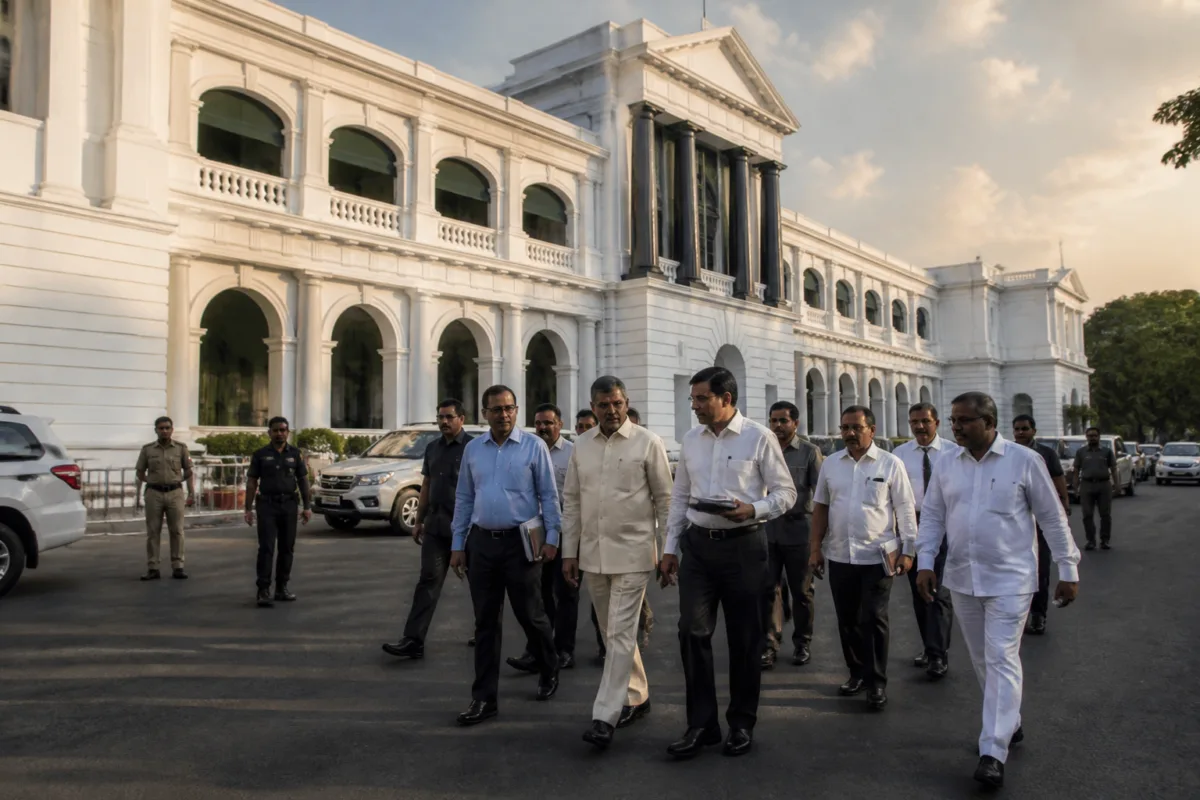
Six months into the Tamilaga Vettri Kazhagam government, power at Fort St George appears to be organised around a compact group of ministers and party functionaries who perform roles extending well beyond their formal portfolios. The arrangement has helped a first-time government defend itself during controversies, coordinate across departments and manage relations with the bureaucracy, but it also raises a central governance question: how much of the state’s public and administrative functioning is being concentrated in a small inner circle?
The Times of India report describes a leadership style in which Chief Minister C Joseph Vijay has largely avoided press conferences and direct responses to criticism. Instead, a group of ministers has become the government’s principal public interface. C T R Nirmal Kumar, Aadhav Arjuna, A Rajmohan, K G Arunraj and K A Sengottaiyan have taken on visible roles in explaining policy, answering opposition attacks and responding to crises. Party general secretary N Anand is described as the less visible but influential coordinator behind the scenes.
This is not merely a question of political messaging. The six functionaries occupy different points in the chain through which a government operates: law and public defence, financial and political strategy, departmental coordination, health and administrative expertise, regional management, and party-bureaucracy mediation. Their combined role suggests that TVK is attempting to compensate for its limited governing experience by relying on a small number of trusted intermediaries.
That model has a clear administrative advantage. A new government does not begin with an established institutional memory of its own. It must understand existing files, inherited programmes, bureaucratic procedures, opposition tactics and local political networks while also demonstrating that it can deliver on its agenda. A compact leadership group can shorten communication channels and ensure that the chief minister’s priorities are conveyed consistently across departments.
But the same arrangement can create risks if informal influence becomes more important than formal responsibility. The report indicates that ministers often answer questions outside their portfolios, consult one another for information and coordinate directly with the chief minister. Rajmohan says ministers prepare for assembly speeches and debates together and seek inputs from colleagues on issues beyond their departments. This may improve political coherence, but it can also make accountability harder to trace when decisions involve several ministries.
Nirmal Kumar has emerged as the government’s most visible legal and political defender. According to the report, he has addressed controversies ranging from the lighting of Karthigai Deepam atop Thiruparankundram to law-and-order criticism and the eviction of residents from Meghamalai. He also led the party’s legal response after the 2025 Karur stampede and articulated the government’s position on court rulings, including the decision to provide jobs to affected families.
His role shows how the law department can become a central political communication channel in a government facing scrutiny. Nirmal Kumar’s defence of Vijay’s decision not to meet the press — that there is no compulsion for a chief minister to do so — is also part of a broader communication strategy. Rather than allowing the absence of direct media engagement to define the government’s public image, the administration has relied on trusted ministers to interpret its position.
Aadhav Arjuna performs a different function. The report presents him as a politically experienced and financially influential crisis manager whose earlier association with the DMK gives him an understanding of the principal opposition’s methods. His aggressive interventions during the assembly session have helped counter attacks on TVK, while younger ministers reportedly approach him for advice. His explanation of Vijay’s silence — that it means the chief minister is planning — converts limited public communication into a deliberate leadership style.
This approach may be effective during political confrontation, but it shifts attention towards the personalities who speak for the government rather than the institutions that implement its decisions. A government’s durability depends not only on how effectively it responds to criticism, but also on whether its departments can translate announcements into rules, budgets, tenders, services and measurable outcomes.
Rajmohan’s comments provide the clearest indication of that implementation challenge. He says the government entered office eager to do new things but has found that correcting old mistakes takes time. He identifies bureaucratic blocks as a reason results have not yet flowed. That observation is important because it locates the problem inside the machinery of government rather than solely in political messaging.
The report also describes a coordination system in which ministers exchange information across portfolios. Rajmohan cites decisions on school playgrounds and teacher vacancies taken during a meeting with Aadhav. He says Vijay remains accessible, sends instructions to ministers through their personal WhatsApp numbers and follows up the next day. Such direct contact can help resolve administrative delays quickly, particularly in a new government where formal processes may be unfamiliar to ministers.
However, informal communication cannot substitute for stable institutional procedures. Instructions passed through personal channels may be efficient, but the public interest requires decisions to be recorded, assigned to the responsible department and implemented through established rules. The report does not establish how these instructions are documented or monitored. That remains one of the key unanswered questions about the TVK government’s administrative model.
K G Arunraj represents a more technocratic element within the inner circle. A doctor and former Indian Revenue Service officer with more than 15 years of administrative experience, he has focused on public health, NEET and welfare schemes such as the Thaaimaaman Thanga Mothira Thittam. Unlike the more combative ministers, he has largely stayed away from political disputes and concentrated on his ministry and constituency.
Arunraj’s account points to a second transition challenge: getting officials at every level to embrace the chief minister’s vision. This is a familiar problem for any new administration, but it is particularly significant for a government attempting to establish its own style while working through an inherited bureaucracy. Political direction can be announced quickly; changing administrative behaviour requires repeated instructions, departmental ownership and sustained follow-up.
His description of Vijay as a demanding leader who scrutinises proposals and adds inputs to final decisions suggests a highly centralised review process. Central review can provide consistency and prevent departments from moving in conflicting directions. Yet it can also place a heavy burden on the chief minister’s office if every significant proposal depends on personal scrutiny before moving forward.
Sengottaiyan’s position adds a regional and historical dimension. A veteran associated with both MGR and Jayalalithaa, he entered TVK with expectations that his experience would have a wider influence. Six months into the government, the report says he has remained focused largely on the revenue portfolio and western districts, including Erode, Coimbatore, Tirupur and the Nilgiris. He also helps the party engage with former AIADMK functionaries.
His role illustrates how the government is combining new political leadership with inherited political experience. Sengottaiyan’s use of historical precedents to defend Vijay, including during the Mekedatu dispute, provides TVK with institutional memory that its newer ministers do not possess. His regional presence may also help the party manage political expansion beyond its core leadership network.
The least visible figure in the arrangement is Anand, whose importance lies in organisation and administrative mediation. The report says he oversees nearly 16 first-time ministers who rose through Vijay Makkal Iyakkam and TVK’s district ranks. He is also approached regarding bureaucratic hurdles and disputes with local authorities and reviews welfare and infrastructure proposals, including farmers’ schemes and new bus terminuses, before approval.
That description places Anand at the junction between party organisation, ministerial management and project scrutiny. It is especially relevant for infrastructure because proposals such as new bus terminuses involve multiple agencies, land decisions, funding questions and local administrative clearances. The report does not provide details of the projects reviewed or the formal authority under which this scrutiny occurs, but it indicates that infrastructure decisions are being assessed within the chief minister’s political organisation as well as through departmental channels.
The TVK government’s emerging structure therefore rests on three overlapping systems. The first is the formal cabinet and bureaucracy, which carry legal responsibility for public decisions. The second is the public defence network, through which ministers explain the government’s position and respond to criticism. The third is the informal inner circle that coordinates ministers, handles political and administrative disputes and reviews proposals before they advance.
This arrangement can help a new administration remain united during its early months. It can also produce faster political responses and give inexperienced ministers access to trusted advisers. The report’s examples — from assembly debates and court responses to teacher vacancies, welfare proposals and bus terminus plans — show how the network operates across both political and administrative issues.
The structural question is whether this model will mature into institutional capacity or remain dependent on personal trust. A government can begin with a small council, but departments eventually need clear responsibilities, transparent decision trails and professional systems that function without constant intervention from a few senior figures. The report records the government’s own acknowledgement that bureaucratic blocks remain a problem, making this transition especially important.
What the first six months establish is not a final administrative blueprint but an identifiable governing pattern. Vijay remains the central decision-maker, while a group of ministers and the party general secretary provide political cover, regional reach, administrative coordination and crisis management. The next test will be whether this inner-circle model can convert access and influence into visible departmental results, while preserving formal accountability for the decisions taken in its name.

