


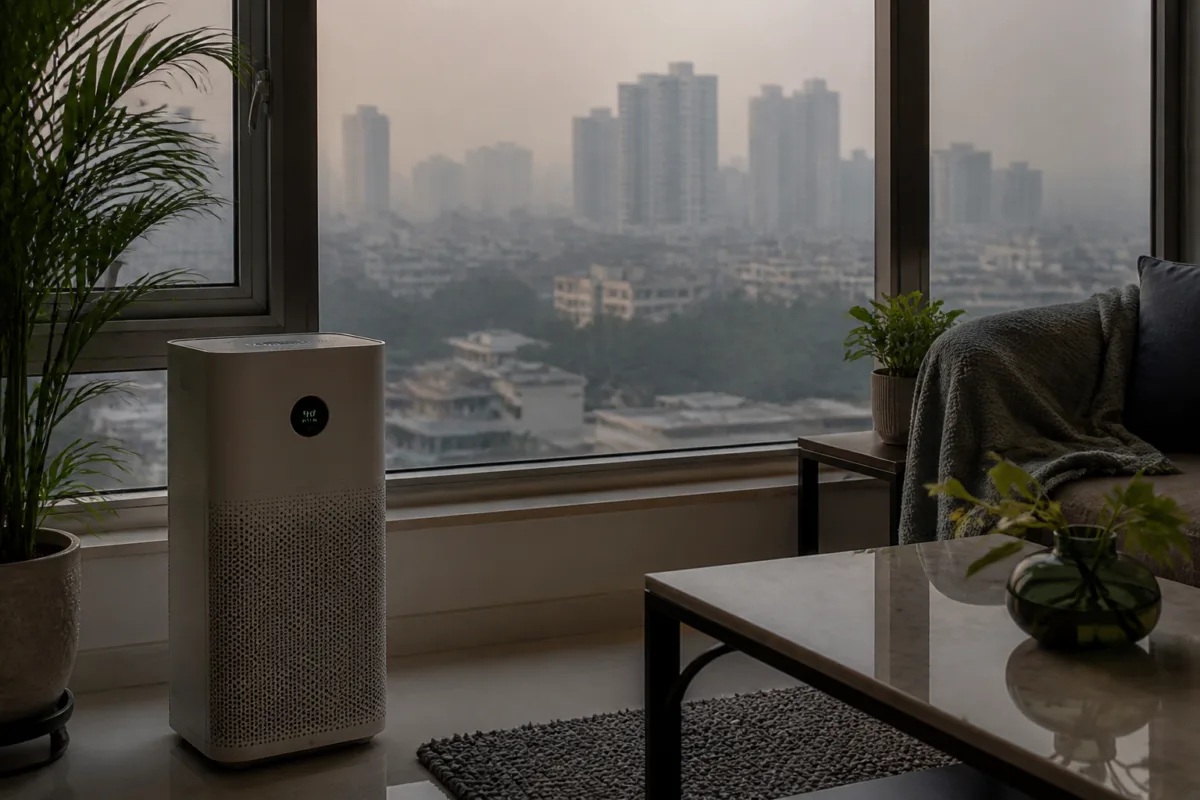
Delhi air pollution is no longer driving only short bursts of post-Diwali panic buying. The latest surge in air purifier demand points to a broader shift: households are beginning to treat indoor air quality as a continuing urban concern, while retailers and manufacturers are positioning the category as an everyday home product rather than a seasonal appliance.
That shift matters because it shows how residents are responding to a pollution problem that remains highly variable but repeatedly disruptive. The Economic Times, citing manufacturers, retailers and marketplace data, reported that air purifier enquiries and purchases rose sharply after Diwali, with Delhi-NCR continuing to be the country’s largest market. The immediate trigger was deteriorating air quality across Delhi-NCR and adjoining parts of North India, but the commercial response is becoming less dependent on a single pollution episode.
The evidence also reveals a widening geography of concern. Demand is increasing in Maharashtra, Karnataka, Tamil Nadu and Telangana, even though Delhi-NCR accounted for nearly 80 per cent of total sales volumes until 2025. Mumbai, according to Infiniti Retail, has also seen an increase during periods of poor air quality. This suggests that the market is following a wider public recognition that air-quality problems are not confined to one metropolitan region, although the supplied report does not establish whether this expansion is driven by measured pollution, consumer awareness, incomes, retail availability or a combination of these factors.
The most significant change is in timing. Versuni India said buyers are increasingly purchasing air purifiers before the seasonal pollution peak instead of waiting for air quality to deteriorate sharply. Its chief marketing officer, Pooja Baid, said demand was becoming more consistent even as the number of severe pollution days in 2026 had reduced compared with the previous year. That combination is important: consumers may be responding less to one exceptional episode and more to the expectation that poor air quality will recur.
This is a transition from reactive consumption to preventive household spending. It does not mean that the underlying pollution problem has been solved. Rather, it indicates that residents are adapting their homes and purchasing decisions around a risk that remains part of the urban environment. The distinction is central to understanding the market. A one-week sales spike reflects immediate anxiety; steadier demand reflects a change in how households define basic home requirements.
The available company figures reinforce the scale of that change. Infiniti Retail, which operates Croma, said air purifier volumes had more than doubled in 2026. Amazon India reported that sales on its platform doubled in the last week, while Xiaomi India said it had recorded approximately fourfold year-on-year growth. Dyson reported that visits to air purifier pages on its Indian website increased by more than 100 per cent in October compared with the same period a year earlier. These figures come from individual companies and platforms rather than a single independent market tracker, so they should not be treated as a consolidated measure of national sales. They nevertheless point in the same direction: interest is rising across mass-market, online and premium segments.
Product features are changing alongside demand. Amazon said consumers were comparing models based on room size, filter types and live AQI sensors through its AI-based shopping assistant. The category is also seeing interest in app-based controls, real-time air-quality displays, heating and humidification. These features turn the purifier from a basic filtration device into a connected home appliance that gives users information about their immediate surroundings. The commercial emphasis is therefore shifting from simply selling a machine to selling a system of monitoring and managing indoor conditions.
That creates an important institutional question. When households purchase equipment to manage air inside their homes, responsibility for coping with pollution becomes partly privatised. The individual consumer pays for filtration, electricity, replacement filters and maintenance, while the sources and governance of outdoor pollution remain matters for public authorities. The supplied report does not provide a breakdown of these costs or assess how effective different products are in particular indoor settings. It does, however, show how market demand is growing around a public problem that households cannot address individually at its source.
The pattern also exposes the unequal geography of protection. Delhi-NCR remains the dominant market, while the category is spreading to other states and metropolitan regions. Yet the report provides no evidence on ownership across income groups, rental households, informal settlements, schools, workplaces or public buildings. Nor does it establish whether people in the most polluted or most exposed neighbourhoods are the ones most able to purchase and maintain such devices. Those gaps matter because a consumer market can expand without delivering equal protection across a city.
The air-quality data in the report explains the immediate urgency. Delhi’s 24-hour average AQI stood at 367 on the day cited, placing it in the ‘very poor’ category. Of 59 monitoring stations reporting data, 17 recorded ‘severe’ air quality, 38 recorded ‘very poor’, three recorded ‘poor’ and one recorded ‘moderate’ levels. The spread across monitoring stations shows that the city was not experiencing a uniform condition at every location, even though the citywide average was very poor. The report also said the Air Quality Early Warning System forecast a decline in PM2.5 and PM10 concentrations over the following two days, with rain potentially bringing marginal relief.
Short-term improvement, however, does not remove the structural feature visible in the sales data: demand is now being built around recurring seasonal deterioration and increasing awareness of indoor air quality. The report cites a projection from consulting firm The Knowledge Company that India’s air purifier market, valued at Rs 320 crore in FY25, could reach Rs 1,000 crore by FY30, implying a compound annual growth rate of 26 per cent. Xiaomi separately estimated that the market could grow by around 20 per cent year on year. These are forecasts and company estimates, not a common official market assessment, but both indicate expectations of sustained expansion.
The policy landscape remains less clear in the supplied material. The report identifies the Air Quality Early Warning System as a source of pollution forecasts, but it does not detail the responsibilities of municipal bodies, pollution-control authorities, housing providers or building managers for indoor air quality. It also does not examine public-building standards, ventilation requirements, affordability measures or the regulation of purifier performance. As a result, the evidence is stronger on changing consumer behaviour than on the institutional response surrounding it.
That imbalance is the larger urban question. A city can record temporary improvements in air quality while residents continue to invest in private protection because they expect the next deterioration. The market’s expansion therefore provides a useful signal of public perception: air pollution is being absorbed into household planning, retail inventories and home-technology choices. But sales growth cannot substitute for cleaner ambient air, and the supplied evidence does not show that purifiers are reducing pollution exposure across the city as a whole.
What the evidence confirms is a shift in behaviour. Delhi-NCR continues to anchor the market, demand is spreading beyond traditional metropolitan buyers, and several major retailers and manufacturers report sharp growth. What remains uncertain is who can participate in this response, how indoor protection varies between homes and public spaces, and how the commercial expansion will interact with long-term efforts to address outdoor pollution. Those are the issues that will determine whether air purifiers remain an emergency purchase or become a permanent feature of India’s urban life.

