


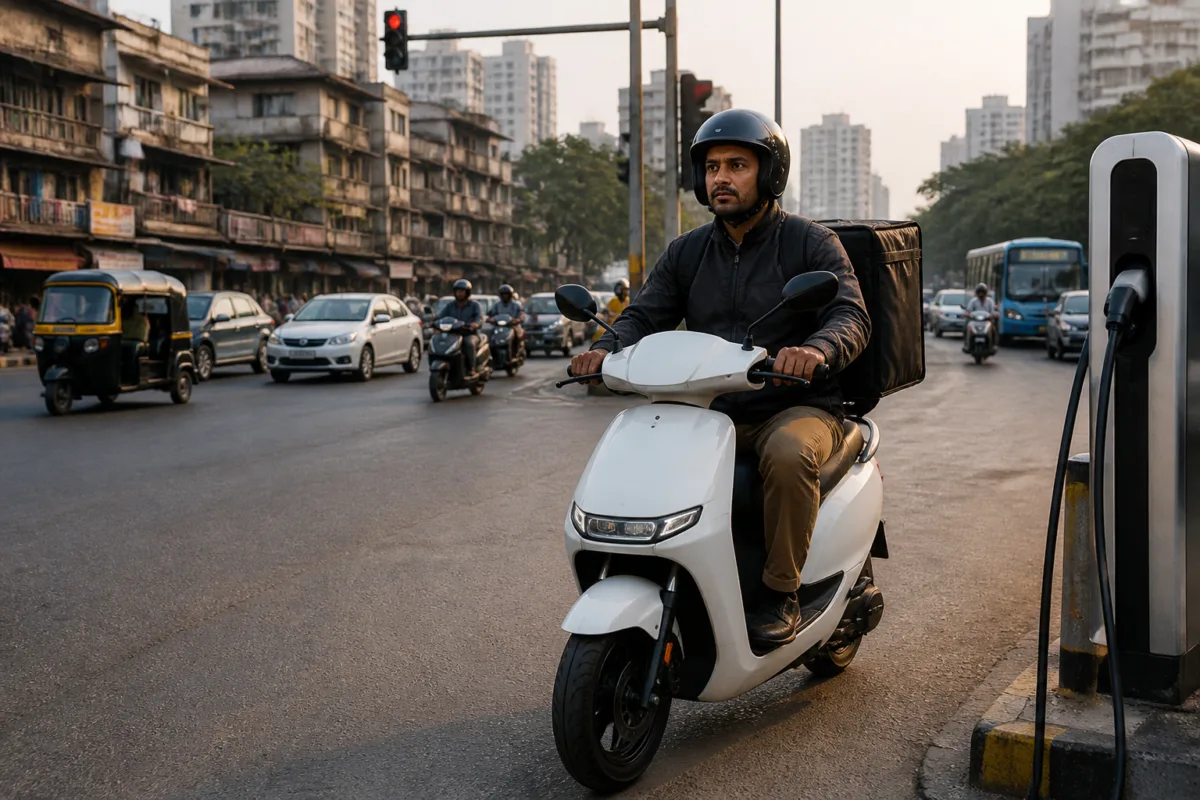
Eternal’s decision to reassess its 2030 target for a fully electric delivery fleet reveals a central difficulty in India’s urban mobility transition: replacing vehicles is easier to announce than to make accessible across the many workers, vehicle types and cities that keep the delivery economy running. The Zomato and Blinkit parent remains committed to electrification, but its own expansion has changed the scale of the problem.
In an interview with PTI, Eternal Chief Sustainability Officer Anjalli Ravi Kumar said the company was working towards a revised timeline after recognising that the earlier deadline may not be feasible. The company is considering electric-vehicle availability, government policy implementation and the transportation requirements of all its businesses before setting a new group-wide target.
That shift is significant because the original target was framed around a smaller and narrower operating system. When it was set, Zomato had about 1.5 lakh monthly active riders, Kumar said. The group now has 12 lakh riders across Zomato and Blinkit. The company also expects to onboard about 30 lakh people a year to maintain that base, across roughly 900 cities. A target designed for a smaller food-delivery network therefore has to be reconsidered in the context of a much larger and more geographically dispersed platform economy.
The issue is not only the number of electric two-wheelers available. Eternal’s delivery network includes several types of movement. Food and quick-commerce deliveries generally rely heavily on two-wheelers, while the group’s Hyperpure business uses four-wheelers, trucks and smaller commercial vehicles. Kumar said the new target would have to cover the group’s complete transportation requirement rather than treat each business separately.
This matters for urban policy because the transition to electric mobility is often measured through vehicle sales or market penetration, while delivery work depends on daily access, operating reliability and the ability to finance a vehicle. A rider may work in a city where electric vehicles are available but still lack dependable charging, rental options, maintenance support or the money required to purchase one. The company’s comments place those practical constraints at the centre of the target-setting exercise.
Eternal said electric-vehicle adoption within its delivery fleet was already ahead of the broader Indian two-wheeler market. Kumar said the company’s previous estimate put market EV penetration at about 6-7 per cent, while approximately 12-13 per cent of partners in its own fleet were already using electric vehicles. That meant adoption among its partners was almost twice the estimated market level at the time of the company’s assessment.
The comparison, however, also shows why a higher starting point does not automatically translate into a fully electric fleet. Moving from roughly one in eight partners using an EV to complete electrification requires the remaining transition to reach workers with different incomes, vehicle needs and locations. The company’s own scale makes that final stretch more difficult than the initial adoption phase.
Eternal’s current approach is based on incentives and access rather than a compulsory vehicle choice. The company said it offers financial incentives, rental options and awareness initiatives to encourage partners to shift. Its equal-benefit policy pays delivery partners using electric vehicles as much as those using petrol vehicles, even though electric vehicles can have lower operating costs. The delivery partner application also provides access to rental options, while the EV Bazaar initiative is intended to familiarise workers with available models.
The design of these measures points to an important institutional reality: delivery partners generally arrange their own vehicles. The company can influence the economics of adoption, but it does not control the entire vehicle, financing and infrastructure system. A corporate target can therefore depend on public policy, manufacturers, financiers, rental providers and city-level charging networks that sit outside the company’s direct control.
Kumar said the company could not guarantee that all 30 lakh people it needs to onboard annually would be able to access an electric vehicle reliably across 900 cities. That limitation is especially relevant to the geography of platform work. Adoption conditions in a major metropolitan area cannot be assumed to exist in every smaller city where delivery platforms are expanding. A policy that works in one urban market may not provide the same result where vehicle supply, charging access, servicing and rental networks are less developed.
The question of affordability is also inseparable from employment. If delivery workers are expected to purchase or rent electric vehicles without suitable financial support, the cost of the transition could affect who can enter or remain in the sector. Eternal said it was advocating worker-friendly EV policies so that cleaner mobility would not restrict employment opportunities for people who may not be able to buy an electric vehicle.
This places delivery workers at the intersection of two policy objectives: reducing transport emissions and preserving access to urban livelihoods. A transition measured only by the number of electric vehicles may miss whether workers can use those vehicles productively. For a delivery partner, range, charging time, battery performance, rental terms and maintenance are operational questions, not only environmental ones. The supplied material does not establish how these factors vary across the company’s cities, but it shows why they are relevant to any credible fleet target.
Government policy is consequently part of the company’s timetable. Kumar said the possibility of a revised target, including a date such as 2035, would depend partly on whether EV policies were rolled out sufficiently across the country. Eternal remains hopeful about a future commitment but has not announced a final revised date. The company’s position illustrates how corporate electrification pledges can be affected by the pace and geographical reach of public policy.
The policy challenge extends beyond two-wheelers. Hyperpure’s use of trucks and smaller commercial vehicles means that group-wide electrification would require attention to commercial-vehicle availability and operating requirements. These vehicles may have different purchase costs, charging needs and duty cycles from delivery scooters. A single percentage target can conceal these differences unless the company defines the vehicle categories and activities included in the calculation.
The same platform is also addressing a separate sustainability issue in the food system: packaging. Through PackSwitch, Eternal is helping restaurant partners identify alternatives to plastic packaging based on the dishes they serve, improve access to suppliers and connect with startups developing new solutions. The company said Hyperpure sold more than 3,000 metric tonnes of sustainable packaging to 50,000 restaurants last year.
On the consumer-facing side, more than 10,000 restaurants across over 400 cities had received Zomato’s low-plastic packaging tag after the company verified that packaging used for their main menu was sustainable, according to Kumar. These figures show the breadth of the group’s sustainability interventions, but they also underline the need to distinguish between adoption programmes with direct company control and fleet electrification, which depends heavily on individual workers and external infrastructure.
The evidence therefore supports a narrower conclusion than a simple success-or-failure assessment of Eternal’s 2030 pledge. The company has not abandoned electrification. It reports EV adoption among its partners above the broader two-wheeler market, has introduced financial and rental support, and says electric mobility continues to make economic sense. At the same time, it has acknowledged that rapid business growth, multiple vehicle categories and uneven policy implementation make the earlier deadline difficult to maintain.
The larger urban question is whether India’s EV transition can scale with the informal and platform-based work that increasingly supports city life. Food, groceries and restaurant supplies move through networks whose environmental performance depends on millions of individual journeys. Those journeys cannot be decarbonised through corporate ambition alone. They require vehicles that workers can access, infrastructure that functions across cities and policies that account for the financial realities of people who arrange their own transport.
Eternal is now working towards a revised date, but it has not committed to one. The next significant development will be the company’s eventual group-wide target and the policy conditions it identifies as necessary to achieve it. Until then, the reassessment offers a clear measure of the gap between setting an electric-fleet ambition and delivering it across a rapidly expanding, multi-city urban economy.

