


Sunil Mittal’s Airtel strategy is moving beyond the familiar telecom battle over subscribers and tariffs. Fifty years after starting with a bicycle-component factory in Ludhiana, the Bharti Enterprises founder is describing a larger transition in which connectivity becomes the base layer for artificial intelligence, sovereign cloud, digital finance, satellite communications and other technology services. His argument also exposes the infrastructure and financial pressures beneath India’s digital economy: networks must expand, operators must remain financially strong and consumers may have to pay more for access.
Mittal’s most immediate proposal is a rise in mobile average revenue per user, or ARPU, to about Rs 350 a month. Airtel reported mobile ARPU of Rs 271 in the September quarter, compared with Rs 256 a year earlier. Reaching the proposed level would therefore require an increase of about 29 per cent from the latest reported figure. The last major industry-wide tariff revision came in June 2024, when operators raised prices by around 10-25 per cent. Mittal did not provide a timeline for reaching Rs 350.
His case is built around the widening role of mobile connectivity in daily life. In the interview with PTI, he linked mobile services not only to calls and data but also to banking, education, healthcare records, direct benefit transfers, UPI payments and entertainment. He argued that a daily cost of Rs 10-12 should be viewed against the range of services enabled by a connection. The position places telecom tariffs within a broader debate over affordability, digital access and the financial capacity of operators to maintain networks.
That debate matters because the digital economy is dependent on physical systems that remain largely invisible to users. Telecom companies must invest in spectrum, towers, fibre, network equipment, data infrastructure and submarine cables before online services can reach consumers. Mittal said operators carry much of this investment burden while digital platforms often command higher valuations and capture a larger share of the commercial value generated by internet use. His complaint reflects a structural tension in the sector: connectivity is treated as an essential service, but its underlying infrastructure requires continuous and capital-intensive investment.
Bharti’s own history illustrates how India’s communications network was built through a series of commercial and institutional bets. Mittal began with manufacturing in Ludhiana in 1976 and later moved through hosiery, stainless steel sheets and imported communications equipment. A profitable portable-generator business collapsed after a change in government import policy, showing how regulatory decisions could quickly reshape business models in India’s tightly controlled economy.
The decision to enter mobile services came as the technology was still largely unaffordable for ordinary consumers. Bharti launched Airtel’s mobile services in Delhi in 1995, when a survey had estimated that the city would have only 10,000 mobile subscribers in a decade. Mittal said Airtel crossed that number within its first year. The company then expanded beyond major cities into markets such as Bihar, Odisha, Assam and the northeast, where demand was uncertain and network deployment was more difficult.
That expansion was important not only for Airtel’s scale but also for the geography of India’s digital economy. A network strategy focused only on affluent urban markets would have left large parts of the country outside the first wave of mobile growth. Mittal’s account suggests that expansion into smaller towns and difficult regions was based on an expectation that lower tariffs and rising affordability would unlock demand. In some areas, he said, Airtel was for a period the only operator.
Bharti also adopted an operating model that shifted significant network and information-technology functions to specialist vendors. The decision was taken when the company had around four to five million subscribers and wanted to expand to 25-35 million. The model allowed Airtel to concentrate on customers, marketing and business strategy while external partners handled much of the network equipment and its management. According to Mittal, the approach was initially questioned by international telecom companies but later became a reference point for other operators and a Harvard case study.
The institutional consequences of that model are visible in the way telecom networks operate today. Consumer-facing digital services depend on a chain that includes spectrum allocation, tower construction, fibre deployment, equipment procurement, data centres, submarine cables and network maintenance. The commercial operator may control the customer relationship, but the system is distributed across multiple vendors, regulators and infrastructure providers. This makes the financial health of operators a public infrastructure concern rather than only a corporate matter.
Mittal’s assessment of competition is shaped by the sector’s recent consolidation. He identified 2002, 2009 and 2016 as three especially difficult periods for Bharti. The 2016 disruption followed Reliance Jio’s entry with free introductory services and aggressive pricing, triggering a price war and accelerating consolidation. Several operators exited or merged, while surviving companies faced pressure to invest in networks and retain customers.
The result was a market with far fewer major operators. Mittal said India should not return to the period when more than a dozen companies competed for subscribers and described three private operators alongside state-owned BSNL as an appropriate structure. The comments come as Vodafone Idea continues to face financial challenges and BSNL works to rebuild its network and competitive position. The underlying policy question is how to balance consumer prices, competition and the minimum financial strength required for long-term network investment.
The experience of 5G has added another layer to that question. Mittal said the technology had not delivered the new revenue streams operators expected, particularly from industrial applications such as connected factories and automation. He described this as a global disappointment. At the same time, he said spectrum expenditure across operators had run into lakhs of crores of rupees and estimated network deployment costs at another Rs 1.5 lakh crore. The figures, as presented in the interview, show the gap between the cost of preparing for a new technology cycle and the speed at which monetisable use cases emerge.
Mittal nevertheless considers the investment necessary for future demand. He pointed to a possible next cycle involving 6G and sensing networks over the next three to five years, with connected glasses, rings, watches and earpods potentially taking on functions now handled by smartphones. He also expects networks to interact increasingly with users’ artificial intelligence agents. These claims describe a possible direction for the industry, but the evidence supplied in the interview does not establish the commercial scale or timing of such applications.
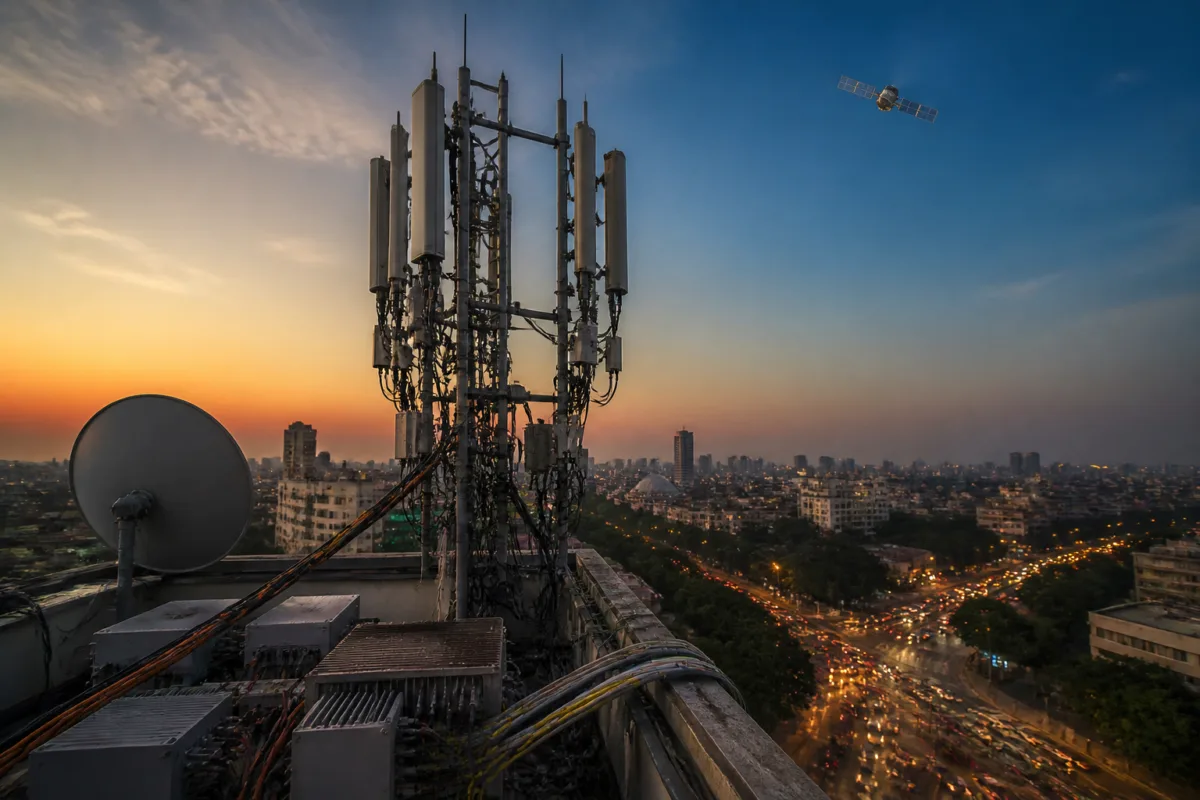
The more immediate infrastructure issue is capacity. Mittal said India has around 350,000 mobile towers, compared with more than one million in China, and argued that India needs to at least double its tower base. He also identified greater requirements for fibre, submarine cables, satellites and AI data centres. The comparison is presented as Mittal’s assessment rather than an independently supplied benchmark in the report, but it captures the physical scale of the expansion he believes will be needed if India is to support a larger digital economy.
Satellite connectivity forms part of that strategy. Through Eutelsat OneWeb, in which Bharti has invested, the group is seeking to connect remote villages, forests, mountains, ships and aircraft where conventional mobile and fibre networks may not be economical. Mittal described satellite services as complementary to terrestrial networks rather than a replacement for them: fibre remains stronger where it is available, while satellites can serve locations that are difficult to reach through fixed or terrestrial infrastructure.
The satellite proposition also carries a governance and national-security dimension. Mittal argued that India should retain control over strategic communications systems, including how data is routed and what equipment enters the country. He said OneWeb services were functioning and that the company was awaiting the final government signal to expand commercial operations. The report does not specify the regulatory process or timeline behind that signal, leaving the institutional pathway for wider commercial deployment unclear.
This is where Mittal’s 50-year business account becomes an urban and national infrastructure story. Telecom networks are no longer limited to voice services. They support payments, public transfers, healthcare records, e-commerce, delivery platforms, education and entertainment. Yet the network is unevenly experienced: dense urban areas may receive multiple forms of connectivity, while remote settlements can remain dependent on a smaller number of infrastructure options. The question is not simply whether India is digitally connected, but whether its networks are sufficiently broad, resilient and financially sustainable for the services built on them.
Airtel’s proposed shift into AI, sovereign cloud, digital finance, fibre-to-the-home and satellite links reflects an attempt to capture more value from that infrastructure. It also represents a move from being primarily a connectivity provider to becoming a wider technology platform with connectivity at its core. Whether that model succeeds will depend on demand, regulation, capital requirements and the ability of operators to convert network investment into durable revenue.
The evidence in the interview confirms three immediate realities. Mobile services have become foundational to India’s digital economy; telecom networks require continuing investment; and the industry’s financial structure remains central to future infrastructure expansion. What remains unresolved is how higher tariffs would affect affordability, how competition should be maintained without weakening operators, and how proposed AI, cloud and satellite businesses will develop commercially. Those questions will determine whether India’s next digital phase is supported by a resilient public-facing network or constrained by the cost of building it.

