


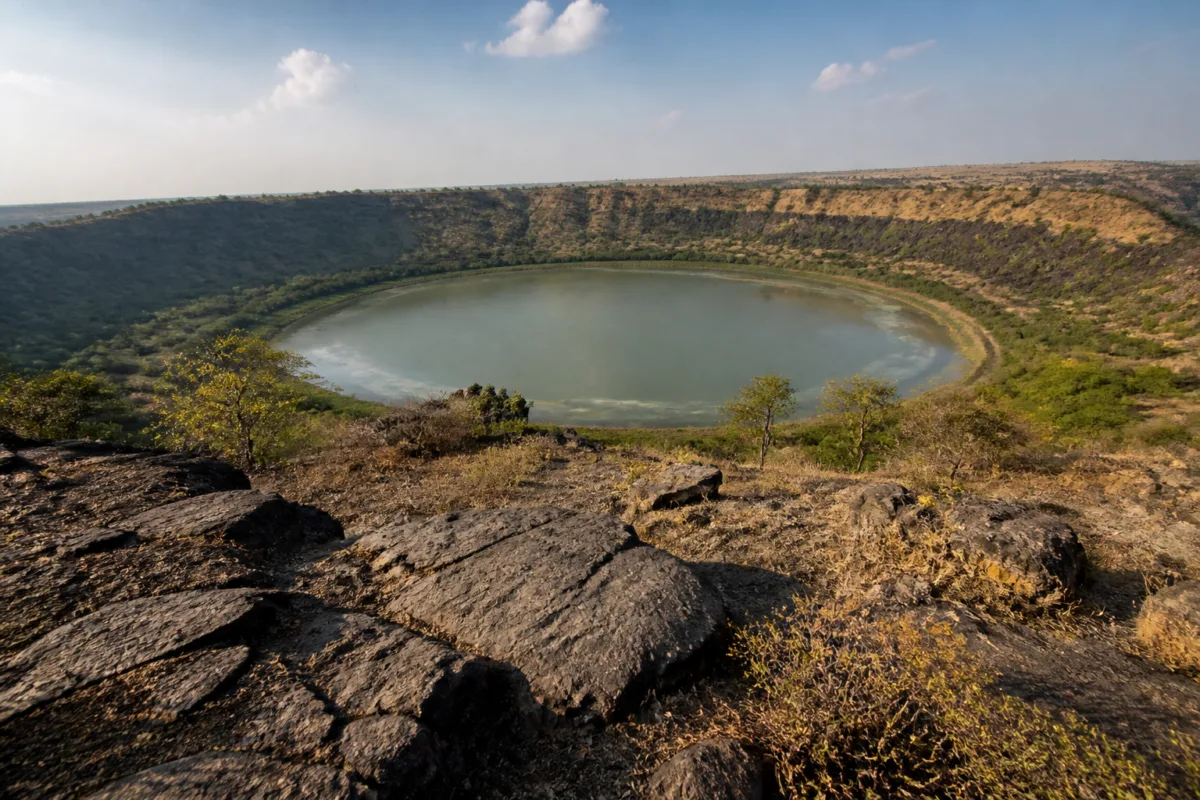
Lonar Lake impact crater has gained global recognition, but the more consequential question is whether that recognition can strengthen the systems needed to protect one of India’s most unusual geological landscapes. The crater in Maharashtra’s Buldhana district has been included in the International Union of Geological Sciences’ Third 100 Geological Heritage Sites after a nomination led by the Kolkata-headquartered Geological Survey of India. The selection places Lonar alongside internationally recognised formations including Mount Fuji, Norway’s fjords, the San Andreas Fault, Mount Aconcagua and the Chocolate Hills.
The announcement, made at an international geoheritage event hosted by Algarvensis Geopark in Portugal on November 6, is primarily a scientific and conservation milestone. It is also an institutional marker for the Geological Survey of India, which has been working to identify, document and conserve geological heritage in the country. Lonar’s inclusion gives that work an international platform and makes the crater part of a wider conversation about how exceptional geological sites are documented, interpreted and protected.
## Why Lonar is geologically exceptional
Lonar is estimated to be approximately 12,000 years old and is described as one of the youngest and best-preserved bowl-shaped hypervelocity impact craters on Earth. It measures around 1.88 km in diameter and was formed when a meteorite struck the Deccan Traps, the vast volcanic basalt formation created around 65 million years ago.
Its importance lies not only in its age or size. Lonar was formed in basaltic rock, unlike most terrestrial impact craters that occur in other geological formations. The source report identifies it as one of only five known hypervelocity meteorite impact craters developed in basaltic terrain. That makes the site valuable for understanding both the impact event and the geological material into which the meteorite struck.
The crater also contains a saline-alkaline lake, creating an unusual combination of geological and ecological characteristics. Its circular form, fractured basalt, overturned rock layers and deposits of material thrown out during the impact preserve visible evidence of the collision. Impact glass, microscopic spherules and rocks melted by the energy of the event provide further material for studying the physical and chemical processes associated with high-velocity meteorite strikes.
This combination is what makes Lonar more than a scenic lake or a tourism destination. The site functions as a natural record of a planetary-scale event, preserved within a specific geological setting. Its value depends on the continued visibility and integrity of that record, as well as on the scientific access needed to study it.
## Recognition is not the same as protection
The IUGS listing creates international visibility, but the nomination itself does not establish how Lonar will be managed on the ground. The source material says the recognition is expected to strengthen protection efforts, promote geological education and encourage scientifically responsible geotourism. Those objectives point to the practical work that follows recognition: documenting the site, communicating its significance and ensuring that visitor activity does not undermine the features that make it important.
That distinction matters for geological heritage sites. The central challenge is not simply to attract more visitors or secure a prestigious designation. It is to ensure that public access, tourism activity and conservation remain compatible with the geological evidence contained within the site. For Lonar, that evidence includes rock formations, impact deposits and the lake’s saline-alkaline character. Any conservation approach must therefore account for the crater as an interconnected geological and ecological landscape rather than treating it as a single viewpoint or tourist attraction.
The recognition also raises a question about institutional coordination. The GSI led the nomination and has a continuing role in identifying, documenting and conserving India’s geological heritage. The international listing gives the agency a stronger basis for explaining the site’s scientific value, but the supplied material does not specify which local or state institutions will implement future protection, visitor management or education measures. That administrative detail will be important in determining how the recognition translates into local outcomes.
## The scale of the global programme
Lonar’s selection is part of a programme that has involved more than 1,000 experts from 90 countries and 20 international organisations. The latest group spans 47 countries, including 22 sites in the Asia-Pacific region, 34 in Europe, 22 in the Americas, 11 in Africa, six in the Middle East, two in Antarctica and three in the high seas.
These figures show that the listing is not a local tourism award or a limited institutional citation. It forms part of an international effort to identify geological sites with exceptional scientific and educational value. The programme was launched in 2022, and the participation of experts and organisations indicates the scale of the assessment network behind the designation.
For India, the recognition brings attention to the country’s geological diversity through a site whose significance is easy to describe but difficult to replicate elsewhere. Lonar’s basaltic impact setting, crater form and saline-alkaline lake combine characteristics that are individually important and collectively rare. The listing therefore strengthens the case for geological heritage to be treated as part of the country’s wider conservation and educational infrastructure.
## From global status to local stewardship
The most important next phase is likely to be the conversion of scientific recognition into sustained stewardship. The source report identifies three broad areas: protection, geological education and scientifically responsible geotourism. Each requires a different form of institutional response.
Protection requires the geological features of the crater to remain documented and conserved. Education requires the site’s scientific evidence to be made understandable to students, residents and visitors without reducing it to a simplified tourism narrative. Responsible geotourism requires access and interpretation that respect the crater’s geological and ecological characteristics. The supplied material does not provide details of specific projects, budgets, visitor rules or implementation timelines, so the operational framework remains to be established from the information available.
The distinction between recognition and implementation is particularly relevant because geological heritage cannot be recreated once damaged. Lonar’s value comes from the survival of physical evidence: fractured basalt, overturned layers, impact debris, impact glass and other material associated with the meteorite strike. International attention can help mobilise conservation interest, but it cannot substitute for a clear local management structure.
The recognition also expands the role of public-facing science. A site such as Lonar can help connect geological research with education and place-based tourism. But that connection depends on communicating why the crater matters, not merely presenting it as a natural spectacle. The GSI’s nomination work provides the institutional foundation for that explanation; the long-term test will be whether the site’s scientific character remains central to how it is protected and presented.
Lonar’s inclusion in the IUGS Third 100 Geological Heritage Sites confirms its international geological importance and highlights the GSI’s role in bringing India’s formations into global conservation discussions. What remains less clear is how the designation will affect day-to-day management in Buldhana district. The developments that deserve monitoring are the protection measures, educational initiatives and geotourism framework that follow. For Lonar, the global listing is an important beginning, but its lasting value will depend on whether recognition leads to disciplined local stewardship.

