


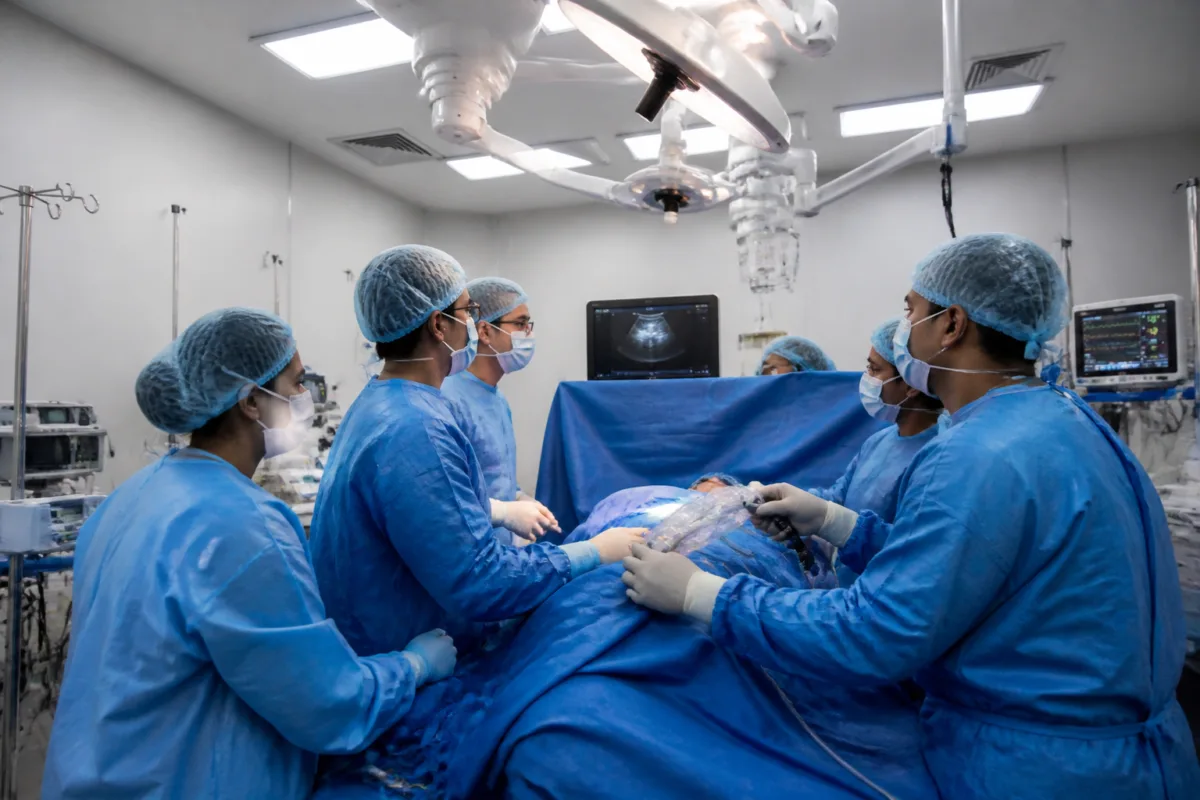
AIIMS Delhi’s first fetal spine surgery in India marks more than a medical milestone. It demonstrates the arrival of a highly specialised form of prenatal care in a public institution, while also exposing the clinical, organisational and access challenges that will determine whether such treatment remains a one-off achievement or develops into a dependable service for eligible families.
Doctors at the All India Institute of Medical Sciences performed the six-hour procedure on November 12 at the AIIMS Neurosciences Centre, operating on a foetus at 25 weeks of pregnancy. The surgery was undertaken to repair myelomeningocele, the most severe form of spina bifida. The mother and foetus were reported to be stable and recovering well, according to Dr K Aparna Sharma of the maternal-fetal medicine team.
The condition involves an opening in the developing spine through which the spinal cord and its coverings protrude. The exposed nerves can suffer progressive damage during the remaining months of pregnancy. Children born with severe spina bifida may face paralysis, bladder and bowel dysfunction, and hydrocephalus, a condition that can require additional surgery.
The procedure changes the timing of treatment. Traditionally, the spinal defect is repaired after birth. Prenatal repair attempts to protect the exposed spinal cord before delivery, potentially limiting some of the damage that may occur in the uterus. Professor Deepak Gupta, who led the neurosurgical team, said the aim was to protect the spinal cord from further injury rather than provide a cure.
That distinction is important. Fetal surgery is not a universal solution for spina bifida, and the AIIMS team said it must be offered only to carefully selected patients. The procedure also carries significant risks, including premature labour, preterm delivery, bleeding, infection and complications associated with the uterine scar. The intervention therefore requires a system capable of managing maternal-fetal medicine, neurosurgery, obstetric anaesthesia, neuroanaesthesia, plastic surgery and neonatal care as one coordinated clinical pathway.
The AIIMS operation involved more than 30 clinicians and nurses. The participating teams included maternal-fetal medicine and obstetrics, obstetric anaesthesia and neuroanaesthesia, plastic surgery and neonatology. This makes the procedure an institutional achievement rather than the work of a single specialty. Its success depended on the ability to assess the pregnancy, operate on the foetus, protect the mother, manage anaesthesia and prepare for neonatal care within the same care system.
The clinical rationale for intervening before birth is supported by international evidence cited in the report. The Management of Myelomeningocele, or MOMS, trial found that 40% of children who underwent fetal surgery required a cerebrospinal fluid shunt for hydrocephalus by 12 months, compared with 82% of children who underwent surgery after birth. The comparison points to one potential benefit of prenatal repair: reducing the need for a later intervention to manage fluid accumulation in the brain.
The same evidence also shows why the operation cannot be assessed through a single outcome. The purpose of fetal repair includes reducing hindbrain herniation, improving early lower-limb function and increasing the likelihood of independent walking in carefully selected babies, according to Professor Gupta. These are potential improvements in outcomes, not guarantees. The procedure remains dependent on patient selection, surgical expertise, pregnancy monitoring and post-operative care.
For a public hospital, the financial structure of the operation is also significant. AIIMS said the surgery was provided free of cost under the Centre’s Janani Shishu Suraksha Karyakram, or JSSK. The programme’s involvement places the procedure within a public-service framework rather than treating it solely as a high-cost tertiary-care innovation available to families able to pay privately.
However, making a procedure free at the point of treatment does not by itself make it broadly accessible. Families must first receive timely antenatal care, obtain an accurate diagnosis, reach a specialist centre and meet the clinical criteria for surgery. They also require counselling about risks to the mother and foetus. The report does not establish how many Indian hospitals currently have the capacity to diagnose, refer or perform such procedures, or how many families could eventually be eligible.
That gap highlights the infrastructure required behind advanced medical care. A fetal-care programme depends not only on an operating team but also on referral networks, imaging and diagnostic capacity, trained obstetric and neonatal staff, intensive monitoring and the ability to manage premature delivery if complications arise. The uterine scar created by the operation adds another clinical consideration for the mother and requires continued obstetric supervision.
AIIMS said it plans to develop a structured fetal-care programme to offer the procedure to eligible families. The proposed programme is the next institutional step following the first operation. Its significance will depend on whether it establishes consistent protocols for referrals, selection, counselling, surgery and follow-up. The supplied report does not provide details of the programme’s proposed capacity, eligibility criteria, timelines or funding beyond the stated support under JSSK.
The operation also reflects a broader shift in the boundaries of specialised healthcare. A condition once treated only after birth can now, in selected cases, be addressed during pregnancy. But the shift is not simply technological. It requires public hospitals to coordinate different departments, build rare clinical expertise and sustain monitoring over a long period. In this sense, the procedure tests the depth of an institution’s healthcare infrastructure as much as the skill of its surgeons.
The public-health value of such a service will ultimately be measured through more than the completion of a technically successful operation. It will involve maternal safety, foetal survival, neurological outcomes, the need for later procedures and the quality of long-term follow-up. The report provides the early clinical status of the mother and foetus and cites international trial evidence, but it does not yet establish the long-term outcome of the AIIMS case.
The first procedure also raises a question about how advanced care is distributed within India’s public health system. AIIMS Delhi is a national referral institution, and the report presents the operation as a first for the country. If the planned programme expands, families from outside Delhi may need referral and travel pathways to access it. Without details on the programme’s geographic reach, it remains unclear how the service will connect with state hospitals, private providers and antenatal-care networks.
What is established is that AIIMS has performed India’s first reported fetal spine surgery, that the operation addressed severe myelomeningocele at 25 weeks, that the mother and foetus were stable after the procedure, and that the treatment was provided free under JSSK. What remains to be established is the programme’s scale, its long-term clinical results and the number of eligible families it can serve.
AIIMS’s planned structured fetal-care programme will therefore be the next milestone to watch. Its protocols, referral system, monitoring arrangements and outcome reporting will show whether the operation becomes the foundation of a safe and accessible public service or remains an isolated example of advanced specialist care.

