


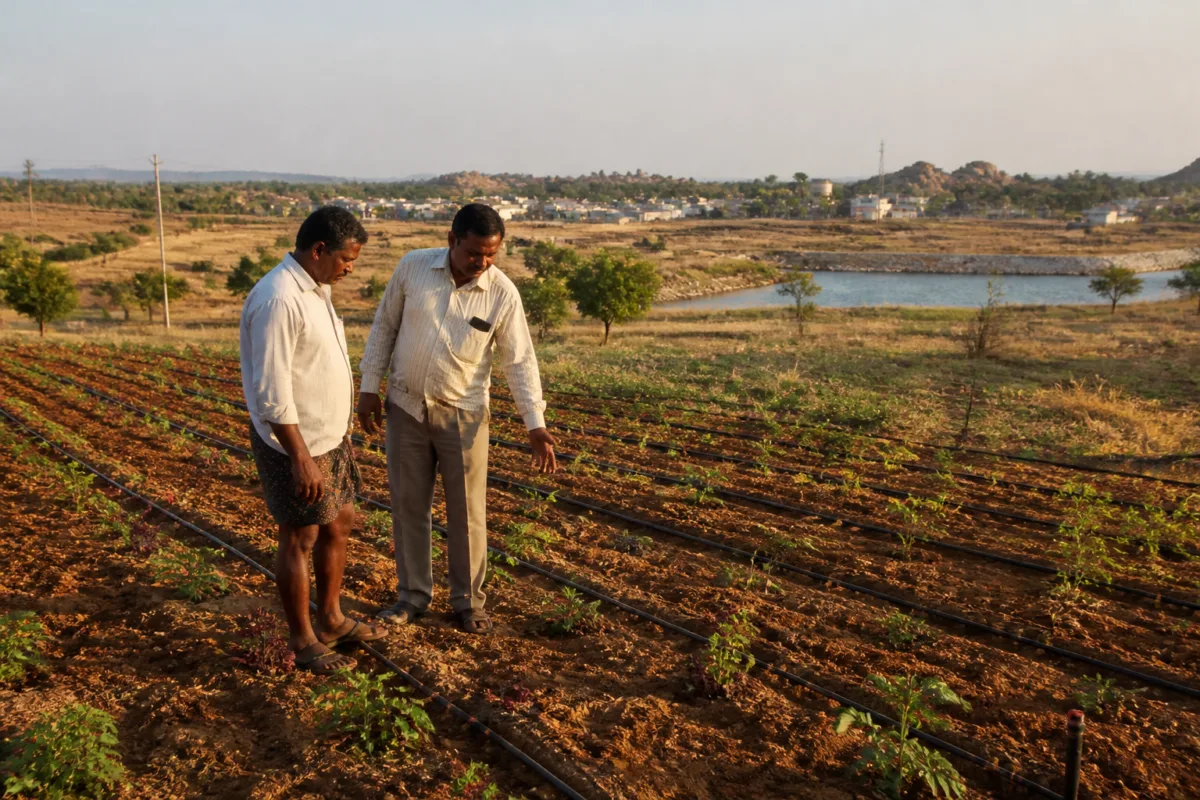
Telangana’s crop diversification debate is often presented as a choice farmers can make after receiving better advice. The argument examined here is more demanding: farmers will not reliably move away from water-intensive paddy unless the state also absorbs the financial, procurement, irrigation and market risks attached to that transition. That makes crop diversification not merely an agricultural question, but a test of how Telangana manages water, public spending, rural livelihoods and food supplies for its cities.
A recent article by former legislator and former agriculture adviser Dr Ramesh Chennamaneni links the state’s drought vulnerability to a combination of climate risk, reservoir dependence and institutional gaps. It refers to warnings in June 2026 from climate models and meteorological alerts, including those associated with the Indo-German Project Group, about a developing El Niño, weak monsoon conditions, intense downpours and prolonged heatwaves. The article also points to reduced inflows from drought-affected upstream catchments in Karnataka and Maharashtra into reservoirs such as Srisailam and Nagarjunasagar.
These claims are presented in the source as the basis for an argument about preparedness. The wider issue is that Telangana’s water system serves several competing needs at once: irrigation, drinking water, groundwater recharge and the operation of a large agricultural economy. When reservoir inflows weaken, the consequences do not stop at the farm boundary. Rural incomes are exposed, food supply chains become vulnerable and urban consumers can face higher prices when supplies of rice, vegetables or other crops are disrupted.
The article argues that infrastructure alone cannot resolve this problem. The Kaleshwaram Lift Irrigation Project was designed to move Godavari floodwaters into interconnected reservoirs, including Mallanna Sagar, but the source says delays in essential repairs have reduced its ability to respond to dry conditions. Whether or not this infrastructure can provide the intended protection in a particular season, the institutional question remains important: drought resilience depends on the reliability of both physical networks and the administrative systems that maintain, operate and coordinate them.
The limits of persuasion
The central criticism in the article is directed at a policy model based mainly on advisories, awareness programmes and voluntary crop switching. Paddy remains attractive to farmers because it is supported by a familiar ecosystem of minimum support prices and state procurement. By contrast, pulses, oilseeds and millets can expose cultivators to uncertain prices, unfamiliar input markets and weaker buying arrangements.
This is a classic policy asymmetry. The state may gain from lower water demand, while an individual farmer bears the immediate cost of changing crops. Alternative crops can require different seeds, cultivation practices, irrigation arrangements and marketing channels. If the harvest then enters a volatile open market, the farmer has little reason to accept the transition simply because it serves a broader water-management objective.
The proposed solution is a Mandal-Wise Decentralised Alternative Production Package, or MDAPP. In the article, this is not presented as an existing government programme but as a framework that the state should adopt. Its purpose would be to replace broad, state-wide crop advisories with production plans based on local soil conditions, groundwater availability and the specific water stress affecting each mandal.
The proposed mapping would classify all 621 mandals, with priority given to 365 areas identified in the article as drought-hit. It describes three broad production zones. Deep black cotton soils with over-exploited groundwater would shift away from Yasangi paddy towards long-staple cotton intercropped with pigeon pea or Bengal gram. Red sandy loams with low water tables would be directed towards groundnut, castor, pearl millet and finger millet. Alluvial and medium loamy soils connected to canal systems facing water shortages would move towards crops such as safflower, mustard and green gram, alongside a reduction in flood irrigation.
This approach is significant because it treats crop planning as a spatial governance task. It places the Agriculture Department, soil-survey institutions and the Ground Water Department in a shared decision-making structure. It also raises an implementation challenge: a crop code assigned to a landholding can only work if the underlying soil, aquifer and water-use data are accurate, current and accessible to local officials and farmers.
Paying for the transition
The article’s proposed financial model recognises that a crop switch creates a liquidity problem before it creates any environmental benefit. It suggests combining existing Rythu Bharosa support with a Green Transition Bonus of Rs 3,000 per acre per season for farmers who move from paddy to an assigned alternative crop. Sixty per cent of the combined support would be released 15 days before sowing, including Rs 1,800 per acre from the proposed bonus. The remaining 40 per cent would follow crop verification 30 days after sowing.
The design is intended to address the timing of farm expenses. A reimbursement received after cultivation begins cannot solve the immediate need to buy seed, prepare land or install irrigation. The article therefore proposes a front-loaded payment, with later verification through remote sensing or physical inspection by an Agriculture Extension Officer.
However, a payment system of this kind would require clear eligibility rules, reliable land and crop records, and a mechanism for resolving disputes when a crop is damaged by weather or fails despite compliance. The source does not provide a government order establishing MDAPP or the proposed bonus. Its contribution is to identify the administrative architecture that would be needed if Telangana chose to make crop diversification a binding public programme rather than a voluntary appeal.
The proposed transformation of more than 2,600 Rythu Vedikas follows the same logic. Instead of functioning primarily as meeting spaces, they would become local material and logistics hubs. The article proposes digital seed vouchers, fully subsidised drought-resistant seed varieties, and a 90 per cent subsidy for drip or sprinkler systems. It also suggests that installation teams should deliver and commission irrigation systems within seven days of seed distribution.
Such a model would bring the state’s support system closer to the farm. It would also make Rythu Vedikas responsible for more than communication. They would become points where farmers register crops, receive inputs, access irrigation technology and potentially sell produce. That concentration of functions could improve coordination, but it would also increase the need for staffing, procurement controls, digital access and transparent monitoring.
The procurement problem
No crop-diversification strategy can be durable if farmers are encouraged to produce crops that the market does not reliably buy. The article therefore proposes a Telangana Alternative Crop Procurement Board, working with MARKFED and HACA, to purchase all marketable quantities of alternative crops that meet Fair Average Quality standards. It suggests a procurement price equal to 120 per cent of the central minimum support price, with the additional 20 per cent funded by the state.
The proposed mechanism would use decentralised weighbridges and convert spaces around Rythu Vedikas into procurement centres. Payments would be transferred directly to farmers within 72 hours. These details address several points where farmers can lose value: transport costs, dependence on commission agents, delayed payments and uncertainty about whether produce will be accepted.
But the proposal also makes the fiscal burden visible. A full procurement guarantee is not simply a price announcement. It requires storage, quality testing, transport, working capital, budgetary provision and a buyer or distribution channel for the acquired crop. Without these supporting systems, a higher announced price may not translate into a dependable market in practice.
Rural production and urban food security
The article extends the crop-diversification argument into urban food markets. It proposes that Farmer Producer Organisations and Primary Agricultural Credit Societies create clusters for short-duration vegetables such as cluster beans, green chillies, okra and leafy greens. These groups would use shared drip systems, transport produce collectively and receive dedicated stalls and loading bays at urban Rythu Bazars.
This is where agricultural policy becomes directly connected to the built environment. Cities depend on logistics networks that move food from dispersed farms to concentrated consumer markets. When rural producers lack aggregation, storage, transport or direct selling space, urban buyers can pay more while farmers receive less. The proposed vegetable corridors are intended to shorten that chain and allow rural organisations to access urban demand more directly.
The article also refers to watershed work in villages including Kothapally, Gottigarpalli, Bendalapadu, Ramachandrapuram, Gambhiraopet and Thimmapur. It identifies check dams, contour trenches, conservation of traditional water bodies and the ‘Four Waters Concept’—rainwater, soil moisture, groundwater and traditional water resources—as elements of a community-led model. It further cites the Indo-German Accelerating Climate-Resilient Agriculture in Telangana project in parts of Rajanna Sircilla district, where tools such as Weather X and Trap Snap were used through farmer organisations.
These examples are presented by the author as models that Telangana could scale. The source does not establish that they can be replicated across every district or soil type. Their relevance lies in showing that drought resilience is being framed as a combination of watershed management, crop choice, digital information, producer organisation and market access rather than as a single irrigation project.
The larger urban question is whether Telangana can manage agricultural transition as a public system. Advisories may identify the right crop, but they do not guarantee income. Irrigation infrastructure may expand supply, but it does not remove climate variability. Procurement may protect farmers, but it requires sustained public capacity. And urban food security depends on the links between all these systems.
The evidence supplied here confirms that crop diversification is being argued as an institutional and financial reform, not simply a change in farmer behaviour. The proposed MDAPP, Green Transition Bonus, upgraded Rythu Vedikas and alternative-crop procurement board remain proposals in the source. Their progress would depend on formal government orders, budget commitments, reliable local data, functioning repairs to water infrastructure and credible implementation at mandal level. Those are the milestones that will determine whether Telangana’s drought response moves from seasonal advice to a durable climate-resilience framework.

